⚛️Ars Technica•Freshcollected in 60m
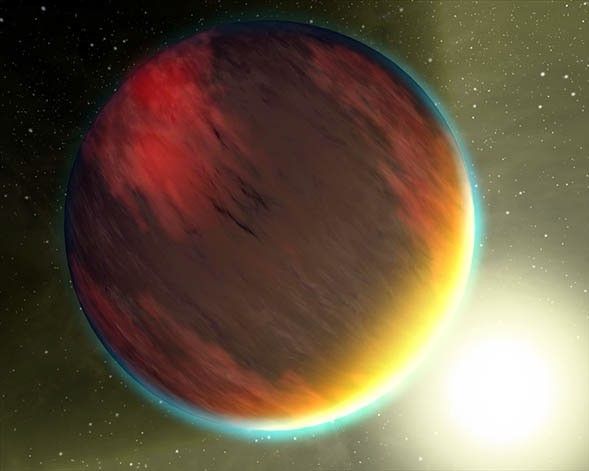
Helium loss observed on rocky exoplanet atmosphere
💡Learn how advanced spectral analysis techniques are being applied to model complex planetary atmospheric data.
⚡ 30-Second TL;DR
What Changed
Detected helium 'baking off' from a rocky exoplanet's atmosphere
Why It Matters
This research improves our ability to model planetary atmospheres, which is relevant for training AI models on complex physical simulations and spectral data analysis.
What To Do Next
Explore the use of spectral data processing libraries like 'astropy' to refine your signal-to-noise ratio algorithms for noisy time-series data.
Who should care:Researchers & Academics
Key Points
- •Detected helium 'baking off' from a rocky exoplanet's atmosphere
- •Provides a method to infer the composition of the remaining planetary core
- •Advances techniques in remote atmospheric spectroscopy
🧠 Deep Insight
AI-generated analysis for this event.
🔑 Enhanced Key Takeaways
- •The detection was achieved using high-resolution transit spectroscopy, specifically targeting the 10830 Angstrom helium triplet line.
- •This phenomenon is primarily driven by extreme X-ray and extreme ultraviolet (XUV) radiation from the host star, which strips the upper atmosphere.
- •The target planet is likely a 'super-Earth' or 'sub-Neptune' transitioning into a bare rocky core, often referred to as the 'photoevaporation desert' population.
- •Observations indicate that the helium outflow creates a comet-like tail, providing a unique geometry for measuring mass-loss rates.
- •This discovery helps constrain the 'radius valley' theory, which explains the observed bimodal distribution of exoplanet sizes.
🛠️ Technical Deep Dive
- Instrument: High-resolution spectrographs such as CARMENES, ESPRESSO, or NIRSPEC were utilized to resolve the helium absorption line profile.
- Methodology: Transit spectroscopy measures the dip in stellar flux as the planet passes in front of the star, with the helium line showing a deeper transit depth than the optical continuum.
- Modeling: Hydrodynamic escape models (e.g., the energy-limited escape approximation) are used to calculate the mass-loss rate based on the observed helium column density.
- Data Processing: Doppler-shifting corrections are applied to the spectra to account for the planet's orbital velocity and the star's rotation, isolating the planetary signal from stellar activity.
🔮 Future ImplicationsAI analysis grounded in cited sources
Atmospheric characterization will shift toward identifying secondary atmospheres on rocky worlds.
Confirming the loss of primordial helium allows researchers to distinguish between remnant gas envelopes and atmospheres outgassed from the planetary interior.
JWST and ELT observations will confirm the presence of heavier elements in the outflow.
Detecting helium serves as a tracer for the escape of heavier, more difficult-to-detect species like oxygen or carbon, which are expected to be dragged along in the hydrodynamic flow.
⏳ Timeline
2018-05
First detection of helium in an exoplanet atmosphere (WASP-107b) using Hubble.
2020-01
Refinement of photoevaporation models to explain the radius valley in exoplanet populations.
2022-07
JWST begins high-precision atmospheric characterization of rocky exoplanet candidates.
2025-03
Development of advanced cross-correlation techniques for ground-based detection of helium in smaller, rocky planets.
📰
Weekly AI Recap
Read this week's curated digest of top AI events →
👉Related Updates

AI-curated news aggregator. All content rights belong to original publishers.
Original source: Ars Technica ↗