Health App Sells 150k User Stool Photos for AI Training
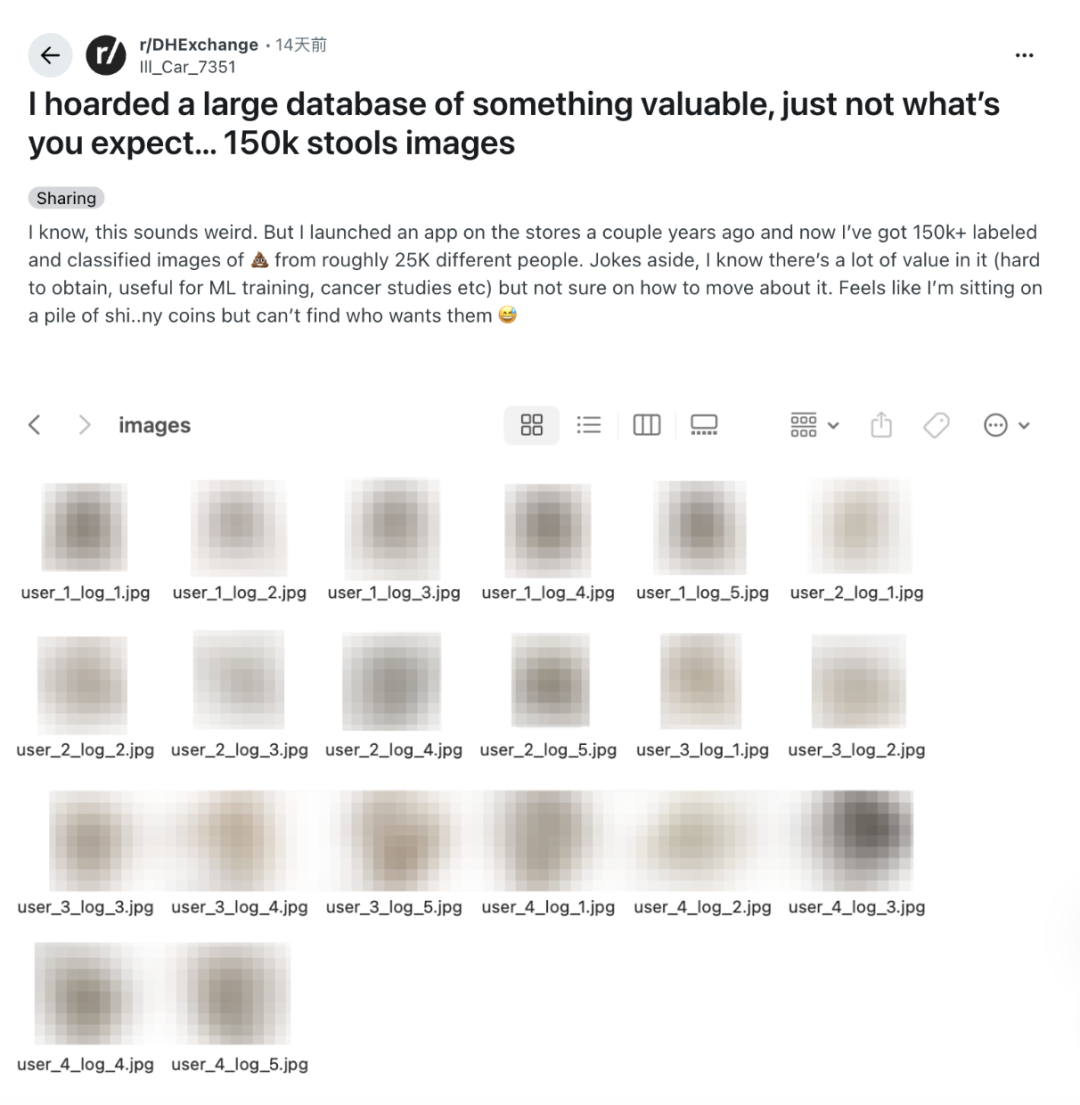
💡A cautionary tale on data privacy: how consumer health apps are monetizing sensitive user data for AI training.
⚡ 30-Second TL;DR
What Changed
PoopCheck app collected 150,000 stool images from 25,000 users under the guise of health tracking.
Why It Matters
This case underscores the growing demand for niche, high-quality human physiological data for AI, while exposing the fragility of user privacy in the absence of comprehensive data protection laws.
What To Do Next
Audit your data pipeline to ensure that any user-provided health or sensitive data is strictly anonymized and that your terms of service explicitly prohibit the sale of training data.
Key Points
- •PoopCheck app collected 150,000 stool images from 25,000 users under the guise of health tracking.
- •The developer is selling access to this sensitive dataset, including demographic and health condition data, for AI model training.
- •The data lacks proper anonymization and informed consent, posing significant re-identification risks.
- •Consumer health apps often operate in a regulatory gray area, lacking the strict protections of HIPAA.
🧠 Deep Insight
Web-grounded analysis with 21 cited sources.
🔑 Enhanced Key Takeaways
- •The developer, Soft All Things LLC, actively advertised the "Annotated Dataset" of over 140,000 images for AI model training on its "For Business" website page and through a Reddit post, marketing it as the "largest consumer stool image dataset" known.
- •The PoopCheck app's privacy policy on the App Store misleadingly stated, "The developer does not collect any data from this app," directly contradicting the extensive data usage and sale license granted to Soft All Things LLC within the app's "Service Agreement" and "Terms and Conditions" that users agreed to upon account creation.
- •Approximately 5,000 of the 150,000 collected stool images were manually reviewed and annotated by a team member, significantly enhancing their value and classification for machine learning training purposes.
- •The PoopCheck app utilizes AI to analyze stool images based on the Bristol Stool Scale and advanced pattern recognition, providing users with a "daily gut health score" and insights into consistency, color, and shape, and also includes an AI chat assistant named "SOFTie."
- •This incident underscores a broader industry trend where venture capital funding structures often incentivize aggressive data monetization strategies in health app startups, potentially leading to business models that prioritize data extraction over user privacy and wellness.
🛠️ Technical Deep Dive
- The PoopCheck app employs AI for analyzing stool images, specifically using the Bristol Stool Scale and advanced pattern recognition to assess consistency, color, and shape.
- The AI system provides users with a "daily gut health score" and personalized digestive health reports.
- An AI chat assistant, named "SOFTie," is integrated into the app to help users understand their results and answer gut health questions.
- The collected dataset, comprising over 150,000 images, is described as "labeled and classified," with approximately 5,000 images having undergone manual review for annotation.
- User data, including images, is linked to individuals through an "externalIndividualID."
- While the App Store privacy policy claimed data encryption "in transit and at rest" and secure photo processing, this was contradicted by the app's terms of service regarding data monetization.
- Broader research in stool image analysis for AI has successfully utilized Deep Learning models, such as Vision Transformer (ViT), for high-accuracy classification of stool forms and detection of blood, with some studies training AI on 30,000 annotated images to characterize bowel movements using multiple parameters like BSS, consistency, edge fuzziness, fragmentation, and volume.
🔮 Future ImplicationsAI analysis grounded in cited sources
⏳ Timeline
📎 Sources (21)
Factual claims are grounded in the sources below. Forward-looking analysis is AI-generated interpretation.
- Google Search Source
- Google Search Source
- Google Search Source
- Google Search Source
- Google Search Source
- Google Search Source
- Google Search Source
- Google Search Source
- Google Search Source
- Google Search Source
- Google Search Source
- Google Search Source
- Google Search Source
- Google Search Source
- Google Search Source
- Google Search Source
- Google Search Source
- Google Search Source
- Google Search Source
- Google Search Source
- Google Search Source
Weekly AI Recap
Read this week's curated digest of top AI events →
👉Related Updates


AI-curated news aggregator. All content rights belong to original publishers.
Original source: 虎嗅 ↗