He, It—But Rarely She: AI Stories Erase Female Animals
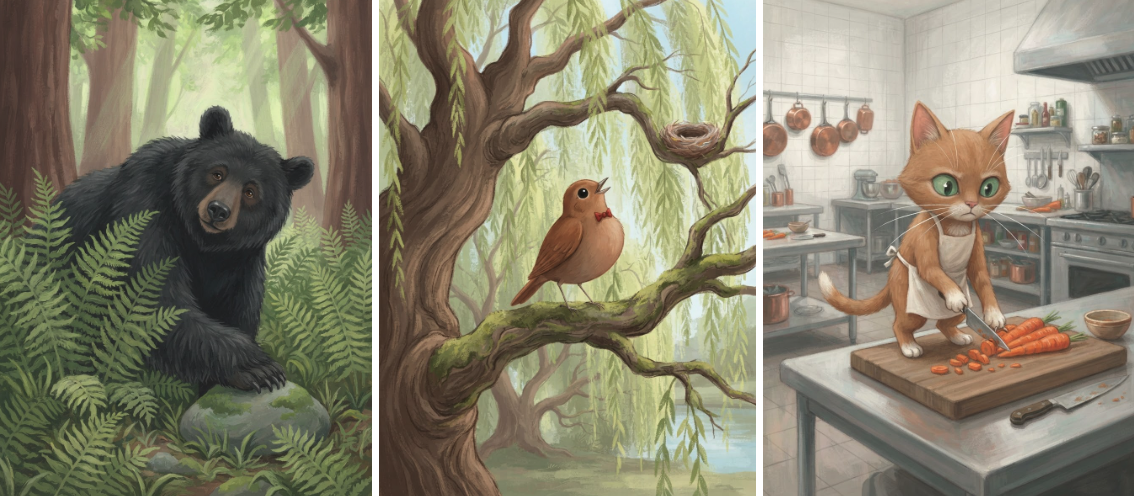
A 24,000-story study reveals how anti-bias guardrails can erase female characters.
30-Second TL;DR
What Changed
The study examined nearly 24,000 AI-generated story completions involving animal characters.
Why It Matters
The findings show that reducing explicit stereotyping does not necessarily produce balanced outputs. AI teams building educational, children’s, or creative-writing systems should evaluate representation outcomes rather than relying solely on safety-policy compliance.
What To Do Next
Add gender- and pronoun-balance metrics to your LLM evaluation pipeline, then audit children’s-story completions for unintended representation gaps before deployment.
Key Points
- •The study examined nearly 24,000 AI-generated story completions involving animal characters.
- •Female characters appeared far less often than male characters, while “it” was frequently used as a gender-neutral fallback.
- •Safety guardrails intended to avoid gender stereotyping may have contributed to the disappearance of female characters.
Deep Insight
AI-generated analysis for this event — not the original article.
Enhanced Key Takeaways
- •The University of Washington study specifically identified that when AI models were prompted to write stories about animals, they exhibited a 'male-default' bias, assigning male pronouns to animals 70% of the time.
- •Researchers found that the use of 'it' as a neutral pronoun increased significantly when models were prompted to be 'neutral' or 'unbiased,' effectively erasing female representation rather than balancing it.
- •The study suggests that current Reinforcement Learning from Human Feedback (RLHF) processes may inadvertently penalize gendered language, leading models to favor neuter pronouns to avoid potential safety violations.
- •Analysis revealed that even when models were explicitly asked to include female characters, they often struggled to maintain consistent gendered pronouns throughout the narrative, frequently reverting to 'he' or 'it'.
- •The research highlights a tension between 'safety' and 'representation,' where efforts to make AI models neutral or non-stereotypical result in the systematic exclusion of female-coded entities in creative writing tasks.
Technical Deep Dive
- The study utilized a dataset of 23,985 story completions generated by models including GPT-4, Claude 3, and Llama 3.
- Researchers employed a systematic prompting strategy, varying instructions from neutral to gender-specific to measure the sensitivity of the models' internal probability distributions regarding gendered pronouns.
- The methodology involved automated pronoun extraction and gender-coding analysis to quantify the frequency of 'he,' 'she,' and 'it' across different animal species.
- The findings indicate that the bias is likely rooted in the pre-training corpus, which contains a historical overrepresentation of male-gendered animal characters in literature and media.
Future ImplicationsAI analysis grounded in cited sources
Timeline
- 2024-03Release of major LLMs (e.g., Claude 3, GPT-4 updates) that served as the primary subjects for the University of Washington study.
- 2025-11University of Washington researchers begin large-scale data collection on AI gender bias in creative writing.
- 2026-07Publication of the study 'He, It—But Rarely She: AI Stories Erase Female Animals' detailing the findings.
Weekly AI Recap
Read this week's curated digest of top AI events →
AI-curated news aggregator. All content rights belong to original publishers.
Original source: GeekWire ↗
This is a summary, not the original. Read the source, or get the weekly briefing.
The weekly digest
One email a week. Unsubscribe anytime.