HarmonyOS Shifts to Agent-First Operating System Architecture
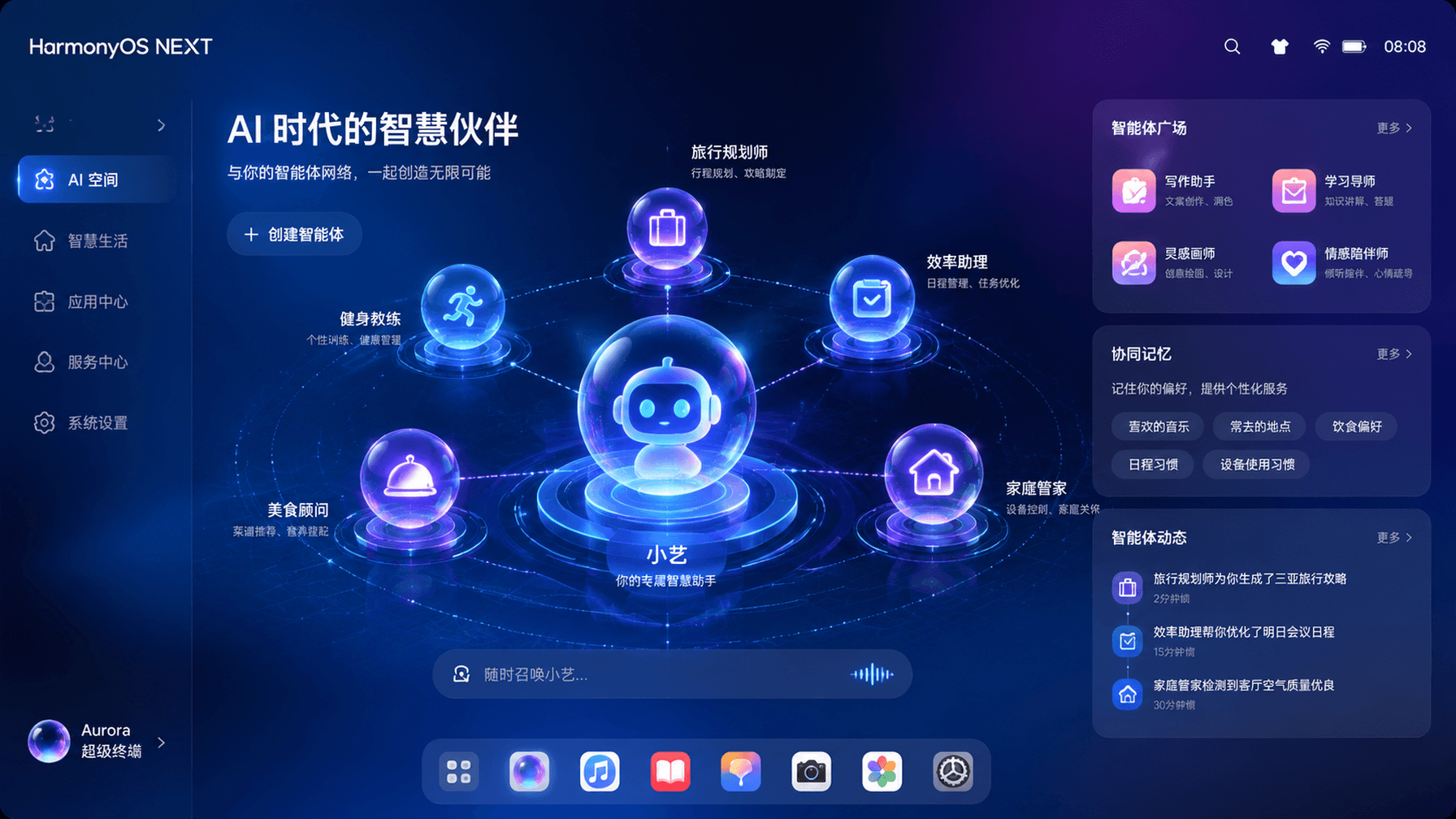
💡Huawei is redefining mobile OS architecture by making AI agents the primary interface. Essential for mobile developers.
⚡ 30-Second TL;DR
What Changed
Complete architectural shift to an agent-native OS design
Why It Matters
This move signals a shift in mobile OS development where AI agents become the primary interface rather than apps. It forces developers to rethink app design to support agentic workflows.
What To Do Next
Review the new HarmonyOS SDK documentation to understand how to expose your app's functions as callable tools for the system's AI agent.
Key Points
- •Complete architectural shift to an agent-native OS design
- •Deep integration of autonomous agents at the system level
- •Enhanced cross-device automation capabilities for users
🧠 Deep Insight
Background and context from public sources — not the original article. 15 sources cited.
🔑 Enhanced Key Takeaways
- •HarmonyOS 7 Developer Beta, unveiled at HDC 2026, marks a strategic evolution of the operating system from an app platform to an intelligent task platform, utilizing the HarmonyOS Agent Framework 2.0 for advanced task decomposition, tool calling, and autonomous execution.
- •Huawei's integrated AI assistant, Xiaoyi, has been transformed into a system-level intelligence agent, deeply embedded within the OS kernel, capable of managing over 2,100 system-level capabilities (Skills) and orchestrating more than 2,000 third-party AI agents.
- •A significant innovation in Agent Framework 2.0 is the introduction of GUI control capabilities, allowing system-level AI to interpret on-screen information and simulate user interactions, thereby enabling agent control over applications even without explicit APIs, under a new 'Intention as Service' paradigm.
- •HarmonyOS 7 features an 'Agentic Self-Evolving Architecture' for Xiaoyi, endowing it with long-term memory, autonomous learning, and reflection capabilities to continuously adapt to user habits and leverage accumulated knowledge for future tasks.
- •The operating system integrates Huawei's openPangu 2.0 foundational model, which includes a Pro version with 505 billion parameters and a Flash variant with 92 billion parameters, both supporting 512K context windows, with plans for on-device 30-billion-parameter models on Kirin chips by autumn 2026.
🛠️ Technical Deep Dive
- The HarmonyOS Agent Framework 2.0 extends AI capabilities beyond traditional Q&A to include task decomposition, tool calling, and autonomous task execution.
- The architecture functions as an "intelligence hub" at the system level, designed to ensure stable operation of both on-device and cloud-side large models.
- System capabilities are "Skill-ified," serving as standardized modules that the AI assistant, Xiaoyi, can invoke.
- Agent Framework 2.0 includes GUI (Graphical User Interface) control capabilities, allowing system-level AI to read on-screen information and simulate clicks or invoke accessibility service interfaces to control applications that lack explicit APIs.
- The "Intention as Service" paradigm aims to compress multi-step operations into a single natural language conversation.
- HarmonyOS 7 introduces an "Agentic Self-Evolving Architecture" for Xiaoyi, providing long-term memory, autonomous learning, and reflection capabilities.
- The core Ark engine in HarmonyOS 7 incorporates a large performance model optimized for system scheduling, contributing to a 15% performance upgrade over HarmonyOS 6 and a 50% boost in inference speed.
- Huawei's foundational model, openPangu 2.0, is integrated, featuring a Pro version with 505 billion parameters and a Flash variant with 92 billion parameters, both supporting 512K context windows.
- On-device 30-billion-parameter models are planned to be supported on Kirin chips by autumn 2026.
- Security features include the HarmonyOS Personal Intelligent Computing (HPIC) white paper, advocating a "local-first, data-minimization, user-controllable" approach, and a "Star Shield anti-fraud" system utilizing AI to detect deepfake calls, AI voice cloning, and face-swapping scams.
- HarmonyOS NEXT (version 5.0), released in October 2024, transitioned away from the Android Open Source Project (AOSP) by adopting Huawei's proprietary Hongmeng kernel.
- The OS employs a microkernel design with a Kernel Abstraction Layer to support various kernels.
- Distributed capabilities are a core design principle, leveraging technologies such as distributed soft bus, distributed device virtualization, distributed data management, and distributed task scheduling.
- The system uses "atomic services" as basic units, deconstructing traditional applications into independently runnable functional modules that can be combined based on scenario needs.
- HarmonyOS 6 introduced an AI agent compatible with OpenClaw, an open-source autonomous AI agent.
🔮 Future ImplicationsAI analysis grounded in cited sources
⏳ Timeline
📎 Sources (15)
Factual claims are grounded in the sources below. Forward-looking analysis is AI-generated interpretation.
Weekly AI Recap
Read this week's curated digest of top AI events →
👉Related Updates


AI-curated news aggregator. All content rights belong to original publishers.
Original source: Pandaily ↗
This is a summary, not the original. Read the source, or get the weekly briefing.
The weekly digest
One email a week. Unsubscribe anytime.