Hardened Images: Reducing CVEs and Attack Surfaces
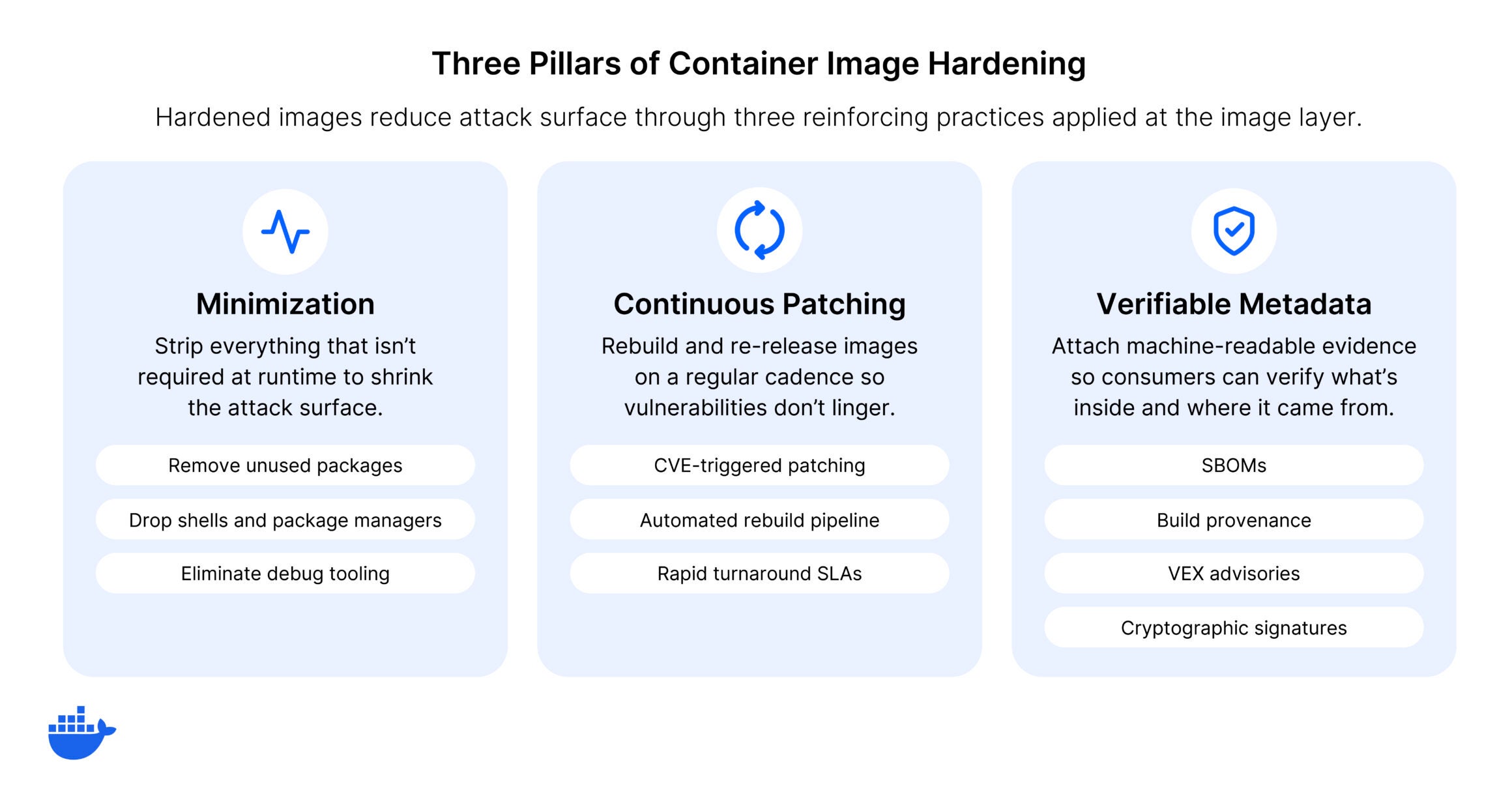
💡Learn how to shrink your container attack surface and eliminate unnecessary vulnerabilities in your AI deployment stack.
⚡ 30-Second TL;DR
What Changed
Most vulnerabilities originate from unused packages in base images rather than application code.
Why It Matters
Adopting hardened images is critical for AI practitioners deploying models in production, as it mitigates risks associated with supply chain attacks and reduces the maintenance burden of patching unused dependencies.
What To Do Next
Audit your current Dockerfiles and switch to minimal base images like 'distroless' or 'alpine' to reduce your container's attack surface.
Key Points
- •Most vulnerabilities originate from unused packages in base images rather than application code.
- •Hardened images remove shells, compilers, and debug utilities to minimize potential entry points.
- •Reducing the image footprint improves both security posture and supply chain integrity.
🧠 Deep Insight
Background and context from public sources — not the original article. 40 sources cited.
🔑 Enhanced Key Takeaways
- •Hardened images often leverage 'distroless' or 'scratch' base images, which are even more minimal than Alpine Linux, completely omitting shells, package managers, and other utilities to drastically reduce the attack surface.
- •The use of Software Bill of Materials (SBOMs) and Vulnerability Exploitability eXchange (VEX) statements is crucial for hardened images, providing transparency into image components and their known vulnerabilities, which aids in compliance and proactive risk management.
- •Hardening practices extend beyond just removing components; they also involve enforcing secure defaults like running containers as non-root users and ensuring runtime immutability to prevent unauthorized modifications post-deployment.
- •Commercial hardened image offerings, such as Docker Hardened Images (DHI), provide continuous security maintenance, including regular updates, vulnerability scanning, and Service Level Agreement (SLA)-backed remediation for critical CVEs, moving beyond one-time hardening efforts.
📊 Competitor Analysis▸ Show
| Feature / Product | Docker Hardened Images (DHI) / Docker Scout | Snyk Container | Trivy (Aqua Security) | Aqua Security Platform | Microsoft Defender for Containers |
|---|---|---|---|---|---|
| Primary Focus | Minimal, secure, production-ready images; supply chain security analysis. | Developer-first container security, vulnerability finding/fixing in CI/CD. | Open-source, all-in-one vulnerability scanner (images, filesystems, IaC, secrets). | Full lifecycle container security (scanning, runtime protection, compliance). | Comprehensive security for container software supply chain, vulnerability scanning, policy enforcement. |
| SBOM Generation | Yes, generates SBOMs with SLSA Build L3 provenance. | Yes, for open-source dependencies. | Yes, generates SBOMs. | Yes, generates SBOMs. | Yes, compiles an inventory of components. |
| Vulnerability Scanning | Yes, continuous CVE scanning, NVD and other sources. | Yes, detects application and container vulnerabilities, prioritizes fixes. | Yes, comprehensive scans for OS packages, application dependencies, unpacked binaries. | Yes, scans for malware, vulnerabilities, embedded secrets, config issues. | Yes, scans container images for vulnerabilities and threats. |
| Runtime Protection | Focus on hardened images; Docker Debug for troubleshooting. | Monitors for vulnerabilities, but primary focus is shift-left. | Primarily a scanner, not runtime protection. | Yes, drift prevention, detects anomalous behavior, virtual patching (vShield). | Helps identify and mitigate risks in runtime environments. |
| CI/CD Integration | Yes, designed for drop-in adoption and integration with existing Docker workflows. | Yes, deep CI/CD integrations, provides feedback in IDE, pull requests, pipelines. | Yes, integrates into CI/CD pipelines for continuous scanning. | Yes, CI/CD policy enforcement. | Yes, integrates into DevOps processes. |
| Remediation Guidance | Yes, provides actionable guidance. | Yes, one-click upgrades, base image recommendations. | Yes, detailed reports with severity prioritization. | Yes, risk remediation capabilities. | Yes, helps identify and mitigate risks. |
| Open Source Availability | DHI Community is free and open under Apache 2.0. | Snyk Open Source for dependencies. Snyk Container is commercial. | Yes, Trivy is open-source. | Aqua offers Trivy (open-source), but the platform is enterprise. | Part of Azure, not open-source. |
| Pricing | Null | Null | Free (open-source) | Null | Null |
| Benchmarks | Null | Null | Null | Null | Null |
🛠️ Technical Deep Dive
- Minimal Base Images: Hardened images are built upon extremely minimal base images like
scratchordistroless.scratchis an empty filesystem, best suited for statically compiled binaries (e.g., Go, Rust), requiring manual management of certificates and debugging tools.Distrolessimages, popularized by Google, include only the application binary, its runtime dependencies (e.g., libc, Java, Python), and essential configuration, deliberately omitting shells, package managers, and debugging utilities, while often including necessary components like CA certificates. - Multi-Stage Builds: A common technique to create hardened images involves multi-stage Dockerfiles. This separates the build environment (which may contain compilers and development tools) from the final runtime environment, ensuring only the necessary application artifacts and their minimal dependencies are included in the production image.
- Non-Root Execution: Hardened images are configured to run containers as non-root users by default, adhering to the principle of least privilege and significantly reducing the potential impact of a container compromise.
- Immutability: The design principle of hardened images emphasizes immutability, meaning images are fixed at build time and runtime modifications are prevented, which enhances consistency and security by eliminating configuration drift.
- Software Bill of Materials (SBOM) & Provenance: Docker Hardened Images include signed SBOMs and adhere to SLSA (Supply-chain Levels for Software Artifacts) Build Level 3 provenance, providing cryptographic verification of the image's components and its build process to ensure authenticity and integrity.
- Debugging Capabilities: Since hardened images intentionally lack shells and debugging utilities, Docker provides mechanisms like
Docker Debugto temporarily attach a debug sidecar container for troubleshooting without altering the original hardened image.
🔮 Future ImplicationsAI analysis grounded in cited sources
⏳ Timeline
📎 Sources (40)
Factual claims are grounded in the sources below. Forward-looking analysis is AI-generated interpretation.
- oneuptime.com
- medium.com
- docker.com
- aws.com
- wordpress.com
- docker.com
- docker.com
- dockerhol.com
- docker.com
- rapidfort.com
- docker.com
- ibm.com
- bell-sw.com
- snyk.io
- medium.com
- echo.ai
- docker.com
- docker.com
- snyk.io
- snyk.io
- gartner.com
- snyk.io
- devopstraininginstitute.com
- jit.io
- kubeops.net
- betterstack.com
- wazuh.com
- chainguard.dev
- aquasec.com
- medium.com
- aquasec.com
- microsoft.com
- aquasec.com
- flaviusdinu.com
- snyk.io
- reddit.com
- cmu.edu
- cyberark.com
- redhat.com
- ox.security
Weekly AI Recap
Read this week's curated digest of top AI events →
👉Related Updates
AI-curated news aggregator. All content rights belong to original publishers.
Original source: Docker Blog ↗
This is a summary, not the original. Read the source, or get the weekly briefing.
The weekly digest
One email a week. Unsubscribe anytime.