Hangzhou competition shifts focus to practical robotics application
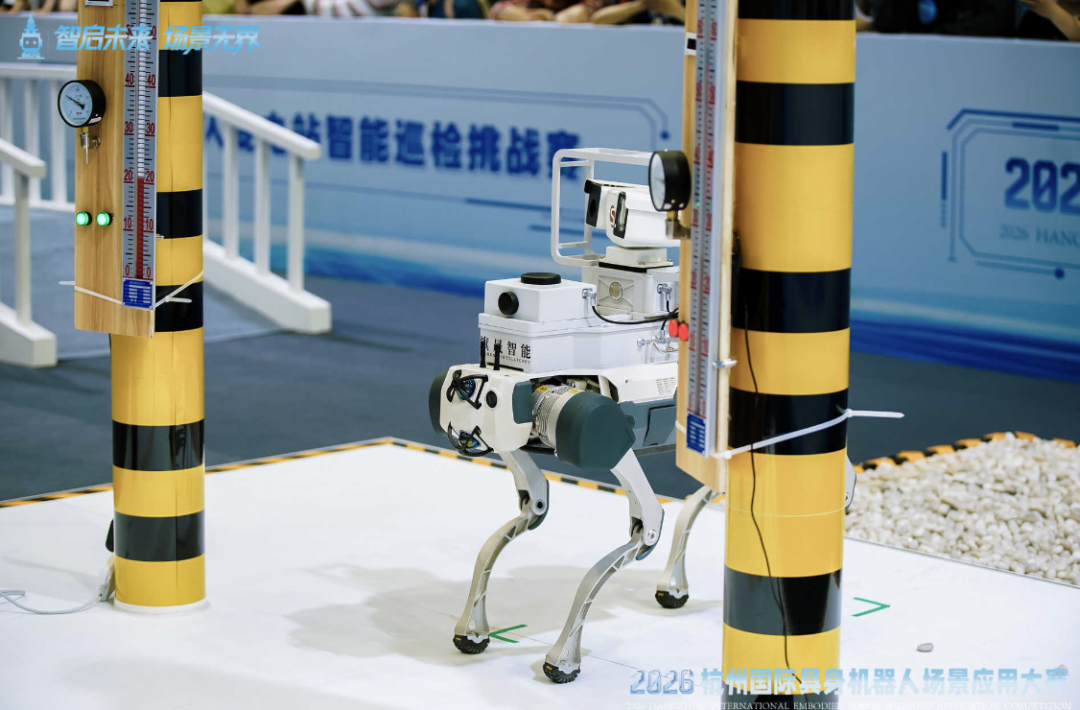
💡Learn how the robotics industry is shifting from hype to real-world deployment standards.
⚡ 30-Second TL;DR
What Changed
The competition focuses on 'getting work done' rather than just technical demos like backflips.
Why It Matters
Moving from lab demos to real-world application is the critical 'climbing phase' for the embodied AI industry.
What To Do Next
Review the competition's standardized testing criteria to benchmark your own robot's navigation and manipulation capabilities.
Key Points
- •The competition focuses on 'getting work done' rather than just technical demos like backflips.
- •Standardized testing covers navigation, voice interaction, and manipulation in complex environments.
- •Real-world scenarios include fire rescue, data center maintenance, and power grid inspection.
- •The event highlights the need for unified industry standards for humanoid and autonomous robots.
🧠 Deep Insight
Web-grounded analysis with 23 cited sources.
🔑 Enhanced Key Takeaways
- •The 2026 Hangzhou International Embodied Robot Scenario Application Competition is the largest of its kind in China to date, attracting over 200 teams from both domestic and international participants, including Switzerland, Russia, and India.
- •Competition tasks are directly sourced from 'practical pain points' identified by prominent companies such as Ant Group, Greentown China, and State Grid Corporation of China, ensuring direct relevance to industrial and service needs.
- •The event is a key component of Zhejiang province's strategic initiative to advance embodied intelligence, fostering a robust local ecosystem that includes more than 20 robot system companies and over 130 core component manufacturers.
- •Certain competition categories strictly mandate autonomous operation, prohibiting remote controls and requiring robots to rely entirely on their own perception and decision-making capabilities.
- •The competition's testing categories are structured around China's CR robot certification system, evaluating critical capabilities such as voice interaction, navigation and obstacle avoidance, motion control, and upper-limb dexterity.
📊 Competitor Analysis▸ Show
| Competition Name | Primary Focus | Key Features / Scenarios | Emphasis on Standards / Commercialization |
|---|---|---|---|
| 2026 Hangzhou International Embodied Robot Scenario Application Competition | Practical application and industry standards | Simulated fire, power, data center environments; tasks from real company pain points (Ant Group, Greentown, State Grid); navigation, voice, manipulation. | High; aims to establish industry standards for deployment, based on China's CR robot certification system. |
| 2026 Beijing E-Town Humanoid Robot Half Marathon | Endurance and autonomous navigation | 21.0975-kilometer urban course with complex conditions (slopes, bends, speed bumps); motion control, autonomous navigation, endurance, heat dissipation. | High; provides a standardized task for technology improvement and accelerates application results. |
| 2025 Zhongguancun Embodied Intelligence Robot Application Competition (Beijing) | Real-world application in daily life and industries | Household tasks (folding clothes, heating meals, cleaning), commercial, industrial, and safety scenarios; autonomous and tele-operation completion. | High; aims to move robots from labs to real-world use and empower industries. |
| 2025 RAICOM Competition CAIR Engineering Challenge (Hangzhou) | Embodied intelligence and motion capture | Dexterous hand precision control, air-ground cooperative control; visual recognition, motion control, data acquisition, path planning. | High; focuses on integrating cutting-edge technologies and accelerating transition from lab to industrial applications. |
| 1st BEHAVIOR Challenge @ NeurIPS 2025 (Simulation-based) | Everyday household activities in virtual environments | 1,000 defined household tasks (cooking, cleaning, organizing) in 50 high-fidelity interactive scenes; long-horizon mobile manipulation. | Focus on bridging research to real-world human-centric applications through simulation. |
| Hangzhou Humanoid Robot Fighting Competition (May 2025) | Entertainment and combat skills | Humanoid robots demonstrating combat skills in single and group performances; operator-controlled in real-time. | Low; primarily a spectacle or demonstration of athletic performance rather than practical application. |
🛠️ Technical Deep Dive
- Embodied AI systems are designed to perceive and interpret multimodal inputs (sight, sound, touch) from the physical environment, make autonomous decisions, carry out physical actions, and learn from interactions.
- Key capabilities evaluated include robust perception, adaptive fine motor control, and continuous adaptation to external conditions.
- Robots in practical scenarios require advanced motion control, autonomous navigation, endurance, efficient heat dissipation, environmental adaptability, and system reliability.
- For data center maintenance, robots must navigate complex layouts, handle equipment sensitive to water, and manage risks associated with lithium-ion batteries, which can undergo thermal runaway.
- Firefighting robots need to access difficult-to-reach and dangerous environments, and collect real-time data to improve response times and efficiency.
- Humanoid robots are being developed to maneuver in human-designed spaces, including navigating narrow hallways, turning doorknobs, using tools, and picking items from shelving, without requiring workspace redesign.
- Advances in hardware, such as improved actuators and edge computing, are crucial for accelerating decision-making and enhancing energy efficiency in robots.
- Training for complex tasks increasingly utilizes simulated methods, which are more time-efficient than real-world data collection.
🔮 Future ImplicationsAI analysis grounded in cited sources
⏳ Timeline
📎 Sources (23)
Factual claims are grounded in the sources below. Forward-looking analysis is AI-generated interpretation.
- Google Search Source
- Google Search Source
- Google Search Source
- Google Search Source
- Google Search Source
- Google Search Source
- Google Search Source
- Google Search Source
- Google Search Source
- Google Search Source
- Google Search Source
- Google Search Source
- Google Search Source
- Google Search Source
- Google Search Source
- Google Search Source
- Google Search Source
- Google Search Source
- Google Search Source
- Google Search Source
- Google Search Source
- Google Search Source
- Google Search Source
Weekly AI Recap
Read this week's curated digest of top AI events →
👉Related Updates


AI-curated news aggregator. All content rights belong to original publishers.
Original source: 虎嗅 ↗