Halupedia: The AI-Generated Encyclopedia of Hallucinations
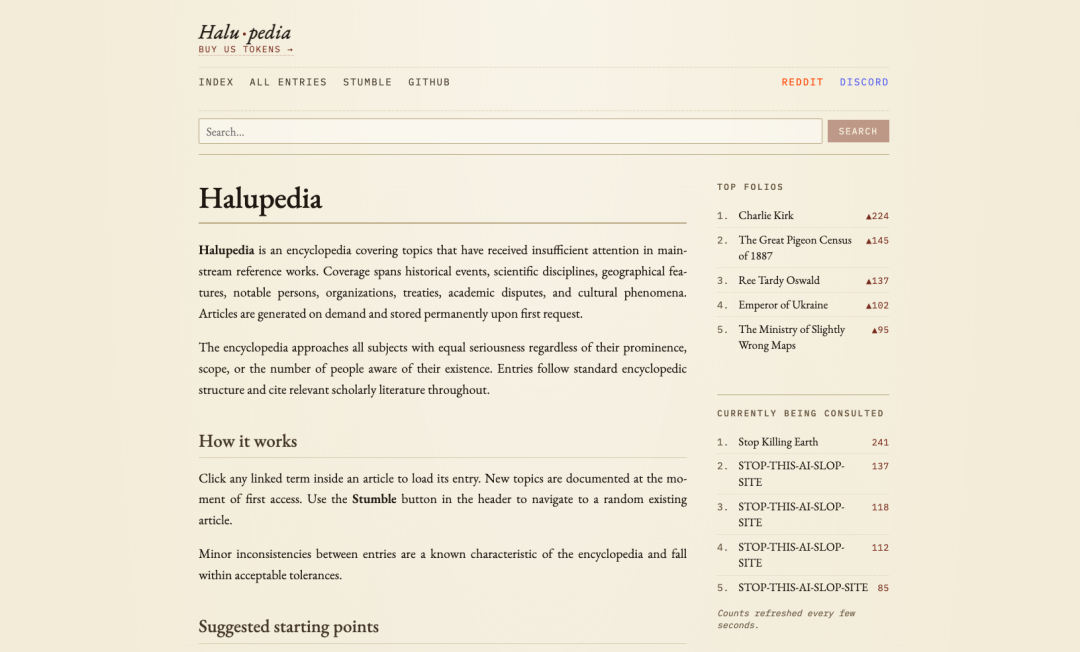
💡A fascinating look at how AI hallucinations can be structured to create consistent, yet entirely false, knowledge.
⚡ 30-Second TL;DR
What Changed
Halupedia uses 'link hints' and metadata to maintain internal consistency across hallucinated articles.
Why It Matters
This project demonstrates the fragility of knowledge verification in an era where AI can generate plausible but entirely false information at scale.
What To Do Next
Implement robust data provenance and filtering pipelines to ensure your training datasets are not contaminated by AI-generated hallucinations.
Key Points
- •Halupedia uses 'link hints' and metadata to maintain internal consistency across hallucinated articles.
- •The project highlights the risk of 'data pollution' where future models are trained on AI-generated noise.
- •It serves as a meta-commentary on the current state of the internet where AI content is increasingly indistinguishable from facts.
🧠 Deep Insight
Web-grounded analysis with 11 cited sources.
🔑 Enhanced Key Takeaways
- •Halupedia was created by software developer Bartłomiej Strama, who conceived the idea during a casual conversation with a friend.
- •The platform operates as an 'infinite' encyclopedia, generating unique, hallucinated entries on demand each time a user searches for a term or clicks a link.
- •It meticulously mimics the formal, scholarly tone of a 19th-century academic press, including fabricated citations and footnotes, to enhance its deceptive realism.
- •A core technical feature is its 'write-forward' consistency mechanism, where outbound links within generated articles embed hidden metadata, or 'link hints,' that guide the AI in maintaining internal lore consistency for future article generations.
- •Beyond being an experiment, Halupedia is explicitly designed to serve as a meta-commentary on the risks of AI hallucinations and to deliberately contribute to the 'pollution' of future Large Language Model (LLM) training data.
🛠️ Technical Deep Dive
- Halupedia is architected as a single-page application (SPA) running on a Cloudflare Worker.
- The frontend is a React SPA designed to visually resemble an antiquated print encyclopedia.
- Article generation is triggered by user requests for unknown slugs, which call an LLM (via OpenRouter) to produce HTML content in the encyclopedia's distinct voice.
- Generated articles are persistently cached in Cloudflare KV (Key-Value store) to ensure subsequent visits are served instantly and without additional LLM calls.
- The 'link hints' mechanism involves the LLM embedding a
context="..."attribute within<a>tags, summarizing the content of the future article being linked. - These context values are stored in a D1 database's
link_hintstable, keyed by(target_slug, source_slug). - When a previously ungenerated target article is requested, the system retrieves these accumulated hints and injects them into the LLM's system prompt as "PRIOR REFERENCES — these are CANON" to enforce internal consistency.
- The LLM is explicitly instructed to generate content that is "hallucinated and absurd, but it must not contradict itself."
- The platform incorporates cost-control measures, including User-Agent regex to filter bots, per-IP rate limits for article generation, and per-IP budgets for minting hallucinated commenter identities.
- Comments feature a threaded structure, are sorted by score, and user identities are AI-hallucinated and tied to a cookie for pseudo-anonymity.
🔮 Future ImplicationsAI analysis grounded in cited sources
⏳ Timeline
📎 Sources (11)
Factual claims are grounded in the sources below. Forward-looking analysis is AI-generated interpretation.
Weekly AI Recap
Read this week's curated digest of top AI events →
👉Related Updates


AI-curated news aggregator. All content rights belong to original publishers.
Original source: 虎嗅 ↗