Guangxiang Tech Launches Industrial Embodied Robot Phi-Bot X1
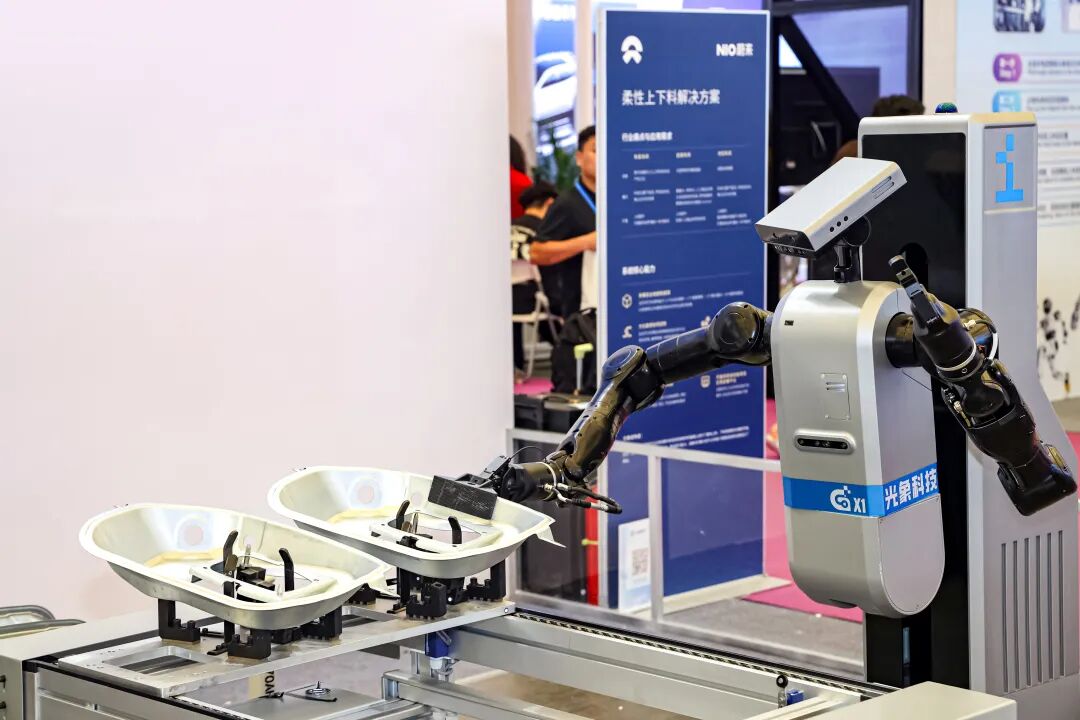
💡A new 'physics-native' approach to robotics that claims to outperform traditional VLA models in industrial precision.
⚡ 30-Second TL;DR
What Changed
Raised hundreds of millions in angel funding for physics-native model R&D.
Why It Matters
Focusing on 'physics-native' models instead of pure imitation learning could provide a more robust path for industrial automation.
What To Do Next
Consider integrating physics-based simulation environments like Phi-Space for training your reinforcement learning agents.
Key Points
- •Raised hundreds of millions in angel funding for physics-native model R&D.
- •Phi-Bot X1 features 27 degrees of freedom and 0.05mm repeatability.
- •Uses a 'three-in-one' system: Phi-RL Matrix, Phi-Space data, and Phi-Arch platform.
- •Successfully validated in automotive welding and quality inspection scenarios.
🧠 Deep Insight
AI-generated analysis for this event — not the original article.
🔑 Enhanced Key Takeaways
- •Guangxiang Tech (Guangxiang Intelligence) is headquartered in Beijing and focuses on the intersection of embodied AI and industrial manufacturing automation.
- •The Phi-RL Matrix model utilizes a proprietary reinforcement learning framework specifically optimized for high-frequency sensor feedback loops in industrial environments.
- •The company's 'physics-native' approach emphasizes simulation-to-reality (Sim2Real) transfer, reducing the need for extensive physical data collection by training models in high-fidelity digital twins.
- •The Phi-Space data engine incorporates a multimodal dataset that includes tactile, visual, and force-torque sensor data to improve robot dexterity in unstructured assembly tasks.
- •Strategic partnerships have been established with Tier-1 automotive suppliers to pilot the Phi-Bot X1 in production lines, specifically targeting tasks previously requiring manual labor due to complexity.
📊 Competitor Analysis▸ Show
| Feature | Guangxiang Tech Phi-Bot X1 | Standard Industrial Robots (e.g., FANUC/ABB) | Emerging Embodied AI Startups |
|---|---|---|---|
| Control Logic | Physics-native AI Model | Traditional PLC/Scripting | Neural Network/End-to-End AI |
| Adaptability | High (Self-correcting) | Low (Pre-programmed) | Medium-High |
| Repeatability | 0.05mm | 0.01mm - 0.03mm | 0.1mm - 0.5mm |
| Deployment | Rapid (Sim2Real) | Slow (Manual tuning) | Moderate |
🛠️ Technical Deep Dive
- Phi-RL Matrix: A reinforcement learning architecture that integrates physics constraints directly into the reward function to ensure stable motion planning.
- Phi-Space Data Engine: A synthetic data generation pipeline that creates diverse industrial scenarios to train the base model on edge cases.
- Phi-Arch Platform: A modular software-hardware interface that allows the Phi-Bot X1 to integrate with existing factory MES (Manufacturing Execution Systems).
- Degrees of Freedom: 27 DOF configuration allows for human-like kinematic redundancy, enabling the robot to navigate around obstacles while maintaining end-effector precision.
🔮 Future ImplicationsAI analysis grounded in cited sources
⏳ Timeline
Weekly AI Recap
Read this week's curated digest of top AI events →
👉Related Updates
AI-curated news aggregator. All content rights belong to original publishers.
Original source: 36氪 ↗
This is a summary, not the original. Read the source, or get the weekly briefing.
Weekly AI briefing
One email a week. Unsubscribe anytime.