Grok Imagine 2.0 Turns Images into Editable Memes
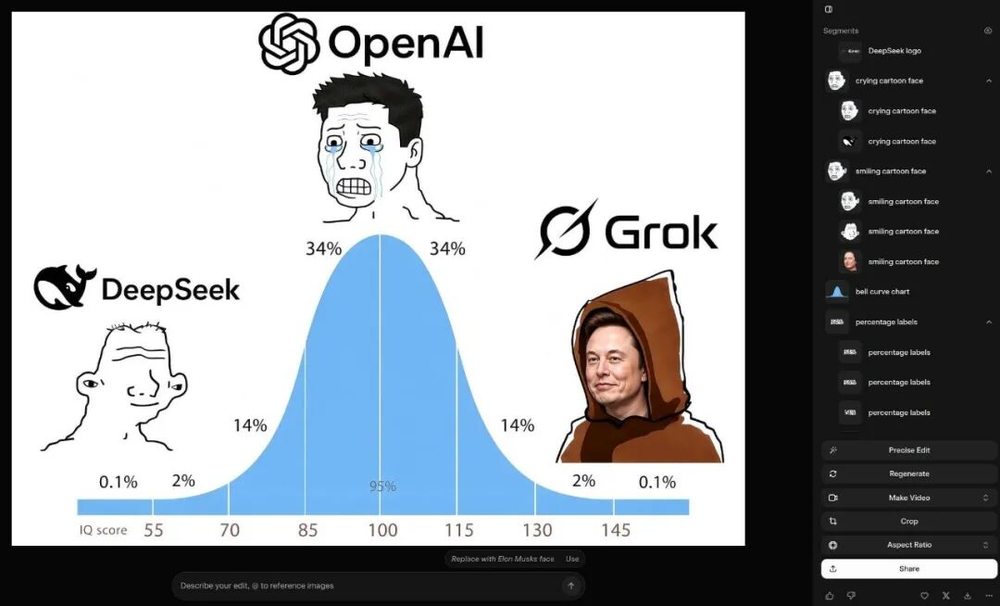
See how Grok’s layer-aware editing changes image workflows—and where copyright filters stop you.
30-Second TL;DR
What Changed
Imagine Image 2.0 reportedly ranks second globally in both text-to-image generation and image-editing categories on an image-model arena.
Why It Matters
Layer-based interaction could make generative image tools more practical for meme production, marketing assets, and rapid creative iteration. However, copyright filters and inconsistent availability may limit workflows that depend on editing recognizable branded characters.
What To Do Next
Prototype a meme or marketing-asset workflow at grok.com/imagine using layer selection, region painting, and five-image compositing, then test how its copyright filters affect your intended inputs.
Key Points
- •Imagine Image 2.0 reportedly ranks second globally in both text-to-image generation and image-editing categories on an image-model arena.
- •Grok automatically separates subjects such as people, clothing, logos, speech bubbles, and background elements into editable layers.
- •Users can select or paint regions for prompt-based edits and export individual subjects with transparent backgrounds.
- •The multi-reference editing workflow supports up to five input images for automatic compositing.
- •Stricter copyright and safety filters may block edits involving protected characters such as Spider-Man.
Deep Insight
AI-generated analysis for this event — not the original article.
Enhanced Key Takeaways
- •The model leverages xAI's proprietary 'Grok-Vision' architecture, which integrates multimodal understanding directly into the image generation pipeline to facilitate real-time layer segmentation.
- •xAI has implemented a 'Provenance-Aware' watermarking system for Imagine 2.0, embedding invisible metadata into exported transparent-background assets to track AI-generated content origins.
- •The multi-reference compositing feature utilizes a novel 'Attention-Masking' technique that allows the model to preserve specific identity features from up to five source images without requiring fine-tuning.
- •Integration with the X (formerly Twitter) platform allows users to directly pull high-resolution media from their own post history as reference material for the Imagine 2.0 editing suite.
- •The model's performance in the image-model arena is largely attributed to a new 'Latent-Consistency' training objective that reduces inference latency for interactive editing tasks.
Competitor Analysis
- Grok Imagine 2.0
- Interactive Layered Editing
- Adobe Firefly Image 3
- Professional Creative Workflow
- Midjourney v6.1
- High-Fidelity Generation
- Grok Imagine 2.0
- Automatic/Real-time
- Adobe Firefly Image 3
- Manual/Generative Fill
- Midjourney v6.1
- Limited
- Grok Imagine 2.0
- Up to 5 images
- Adobe Firefly Image 3
- Limited
- Midjourney v6.1
- 1-2 images
- Grok Imagine 2.0
- X (Twitter) Ecosystem
- Adobe Firefly Image 3
- Creative Cloud/Web
- Midjourney v6.1
- Discord/Web
- Grok Imagine 2.0
- Top 2 (Arena)
- Adobe Firefly Image 3
- Top 5 (Arena)
- Midjourney v6.1
- Top 1 (Arena)
| Feature | Grok Imagine 2.0 | Adobe Firefly Image 3 | Midjourney v6.1 |
|---|---|---|---|
| Primary Focus | Interactive Layered Editing | Professional Creative Workflow | High-Fidelity Generation |
| Layer Segmentation | Automatic/Real-time | Manual/Generative Fill | Limited |
| Multi-Reference | Up to 5 images | Limited | 1-2 images |
| Platform | X (Twitter) Ecosystem | Creative Cloud/Web | Discord/Web |
| Benchmark Rank | Top 2 (Arena) | Top 5 (Arena) | Top 1 (Arena) |
Technical Deep Dive
- Architecture: Utilizes a transformer-based diffusion model with a dedicated segmentation head for real-time layer extraction.
- Latent Space: Employs a high-dimensional latent space that supports non-destructive editing, allowing users to revert changes without re-generating the entire image.
- Compositing: Uses cross-attention mechanisms to blend reference images, maintaining structural consistency while allowing style transfer between layers.
- Inference: Optimized for edge-to-cloud hybrid processing to maintain low latency during interactive painting and selection tasks.
Future ImplicationsAI analysis grounded in cited sources
Timeline
- 2023-11xAI releases the first version of Grok, initially focused on text-based LLM capabilities.
- 2024-08xAI introduces Grok-2, marking the company's entry into image generation using the FLUX.1 model.
- 2026-05xAI announces the development of advanced multimodal vision capabilities for the Grok ecosystem.
- 2026-08Launch of Grok Imagine 2.0 with interactive layer-based editing features.
Weekly AI Recap
Read this week's curated digest of top AI events →
AI-curated news aggregator. All content rights belong to original publishers.
Original source: 虎嗅 ↗
This is a summary, not the original. Read the source, or get the weekly briefing.
The weekly digest
One email a week. Unsubscribe anytime.