Grok as SpaceX’s AI Engineer
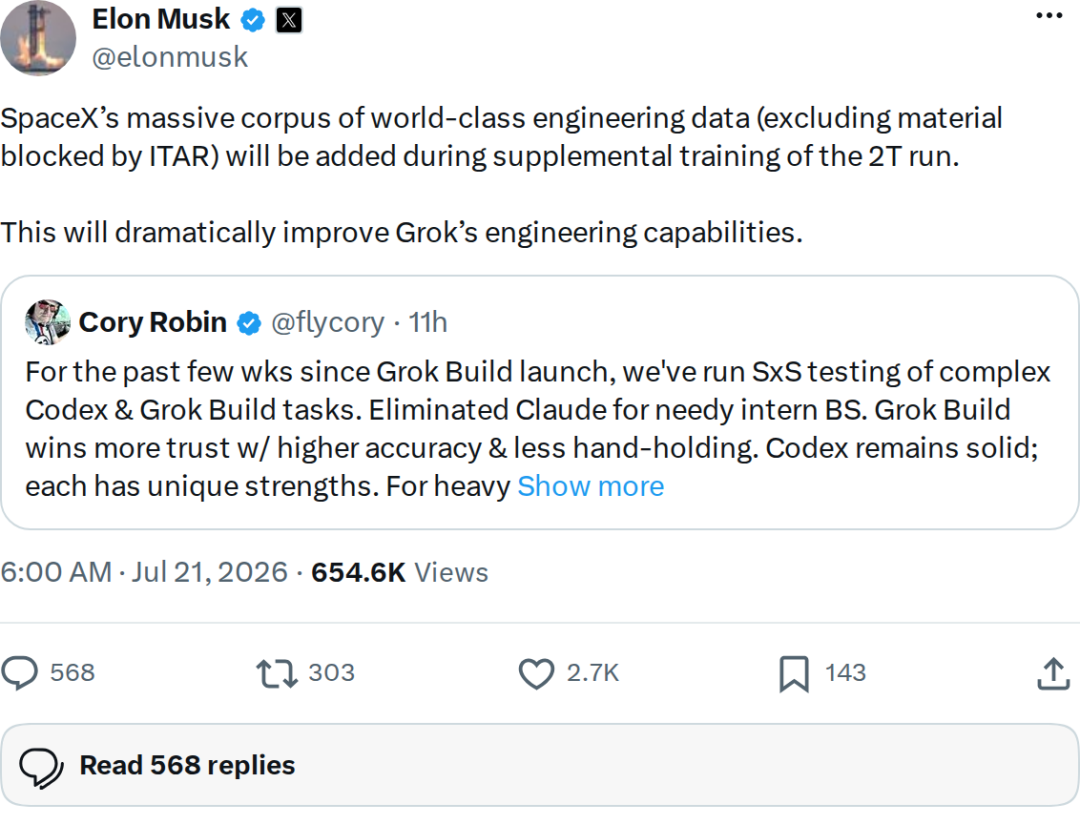
💡SpaceX’s data experiment reveals why domain AI needs versioned evidence, simulation, and real-world testing—not fluent a
⚡ 30-Second TL;DR
What Changed
SpaceX plans to add its historical engineering data to Grok’s reported 2T training run, though the meaning and scale of 2T remain unclear.
Why It Matters
If successful, this approach could make domain-specific AI assistants more valuable for industrial troubleshooting by grounding answers in proprietary failure history rather than generic web knowledge. However, it also highlights the governance, data lineage, version-control, and safety requirements needed before AI can influence high-risk engineering decisions.
What To Do Next
Prototype a retrieval system that links incident reports, telemetry, CAD or configuration metadata, and software commits before fine-tuning a model on engineering archives.
Key Points
- •SpaceX plans to add its historical engineering data to Grok’s reported 2T training run, though the meaning and scale of 2T remain unclear.
- •Linked records could help Grok connect telemetry anomalies with software revisions, component batches, assembly records, and previous failure investigations.
- •Historical data requires metadata for vehicle type, configuration, test session, software version, measurement conditions, and evidence quality.
- •Engineering recommendations must still pass simulation, ground testing, and flight validation because local fixes can create new system-level failures.
- •Public information does not yet establish Grok’s performance on integrated aerospace engineering tasks.
🧠 Deep Insight
Background and context from public sources — not the original article. 14 sources cited.
🔑 Enhanced Key Takeaways
- •SpaceX acquired xAI in February 2026 and rebranded the division as SpaceXAI in July 2026 to centralize AI-driven aerospace engineering.
- •SpaceXAI acquired the AI-native code editor Cursor in August 2026 for $60 billion to integrate proprietary engineering data with developer workflows.
- •The Colossus 1 supercomputer, previously operating at 11% capacity, has been fully repurposed to train the Grok model family, resolving significant infrastructure underutilization.
- •OpenAI terminated its partnership with Cursor in August 2026, citing concerns that SpaceXAI was using the platform to distill data for training Grok.
- •SpaceXAI projects that AI-related revenue will surpass all other company revenue streams, including launch operations, as of September 2026.
📊 Competitor Analysis▸ Show
| Feature | Grok 4.6 (SpaceXAI) | GPT-5.6 Sol Max (OpenAI) | Claude Fable 5 (Anthropic) |
|---|---|---|---|
| Intelligence Index Score | 61 | 61 | >61 |
| API Input Pricing | $2 / 1M tokens | N/A | N/A |
| API Output Pricing | $6 / 1M tokens | N/A | N/A |
| Primary Focus | Aerospace/Hardware Engineering | General Purpose | General Purpose |
🛠️ Technical Deep Dive
- Model Version: Grok 4.7 (upcoming release scheduled for Sept 12, 2026).
- Parameter Count: 2.1 trillion parameters (base).
- Infrastructure: Colossus 1 supercomputer cluster utilizing approximately 200,000 Nvidia GPUs.
- Orchestration: Grok Bot system, which utilizes agent-based workflows to interact with UI-based software rather than relying solely on API endpoints.
🔮 Future ImplicationsAI analysis grounded in cited sources
⏳ Timeline
📎 Sources (14)
Factual claims are grounded in the sources below. Forward-looking analysis is AI-generated interpretation.
Weekly AI Recap
Read this week's curated digest of top AI events →
👉Related Updates

AI-curated news aggregator. All content rights belong to original publishers.
Original source: 虎嗅 ↗
This is a summary, not the original. Read the source, or get the weekly briefing.
Weekly AI briefing
One email a week. Unsubscribe anytime.