Graph Engineering Turns Agent Workflows Into Executable Systems
Learn when agent loops should become graphs—and when adding graph structure only creates unnecessary complexity.
30-Second TL;DR
What Changed
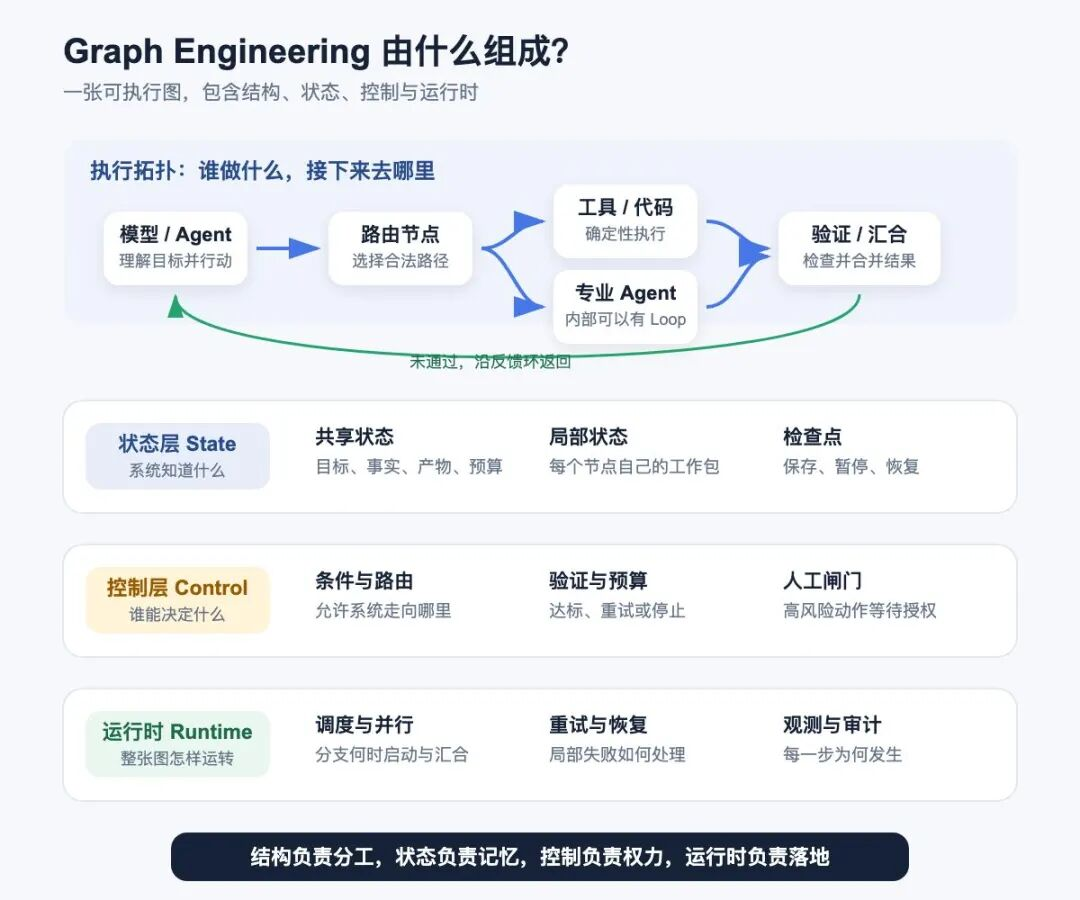
Graph nodes can contain deterministic code, model calls, tools, or complete agents with their own internal loops.
Why It Matters
The concept is important for teams moving agents from demos into production workflows. It suggests that future agent engineering will increasingly resemble distributed-systems design and organizational design, with explicit authority, observability, and recovery boundaries.
What To Do Next
Model one existing multi-agent workflow in LangGraph with explicit state schemas, retryable nodes, parallel branches, and human approval checkpoints.
Key Points
- •Graph nodes can contain deterministic code, model calls, tools, or complete agents with their own internal loops.
- •Graphs address task division, dependency management, control boundaries, shared state, failure isolation, and governance.
- •Parallel graph structures are most valuable for tasks that naturally branch; Google Research reportedly found an 80.9% improvement for parallel financial analysis with centralized multi-agent setups, while sequential tasks could decline by 39% to 70%.
- •The key engineering challenge shifts toward defining node contracts, permissions, state ownership, concurrency handling, retries, routing errors, and version handoffs.
Deep Insight
AI-generated analysis for this event — not the original article.
Enhanced Key Takeaways
- •Graph-based agent orchestration frameworks, such as LangGraph, utilize cyclic graph structures to enable stateful, multi-actor applications that differ from traditional Directed Acyclic Graphs (DAGs) by allowing for iterative feedback loops.
- •The shift toward graph engineering is driven by the need for 'human-in-the-loop' checkpoints, where the system pauses execution to allow for state inspection or modification before resuming the graph traversal.
- •Modern graph engineering implementations often leverage 'State Schemas' to enforce strict data contracts between nodes, ensuring that downstream agents receive predictable input formats regardless of the upstream model's output.
- •Research into graph-based agent systems highlights the 'context window management' advantage, where graphs allow for the selective pruning or summarization of state history at specific nodes to prevent token overflow in long-running workflows.
- •Industry adoption of graph-based workflows is increasingly focused on 'observability-as-code,' where the graph structure itself serves as the primary trace for debugging agent failures, replacing opaque black-box logging.
Competitor Analysis
- LangGraph
- Cyclic Graphs
- CrewAI
- Role-based Orchestration
- AutoGen
- Conversational Patterns
- Microsoft Semantic Kernel
- Modular Plugins
- LangGraph
- Persistent Checkpointing
- CrewAI
- Shared Memory
- AutoGen
- Conversation History
- Microsoft Semantic Kernel
- Context Variables
- LangGraph
- Complex, Stateful Workflows
- CrewAI
- Multi-Agent Collaboration
- AutoGen
- Rapid Prototyping
- Microsoft Semantic Kernel
- Enterprise Integration
- LangGraph
- Open Source
- CrewAI
- Open Source
- AutoGen
- Open Source
- Microsoft Semantic Kernel
- Open Source
| Feature | LangGraph | CrewAI | AutoGen | Microsoft Semantic Kernel |
|---|---|---|---|---|
| Primary Paradigm | Cyclic Graphs | Role-based Orchestration | Conversational Patterns | Modular Plugins |
| State Management | Persistent Checkpointing | Shared Memory | Conversation History | Context Variables |
| Best For | Complex, Stateful Workflows | Multi-Agent Collaboration | Rapid Prototyping | Enterprise Integration |
| Pricing | Open Source | Open Source | Open Source | Open Source |
Technical Deep Dive
- State Persistence: Graphs utilize SQLite, Postgres, or Redis backends to store snapshots of the agent's state at each node, enabling 'time-travel' debugging and fault tolerance.
- Node Contracts: Implementation involves defining Pydantic models for input/output schemas, ensuring type safety across heterogeneous agent calls.
- Concurrency Control: Advanced implementations use asynchronous event loops (asyncio) to manage parallel node execution, with synchronization primitives to handle shared state updates.
- Routing Logic: Conditional edges are implemented as deterministic functions that evaluate the current state to determine the next node, effectively decoupling business logic from LLM reasoning.
Future ImplicationsAI analysis grounded in cited sources
Timeline
- 2024-01Introduction of LangGraph by LangChain, formalizing the cyclic graph approach for agentic workflows.
- 2024-05Microsoft releases AutoGen updates focusing on multi-agent conversation patterns and group chat managers.
- 2025-02Industry-wide shift toward 'Stateful Agents' as the primary architecture for production-grade LLM applications.
- 2026-03Standardization of agentic workflow schemas begins to emerge across major AI orchestration frameworks.
Weekly AI Recap
Read this week's curated digest of top AI events →
AI-curated news aggregator. All content rights belong to original publishers.
Original source: 虎嗅 ↗
This is a summary, not the original. Read the source, or get the weekly briefing.
The weekly digest
One email a week. Unsubscribe anytime.