GPT-5.6 Cross-Region Inference Arrives on Bedrock
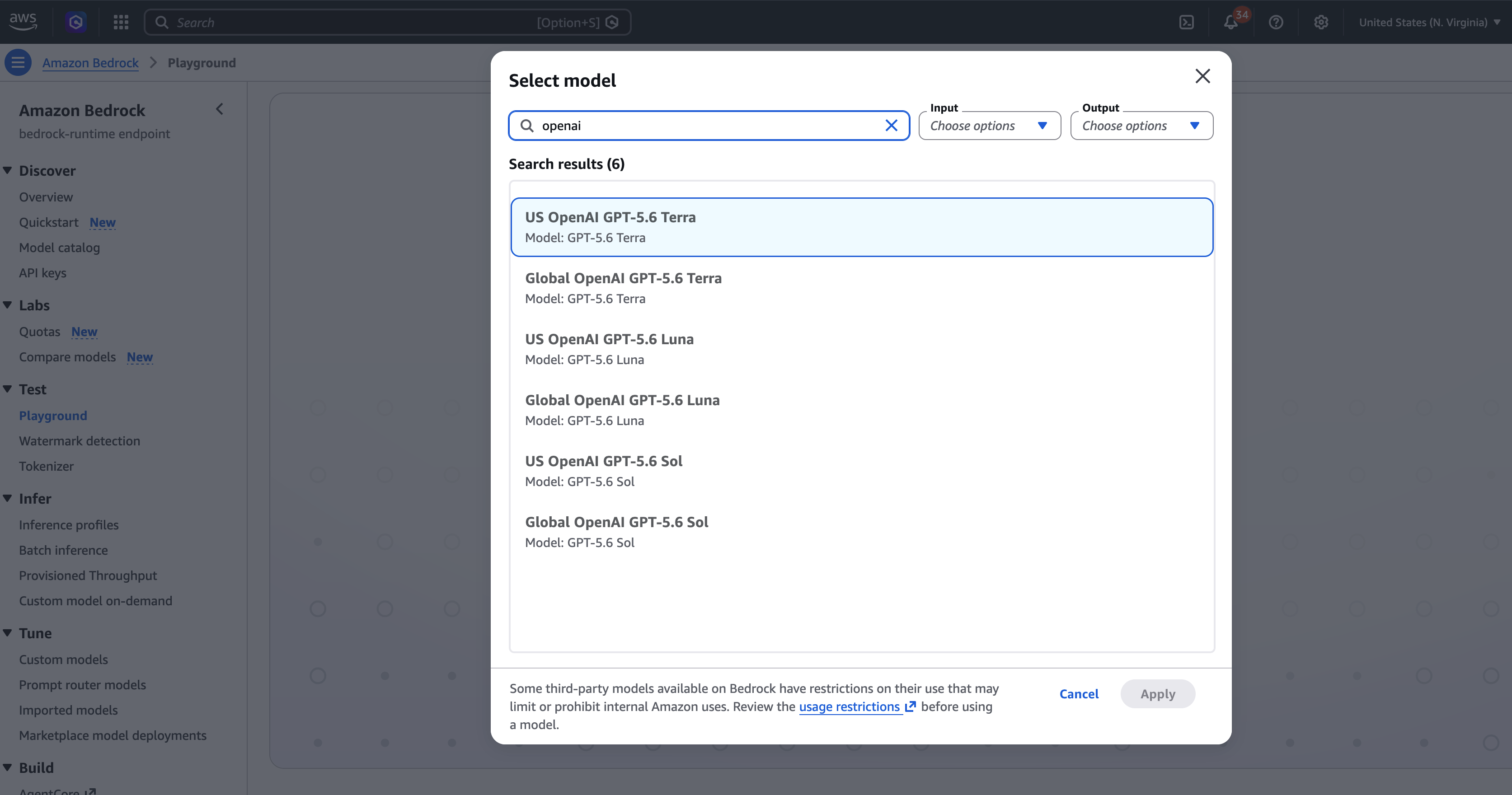
💡See how cross-Region routing expands GPT-5.6 availability and throughput on Amazon Bedrock.
⚡ 30-Second TL;DR
What Changed
OpenAI GPT-5.6 models Sol, Terra, and Luna are available across more than 25 AWS Regions.
Why It Matters
This expansion gives enterprise teams more regional access and potentially better throughput when deploying GPT-5.6 workloads on AWS. Teams should still evaluate data-residency requirements, latency, quota behavior, and cross-Region routing before production rollout.
What To Do Next
Create a staging Bedrock inference profile and benchmark GPT-5.6 through both the OpenAI-compatible and Converse APIs against your latency and data-residency requirements.
Key Points
- •OpenAI GPT-5.6 models Sol, Terra, and Luna are available across more than 25 AWS Regions.
- •US geographic and global inference profiles route requests across Regions for higher throughput.
- •The models can be called through both the OpenAI API and Amazon Bedrock Converse API.
- •AWS provides configuration guidance for IAM permissions, quotas, and monitoring.
🧠 Deep Insight
Background and context from public sources — not the original article. 21 sources cited.
🔑 Enhanced Key Takeaways
- •The OpenAI GPT-5.6 models Sol, Terra, and Luna are distinct variants, with Sol designed for complex reasoning, Terra for balanced everyday use, and Luna optimized for speed and cost-efficiency in high-volume workloads.
- •Cross-Region inference on Amazon Bedrock dynamically routes traffic across multiple AWS Regions, leveraging capacity from all pre-configured regions to maximize application throughput and performance, particularly during demand spikes.
- •Global cross-Region inference for OpenAI models on Bedrock can result in lower per-token costs compared to in-Region and Geographic inferencing.
- •OpenAI announced significant price reductions for GPT-5.6 Luna (80%) and Terra (20%) on Amazon Bedrock, effective July 30, 2026, aligning with OpenAI's first-party pricing changes.
- •Cross-Region inference operates over the secure AWS network with end-to-end encryption, and customer data is not stored in destination regions, ensuring data residency and compliance are maintained within specified geographic profiles.
📊 Competitor Analysis▸ Show
| Feature / Platform | AWS Bedrock | Azure OpenAI Service | Google Cloud Vertex AI |
|---|---|---|---|
| Model Access | Broadest choice: Anthropic (Claude), Meta (Llama), Mistral, Cohere, Stability AI, Amazon (Titan, Nova), OpenAI (GPT-5.6, etc.), DeepSeek, TwelveLabs, Qwen, and more via Marketplace. | Focuses on OpenAI models (GPT family, Codex) with early access to latest versions and tight Microsoft 365 integration. | Leans into Google's own Gemini family (including 1M-token context window), and custom ML models, with direct BigQuery grounding. |
| Provisioned Throughput | Reserves capacity in per-model Provisioned Throughput units. | Uses model-independent Provisioned Throughput Units (PTUs), where output tokens count more than input tokens (e.g., 8:1 for GPT-5). | Uses Generative AI Scale Units (GSUs) with per-model burndown rates and enforces quota over a dynamic window. |
| Data Residency/Compliance | Offers EU data-residency options for some models; cross-region inference can be configured for geographic data residency. Has FedRAMP High. | Strongest compliance posture with clear enterprise data processing agreements; data not used to train OpenAI models by default. Has FedRAMP High. | Data handling posture improved significantly in 2025-2026; FedRAMP High in progress. |
| Pricing Model | Usage-based, per-token (per million tokens for input/output). Separate billing for Knowledge Bases, Guardrails, Agents. | Usage-based per token (matches direct OpenAI rates) plus auxiliary cost layers, making it 15-40% more expensive than direct OpenAI API calls. | Usage-based per million tokens, with a 200K context pricing cliff that doubles input costs above that threshold. |
| Strategic Fit | Best for AWS-native infrastructure, requiring multi-model flexibility and existing AWS certifications for compliance. | Ideal for Microsoft-first shops, deep in Microsoft 365 and Azure, prioritizing OpenAI model depth and Microsoft integration. | Suited for GCP-native environments, data-first teams, and those needing very long context windows or tight BigQuery integration. |
🛠️ Technical Deep Dive
- GPT-5.6 is a family of models (Sol, Terra, Luna) built on a shared architecture but specifically tuned for different performance and cost profiles.
- Sol is the most capable variant, designed for complex reasoning, nuanced generation, and demanding enterprise tasks, including frontier reasoning and long-horizon agentic work.
- Terra offers a balance of intelligence, speed, and cost, suitable for everyday production workloads requiring sophisticated reasoning.
- Luna is the fastest and most cost-efficient variant, optimized for high-volume, lower-stakes applications where speed and affordability are critical.
- All three GPT-5.6 models feature a 1.05 million-token context window and a maximum output of 128,000 tokens.
- Cross-region inference on Bedrock employs a heuristics-based routing system to dynamically select the optimal region, prioritizing the connected source region to minimize latency while maximizing available compute resources and model availability.
- GPT-5.6 introduces new primitives to the Responses API, such as the ability to persist reasoning across model turns and native compaction to compress long-running conversations, enabling agents to operate more efficiently over longer task horizons.
🔮 Future ImplicationsAI analysis grounded in cited sources
⏳ Timeline
📎 Sources (21)
Factual claims are grounded in the sources below. Forward-looking analysis is AI-generated interpretation.
Weekly AI Recap
Read this week's curated digest of top AI events →
👉Related Updates
AI-curated news aggregator. All content rights belong to original publishers.
Original source: AWS Machine Learning Blog ↗
This is a summary, not the original. Read the source, or get the weekly briefing.
Weekly AI briefing
One email a week. Unsubscribe anytime.