Govts Can Cheaply Slow AI Training?
💡Govt tricks to throttle AI training exposed—design resilient pipelines now!
⚡ 30-Second TL;DR
What Changed
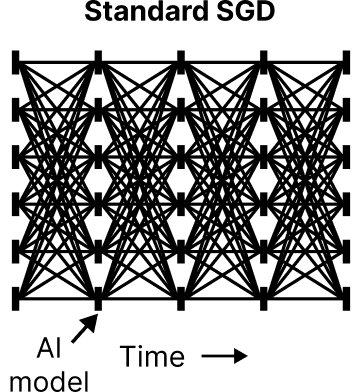
Inference-verification slows training by restricting server communication, but RL needs minimal comms.
Why It Matters
Highlights vulnerabilities in AI safety interventions, urging labs to design resilient training stacks. May spur policy debates on compute verification, affecting scaling plans.
What To Do Next
Audit your RL training comms volume to estimate slowdown under inference-verification regimes.
Key Points
- •Inference-verification slows training by restricting server communication, but RL needs minimal comms.
- •Developers could use 95% compute for RL rollouts covertly, 5% for updates elsewhere.
- •Uploading checkpoints under bandwidth limits creates hurdles but feasible workarounds exist.
- •Aggressive proofs (>95% compute) or frequent memory wipes could buy 1+ year delay.
🧠 Deep Insight
Background and context from public sources — not the original article. 8 sources cited.
🔑 Enhanced Key Takeaways
- •AI training clusters require 100-400 Gbps sustained bandwidth per GPU for synchronous gradient updates across tens of thousands of GPUs, generating 40-160 TB per hour of inter-GPU traffic in a 1000-GPU run[1].
- •Emerging Ethernet standards like IEEE 802.3dj enable 1.6 Tbps operations with 200G/lane signaling, while Ultra Ethernet Consortium's UET 1.0 optimizes small message performance for AI/HPC scale-up to a million hosts[3].
- •Network infrastructure has become the primary bottleneck for AI in 2026, surpassing GPUs and power, as data movement across regions and clouds demands intelligent orchestration[4].
🔮 Future ImplicationsAI analysis grounded in cited sources
📎 Sources (8)
Factual claims are grounded in the sources below. Forward-looking analysis is AI-generated interpretation.
- softwareseni.com — How Bandwidth and Latency Constraints Are Killing AI Projects at Scale
- ascenditgroup.com — AI Is Changing Business Bandwidth
- networkworld.com — Ethernet Groups Keep 2026 Focus on Higher Bandwidth AI Demands
- unifiedaihub.com — AI Infrastructure Shifts in 2026 From Training to Continuous Inference
- ciena.com — Dark, Lit, or Hybridif Your Network Cant Move Data, Your AI Cant Move Forward
- mckinsey.com — The Next Big Shifts in AI Workloads and Hyperscaler Strategies
- deloitte.com — Compute Power AI
- photonics.com — A71993
Weekly AI Recap
Read this week's curated digest of top AI events →
👉Related Updates
AI-curated news aggregator. All content rights belong to original publishers.
Original source: AI Alignment Forum ↗
This is a summary, not the original. Read the source, or get the weekly briefing.
Weekly AI briefing
One email a week. Unsubscribe anytime.