Govern Agent Tools with AgentCore Gateway
💡Learn a staged way to secure and audit agent access to enterprise tools.
⚡ 30-Second TL;DR
What Changed
Provides governed, auditable access from AI agents to enterprise tools.
Why It Matters
The gateway can give enterprise teams a structured way to improve agent tool security and accountability incrementally. This may reduce the risk of uncontrolled tool access while avoiding a large infrastructure migration at the outset.
What To Do Next
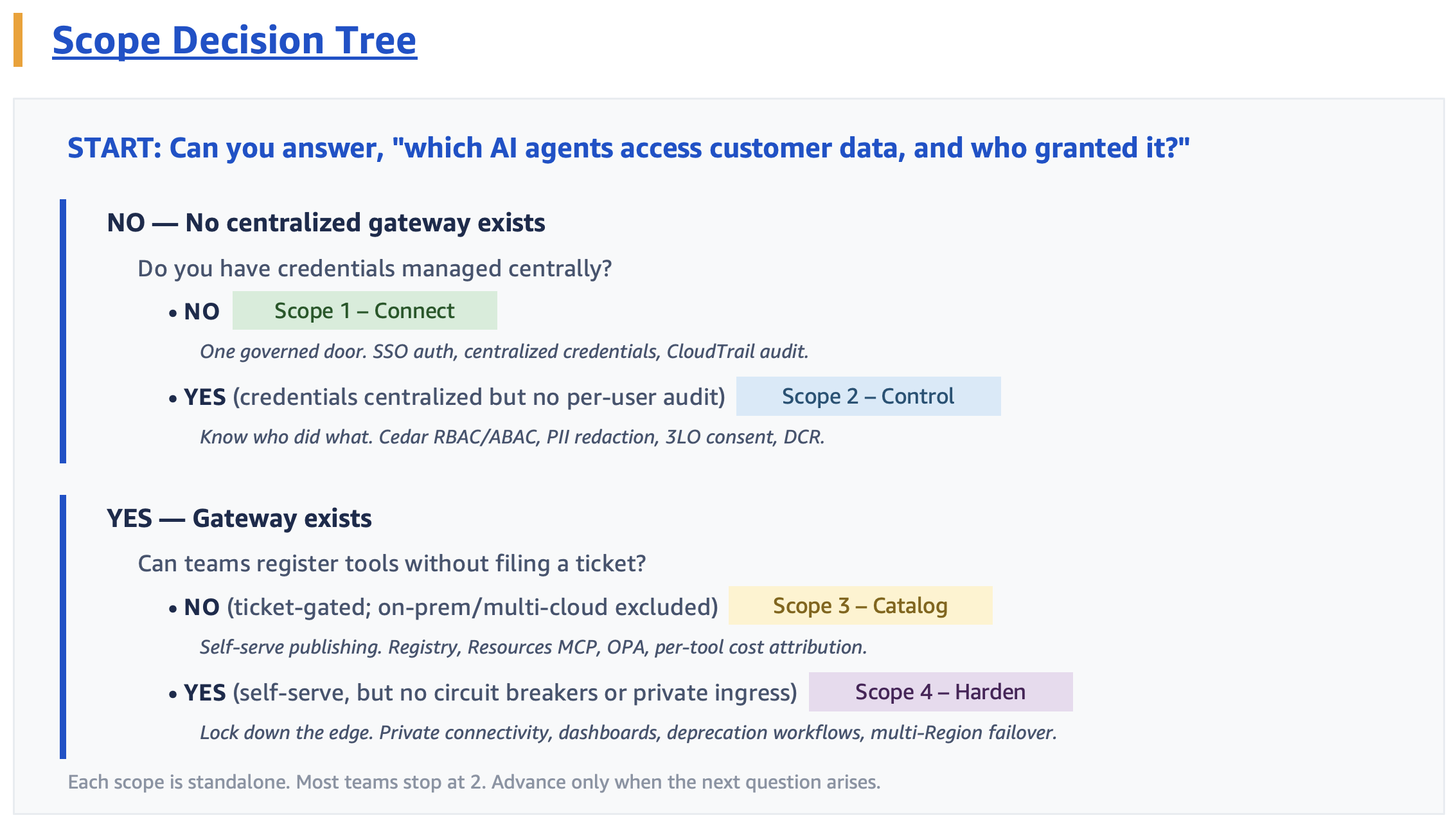
Map one production agent’s tool calls to the AgentCore Gateway maturity model and start by implementing the Connect and Control scopes.
Key Points
- •Provides governed, auditable access from AI agents to enterprise tools.
- •Avoids requiring organizations to consolidate their existing tool infrastructure.
- •Uses the Connect, Control, Catalog, and Harden maturity model to guide governance adoption.
🧠 Deep Insight
Background and context from public sources — not the original article. 11 sources cited.
🔑 Enhanced Key Takeaways
- •The Gateway utilizes the open-source Dogwood language to enforce stateful, temporal security policies that evaluate agent requests based on historical session context.
- •It functions as a protocol translator, bridging modern Model Context Protocol (MCP) requirements with legacy HTTP APIs and AWS Lambda functions without requiring backend refactoring.
- •The service provides dual-layer authentication, managing both ingress verification for agents and egress authorization for backend tool access, including support for OAuth code flow.
- •It offers framework-agnostic compatibility, supporting popular third-party agent ecosystems such as LangGraph, CrewAI, LlamaIndex, and Strands Agents.
- •The platform includes a managed Web Search capability, enabling agents to perform real-time grounding in external data without requiring customers to manage egress infrastructure.
📊 Competitor Analysis▸ Show
| Feature | Amazon Bedrock AgentCore Gateway | LangSmith (LangChain) | Microsoft Azure AI Agent Service |
|---|---|---|---|
| Primary Focus | Governance & Protocol Translation | Observability & Tracing | Orchestration & Integration |
| Tool Integration | Native MCP & Legacy API support | SDK-based integration | Azure-native service ecosystem |
| Security | Temporal policies (Dogwood) | Role-based access control | Entra ID integration |
| Pricing | Managed, per-request/throughput | Tiered subscription/usage | Consumption-based |
🛠️ Technical Deep Dive
- Architecture: Acts as a centralized ingress/egress chokepoint for agentic traffic, decoupling agent frameworks from backend tool infrastructure.
- Protocol Support: Native translation between Model Context Protocol (MCP) and traditional REST/HTTP/Lambda interfaces.
- Policy Engine: Implements stateful authorization via the Dogwood language, allowing for session-aware security rules.
- Routing: Supports multi-target routing across MCP servers, HTTP services, and model inference endpoints.
- Observability: Provides centralized logging and performance monitoring for all agent-to-tool interactions.
🔮 Future ImplicationsAI analysis grounded in cited sources
⏳ Timeline
📎 Sources (11)
Factual claims are grounded in the sources below. Forward-looking analysis is AI-generated interpretation.
Weekly AI Recap
Read this week's curated digest of top AI events →
👉Related Updates
AI-curated news aggregator. All content rights belong to original publishers.
Original source: AWS Machine Learning Blog ↗
This is a summary, not the original. Read the source, or get the weekly briefing.
Weekly AI briefing
One email a week. Unsubscribe anytime.