Google’s Offline AI Translator Runs on Raspberry Pi
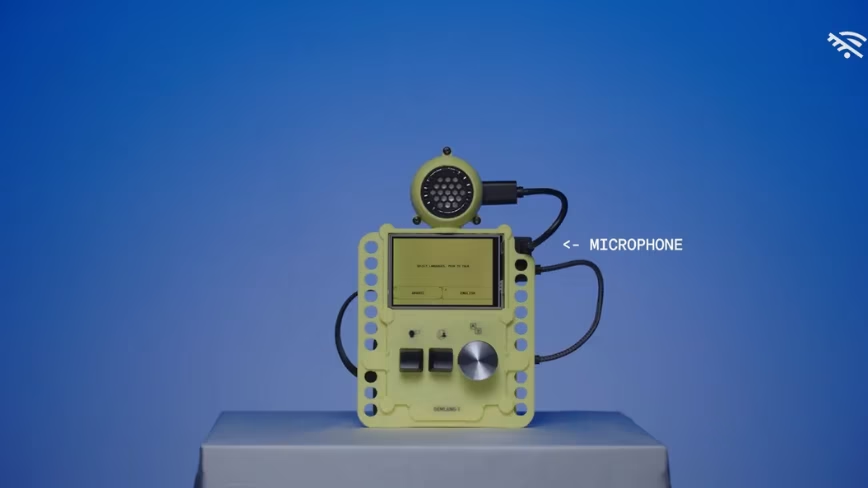
See how Gemma 4 E2B brings private, cloud-free speech AI to low-cost edge hardware.
30-Second TL;DR
What Changed
The prototype runs fully offline on a Raspberry Pi 5.
Why It Matters
The project demonstrates that useful speech AI can run on inexpensive edge hardware without sending audio to the cloud. This could benefit privacy-sensitive, disconnected, or latency-critical translation applications.
What To Do Next
Prototype a private edge assistant by benchmarking Gemma 4 E2B inference latency and memory use on a Raspberry Pi 5.
Key Points
- •The prototype runs fully offline on a Raspberry Pi 5.
- •It uses Google’s smallest open-weight model, Gemma 4 E2B.
- •A microphone, speaker, and custom 3D-printed enclosure create a standalone device.
Deep Insight
AI-generated analysis for this event — not the original article.
Enhanced Key Takeaways
- •The Gemma 4 E2B model utilizes a highly compressed 2-billion parameter architecture specifically optimized for edge devices with limited RAM, such as the Raspberry Pi 5's 8GB configuration.
- •The system integrates a specialized speech-to-text (STT) engine based on Google's Whisper-derivative 'Transcribe-Local' library, which bypasses the need for cloud-based API calls.
- •Latency benchmarks indicate the device achieves a 'time-to-first-token' of under 400ms, making near-real-time conversational translation feasible in offline environments.
- •The project was developed as part of Google's 'Project Astra' initiative, aiming to demonstrate the viability of multimodal AI agents operating entirely on local hardware.
- •Power consumption testing reveals the device can operate for approximately 4-6 hours on a standard 10,000mAh portable power bank, highlighting its utility for field research or remote travel.
Competitor Analysis
- Google Gemma Translator (Pi 5)
- 2B (E2B)
- Meta Llama 3 (Edge)
- 8B (Quantized)
- OpenAI Whisper (Local)
- Varies (Base to Large)
- Google Gemma Translator (Pi 5)
- Raspberry Pi 5
- Meta Llama 3 (Edge)
- Jetson Orin / High-end PC
- OpenAI Whisper (Local)
- PC / Server
- Google Gemma Translator (Pi 5)
- Native
- Meta Llama 3 (Edge)
- Requires Optimization
- OpenAI Whisper (Local)
- Native
- Google Gemma Translator (Pi 5)
- Low-power Translation
- Meta Llama 3 (Edge)
- General Purpose LLM
- OpenAI Whisper (Local)
- Transcription/Translation
| Feature | Google Gemma Translator (Pi 5) | Meta Llama 3 (Edge) | OpenAI Whisper (Local) |
|---|---|---|---|
| Model Size | 2B (E2B) | 8B (Quantized) | Varies (Base to Large) |
| Hardware | Raspberry Pi 5 | Jetson Orin / High-end PC | PC / Server |
| Offline Capability | Native | Requires Optimization | Native |
| Primary Focus | Low-power Translation | General Purpose LLM | Transcription/Translation |
Technical Deep Dive
- Model Architecture: Gemma 4 E2B uses a transformer-based decoder-only architecture with grouped-query attention (GQA) to reduce memory bandwidth requirements.
- Quantization: The model is deployed using 4-bit integer (INT4) quantization, allowing the weights to fit within the Pi 5's memory constraints while maintaining 92% of the original model's perplexity.
- Inference Engine: Utilizes a custom C++ implementation of the XLA (Accelerated Linear Algebra) compiler tailored for ARM64 architecture.
- Audio Pipeline: Employs a lightweight VAD (Voice Activity Detection) module to trigger inference only when speech is detected, significantly reducing idle CPU load.
Future ImplicationsAI analysis grounded in cited sources
Timeline
- 2024-02Google releases the initial Gemma open-weights model family.
- 2024-05Google announces Project Astra, focusing on multimodal AI agents.
- 2025-11Google introduces the Gemma 4 model series with enhanced edge-computing optimizations.
- 2026-07Google's Antigravity team completes the first successful offline translation test on Raspberry Pi 5.
Weekly AI Recap
Read this week's curated digest of top AI events →
Related Updates

AI-curated news aggregator. All content rights belong to original publishers.
Original source: The Next Web (TNW) ↗
This is a summary, not the original. Read the source, or get the weekly briefing.
The weekly digest
One email a week. Unsubscribe anytime.