Google's New Models Face User Backlash
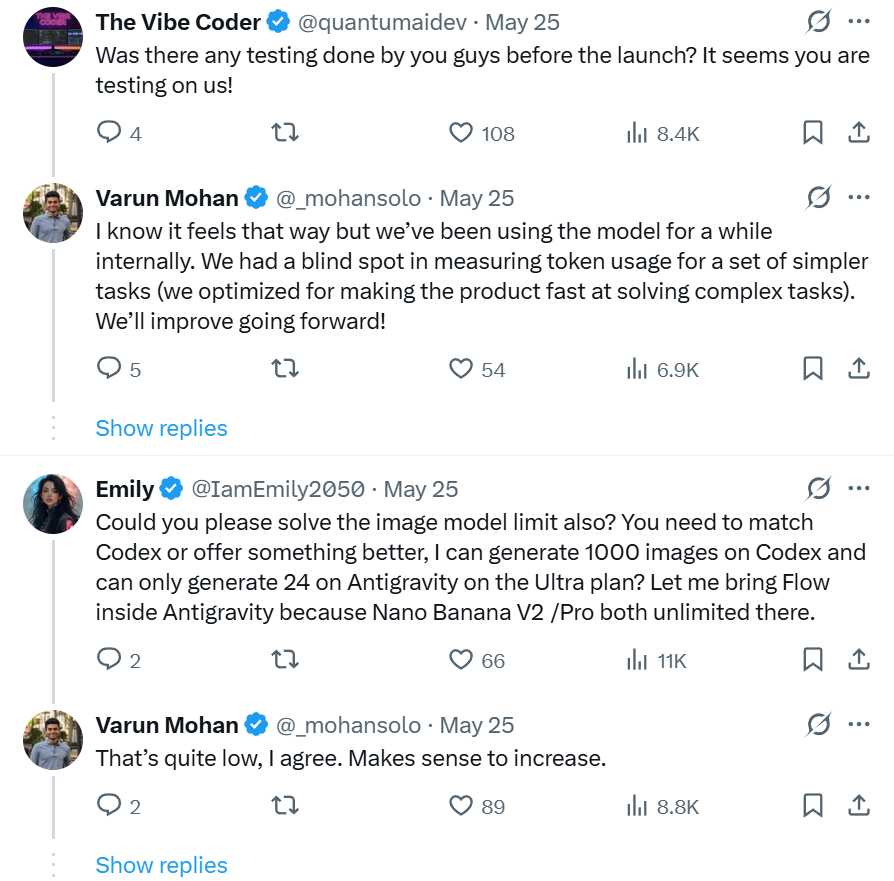
💡A cautionary tale on AI model integration and the importance of user feedback over internal benchmarks.
⚡ 30-Second TL;DR
What Changed
User dissatisfaction with Gemini 3.5 performance
Why It Matters
This backlash highlights the risks of aggressive AI deployment in consumer-facing products without sufficient quality control.
What To Do Next
Test your own RAG pipeline outputs against the latest Gemini API updates to ensure consistent performance before production deployment.
Key Points
- •User dissatisfaction with Gemini 3.5 performance
- •Challenges of integrating new LLMs into existing product ecosystems
- •Discrepancy between internal benchmarks and real-world utility
🧠 Deep Insight
Web-grounded analysis with 31 cited sources.
🔑 Enhanced Key Takeaways
- •User dissatisfaction with Gemini 3.5 performance is exacerbated by changes to Google AI Pro plan usage limits, including a rolling five-hour quota and failed generations counting against limits, leading to accusations of a 'bait and switch'.
- •Gemini 3.5 Flash, despite being a 'Flash' tier model optimized for speed and cost, reportedly outperforms the previous flagship Gemini 3.1 Pro on several agentic and coding benchmarks (e.g., Terminal-Bench 2.1, MCP Atlas, Finance Agent v2) while offering faster output and lower cost.
- •Google is strategically positioning Gemini 3.5 Flash as a core component for agentic workflows, integrating it with new platforms like Antigravity and Managed Agents in the Gemini API, and powering a new personal AI agent called Gemini Spark.
- •The pricing of Gemini 3.5 Flash represents a significant increase over its predecessors in the Flash family (3x the price of 3 Flash Preview and 6x the price of 3.1 Flash-Lite), which, alongside the usage limit changes, contributed to user frustration.
- •Google Search is undergoing its 'biggest' revamp in 25 years with Gemini 3.5 Flash integration, enabling 'AI Mode' in Search globally and moving towards generative UI and always-on information agents.
📊 Competitor Analysis▸ Show
| Feature/Aspect | Google Gemini 3.5 Flash (May 2026) | OpenAI ChatGPT (GPT-5.4 Pro/GPT-5.5) (May 2026) | Anthropic Claude Opus 4.7 (May 2026) |
|---|---|---|---|
| Primary Focus | Agentic execution, coding, multimodal reasoning, speed, cost efficiency. | All-domain dominance, broad feature set, third-party integrations, image generation (DALL-E 3), agentic coding (Codex). | Reasoning quality, safety, writing, coding, analysis, long documents. |
| Context Window | 1,048,576 input tokens; 65,536 output tokens. | 256,000 tokens (GPT-5.5). | 200,000 tokens (standard), 1M in beta. |
| Speed (Output) | ~4x faster than comparable frontier models (e.g., 284 tokens/sec vs. 109 t/s for 3.1 Pro). | Varies by model, but generally strong. | Varies by model. |
| Pricing (per 1M tokens) | Input: $1.50, Output: $9.00. | Plus at $20/month, Pro at $200/month (for ChatGPT). GPT-5.5 is 2x price of GPT-5.4. | Opus 4.7 is ~1.46x price of 4.6. |
| Key Benchmarks (Selected) | Leads on MCP Atlas (83.6%), Toolathlon (56.5%), Finance Agent v2 (57.9%), CharXiv Reasoning (84.2%), MMMU-Pro (83.6%), Terminal-Bench 2.1 (76.2%). | GPT-5.4 Pro leads across advanced reasoning, high-quality code generation, multimodal understanding. SWE-bench Pro (57.7% for GPT-5.4). | SWE-bench Pro (64.3%), OSWorld-Verified (78.0%). Humanity's Last Exam (46.9%). |
| Ecosystem Integration | Deep integration with Google Workspace, Search, Android, Google Cloud (Antigravity, Managed Agents). | Broad third-party plugin and tool support, Microsoft Copilot integration. | Strong in enterprise and professional use, regulated industries. |
| User Perception | Mixed: praised for performance, but backlash over pricing changes and usage limits. | Dominant player, 800M weekly active users. | Strong position in enterprise, valued for reasoning quality and safety. |
🛠️ Technical Deep Dive
- Multimodal Core: Gemini 3.5 Flash is built on a multimodal foundation, allowing it to reason across text, structured data, images, and long documents in a single pass.
- Long-Context Window: The model supports a substantial context window of 1,048,576 input tokens (approximately 750,000 words) and can generate up to 65,536 output tokens per request.
- Agentic Architecture: Designed for multi-step, long-horizon tasks, it can plan, call tools, and iterate across complex workflows while maintaining context and coherence.
- Antigravity Harness Integration: The model is specifically designed to run within Google's Antigravity agent harness, which facilitates the deployment of multiple subagents in parallel for complex tasks.
- Speed and Efficiency: Gemini 3.5 Flash delivers approximately four times faster output than comparable frontier models, achieved through architectural efficiency and training innovations. It also features configurable 'thinking levels' to balance quality, cost, and latency.
- Richer Multimodal Output: Beyond text, the model can generate interactive web user interfaces and graphics, extending its multimodal capabilities.
- Knowledge Cut-off: The model's knowledge cut-off date is January 2025.
🔮 Future ImplicationsAI analysis grounded in cited sources
⏳ Timeline
📎 Sources (31)
Factual claims are grounded in the sources below. Forward-looking analysis is AI-generated interpretation.
- business-standard.com
- livemint.com
- thesouthindiatimes.com
- techshotsapp.com
- digitalapplied.com
- aimlapi.com
- mindstudio.ai
- datacamp.com
- medium.com
- nxcode.io
- buildfastwithai.com
- siliconrepublic.com
- google.dev
- google.com
- labellerr.com
- datacamp.com
- youtube.com
- margrop.net
- pulse2.com
- juheapi.com
- simonwillison.net
- reddit.com
- vellum.ai
- newsdata.io
- venturemagazine.net
- emergent.sh
- deepmind.google
- issarice.com
- wikipedia.org
- itta.net
- evolvagency.io
Weekly AI Recap
Read this week's curated digest of top AI events →
👉Related Updates



AI-curated news aggregator. All content rights belong to original publishers.
Original source: 钛媒体 ↗