Google's AI glasses strategy faces stiff competition
💡Google's late entry into AI glasses: why it struggles against Meta and what it means for the wearable AI market.
⚡ 30-Second TL;DR
What Changed
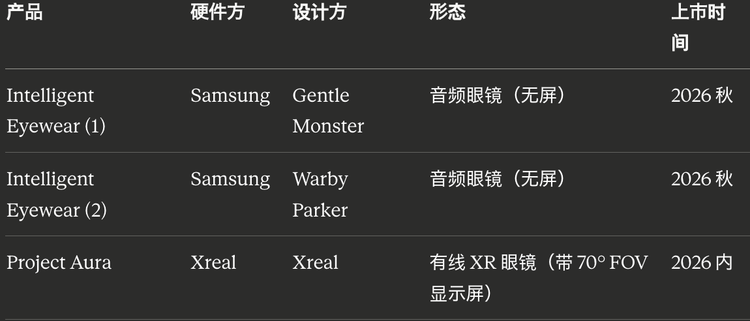
Google announced three Android XR glasses, focusing on AI-powered features like real-time translation and navigation.
Why It Matters
Google's entry into the AI eyewear market highlights the commoditization of basic AI features, forcing companies to compete on ecosystem lock-in and fashion branding rather than just technical capability.
What To Do Next
Analyze the Gemini API's multimodal capabilities to determine if your application can offer better context-aware features than current generic AI glasses.
Key Points
- •Google announced three Android XR glasses, focusing on AI-powered features like real-time translation and navigation.
- •The product lacks hardware or software differentiation against established competitors like Meta Ray-Ban.
- •Strategic partnerships with fashion brands aim to position the device as a lifestyle accessory.
- •The device lacks deep integration with Google's own Pixel hardware, opting for a cross-platform approach.
🧠 Deep Insight
Web-grounded analysis with 28 cited sources.
🔑 Enhanced Key Takeaways
- •Google's new AI glasses, built on the Android XR platform developed with Samsung and Qualcomm, are slated for release in Fall 2026, with initial models focusing on audio-only experiences before introducing integrated displays.
- •The glasses are designed as companion devices, offloading most processing to a connected smartphone (via Bluetooth and Wi-Fi) to maintain a lightweight form factor and extend battery life.
- •Unlike some competitors, Google's Android XR glasses will support both Android and iOS devices, aiming for a broader consumer base.
- •The Gemini AI assistant is deeply embedded, enabling multi-step tasks, real-time translation (speech and text), navigation, and interaction with third-party apps like DoorDash and Uber through voice commands.
- •Google's strategy for Android XR involves a unified platform supporting multiple hardware partners across various price points, with Gemini integrated into every tier, including Samsung's Galaxy XR headset and XREAL's Project Aura.
📊 Competitor Analysis▸ Show
|
| Feature | Google Android XR AI Glasses (Gentle Monster/Warby Parker) | Meta Ray-Ban (Gen 2) | Meta Ray-Ban Display |
|---|---|---|---|
| Release Date | Fall 2026 (Audio-only first, display later) | September 2025 | September 2025 |
| Pricing | Not disclosed | $379 | $799 |
| Display | Audio-only initially; subtle in-lens display planned later | No dedicated display | Dedicated display |
| Camera | Built-in camera (details scarce, LED indicator for privacy) | 12MP camera, 1080p video | (Integrated with display features) |
| Audio | Built-in speakers, voice assistance | Open-ear speakers, improved bass, directional audio | (Integrated with display features) |
| AI Assistant | Google Gemini | Meta AI (LLAMA 4 AI model integration) | Meta AI (LLAMA 4 AI model integration) |
| Key Features | Real-time translation, navigation, hands-free messaging, photo capture, multi-step tasks via Gemini, works with Android/iOS | Photo/video capture, livestreaming, calls/texts, music playback, water-resistant | AR capabilities, Neural Band for gesture control, calls/texts, music playback |
| Battery Life | At least 0.37 Wh (promo renders), relies on phone for processing | 4-12 hours depending on use (Gen 2) | (Not specified, but likely similar to Gen 2) |
| Compatibility | Android and iOS | Android and iOS | Android and iOS |
🛠️ Technical Deep Dive
- Operating System: Android XR, a purpose-built spatial computing platform based on Android, developed in collaboration with Samsung and Qualcomm. It leverages ARCore for environmental understanding, light estimation, and motion tracking, and the Geospatial API for location-based AR experiences.
- AI Integration: Deep integration with Google's Gemini AI assistant, which can understand and act on spoken commands and visual context. It supports natural conversations, multi-step tasks (e.g., ordering coffee via DoorDash), real-time speech and text translation, and navigation. Users activate Gemini by saying "Hey Google" or tapping the frame.
- Hardware Architecture: The initial launch includes audio-only glasses with built-in speakers, microphones, and a camera. Future versions will incorporate subtle in-lens displays for contextual visual information. The glasses are designed to be lightweight, relying on a connected smartphone for most heavy processing and cloud services to conserve battery and reduce on-device bulk.
- Input Methods: Primarily voice commands via integrated microphones, supplemented by a touch-sensitive surface on the side of the frame for controls like volume and AI activation.
- Battery: Promo renders suggest a battery capacity of at least 0.37 Wh.
- Developer Support: Android XR SDK Developer Preview is available, supporting familiar Android development tools (Kotlin/Java, Android Studio, Jetpack XR SDK) as well as Unity, OpenXR, and WebXR.
🔮 Future ImplicationsAI analysis grounded in cited sources
⏳ Timeline
📎 Sources (28)
Factual claims are grounded in the sources below. Forward-looking analysis is AI-generated interpretation.
- notebookcheck.net
- popsci.com
- lifehacker.com
- parametric-architecture.com
- wikipedia.org
- blog.google
- qz.com
- benzinga.com
- engadget.com
- siliconangle.com
- mobiledevmemo.com
- cnet.com
- techradar.com
- pcmag.com
- pcmag.com
- android.com
- blog.google
- pcmag.com
- moorinsightsstrategy.com
- ray-ban.com
- google.dev
- pcworld.com
- t3.com
- android.com
- lucidrealitylabs.com
- infosys.com
- youtube.com
- framesixty.com
Weekly AI Recap
Read this week's curated digest of top AI events →
👉Related Updates




AI-curated news aggregator. All content rights belong to original publishers.
Original source: 虎嗅 ↗