โš›๏ธStalecollected in 4m

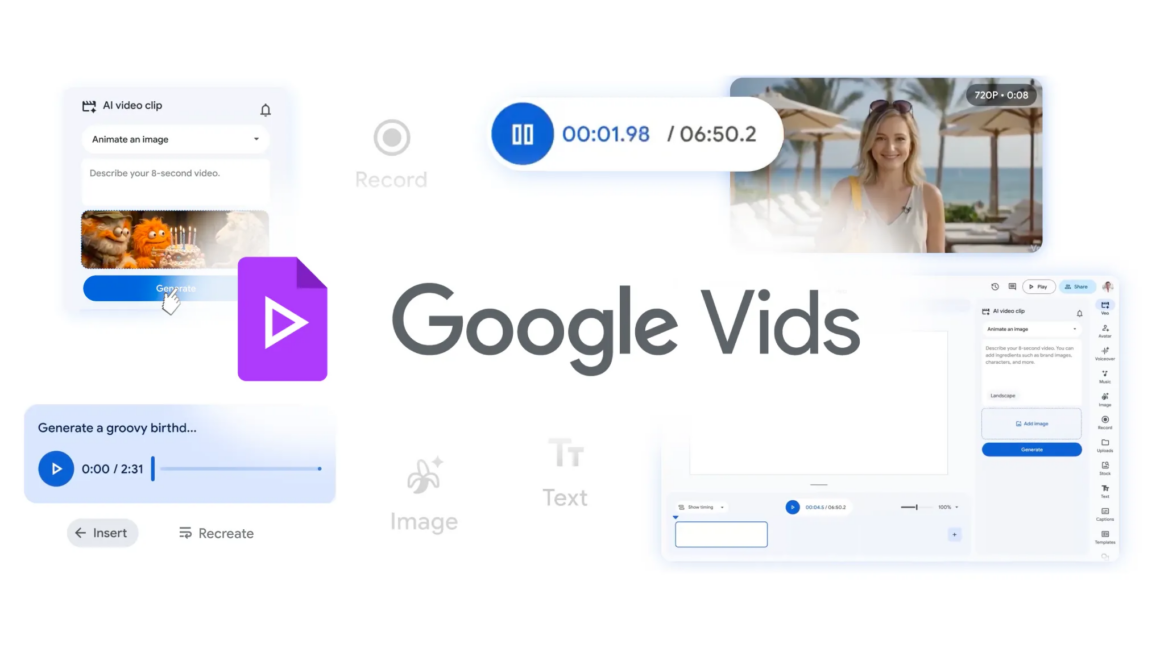
Google Vids AI Upgrade: Veo, Lyria, Avatars
Google Vids AI Upgrade: Veo, Lyria, Avatars
PostLinkedIn
โš›๏ธRead original on Ars Technica AI

๐Ÿ’กGoogle Vids now packs Veo video + Lyria audio + controllable avatars for pro content.

โšก 30-Second TL;DR

What Changed

Integrates Veo model for advanced video generation

Why It Matters

Enhances Google Workspace for enterprise video production, lowering barriers for AI-driven content creation. May boost adoption among creators and teams needing quick, high-quality videos.

What To Do Next

Test Google Vids in Workspace to generate videos using Veo and direct AI avatars.

Who should care:Creators & Designers

Key Points

  • โ€ขIntegrates Veo model for advanced video generation
  • โ€ขAdds Lyria model for music and audio synthesis
  • โ€ขIntroduces directable AI avatars for controlled virtual presenters
  • โ€ขCombines Google's leading AI creation tools in one app

๐Ÿง  Deep Insight

AI-generated analysis for this event.

๐Ÿ”‘ Enhanced Key Takeaways

  • โ€ขThe integration leverages Google's 'Project Astra' multimodal architecture, allowing for real-time synchronization between the Veo-generated visuals and Lyria-synthesized audio tracks.
  • โ€ขGoogle Vids now supports enterprise-grade 'Brand Voice' and 'Brand Visual' fine-tuning, enabling organizations to upload proprietary assets to constrain AI outputs to specific corporate style guides.
  • โ€ขThe new avatar system utilizes a proprietary 'Neural Lip-Sync' engine that reduces latency in video generation, enabling near-instant previewing of directable presenter movements.
๐Ÿ“Š Competitor Analysisโ–ธ Show
FeatureGoogle Vids (with Veo/Lyria)OpenAI Sora/Sora-integrated toolsAdobe Firefly/Premiere Pro
Primary FocusEnterprise/Workplace ProductivityCreative/Cinematic GenerationProfessional Editing/Workflow
PricingGoogle Workspace Add-onUsage-based/EnterpriseCreative Cloud Subscription
Key BenchmarkHigh integration with Docs/DriveHigh visual fidelity/physicsHigh industry-standard control

๐Ÿ› ๏ธ Technical Deep Dive

  • โ€ขVeo utilizes a latent diffusion model architecture optimized for 1080p resolution with temporal consistency across long-form sequences.
  • โ€ขLyria employs a transformer-based architecture capable of generating high-fidelity audio at 48kHz, supporting multi-track layering for background music and voice-over.
  • โ€ขThe avatar system uses a 3D-mesh-based facial animation layer that maps text-to-speech phonemes to blend shapes, ensuring lip-sync accuracy across multiple languages.
  • โ€ขThe platform utilizes Google's TPU v5p infrastructure to handle the parallel processing requirements of real-time video rendering and audio synthesis.

๐Ÿ”ฎ Future ImplicationsAI analysis grounded in cited sources

Google Vids will replace traditional slide-based presentation software in enterprise environments by 2027.
The shift toward generative video-first communication reduces the time-to-production for internal updates compared to static slide decks.
The platform will introduce real-time collaborative editing for AI-generated video assets.
Google's existing infrastructure for collaborative document editing is being extended to the video timeline to allow multiple users to refine AI prompts simultaneously.

โณ Timeline

2024-04
Google announces Google Vids as an AI-powered video creation app for work.
2024-05
Google unveils the Veo video generation model at Google I/O.
2025-02
Google expands Lyria's capabilities for enterprise audio synthesis.
2026-04
Google Vids integrates Veo, Lyria, and AI avatars into a unified production suite.
๐Ÿ“ฐ

Weekly AI Recap

Read this week's curated digest of top AI events โ†’

๐Ÿ‘‰Related Updates

AI-curated news aggregator. All content rights belong to original publishers.
Original source: Ars Technica AI โ†—