Google tests Planning Mode for NotebookLM Video Overviews
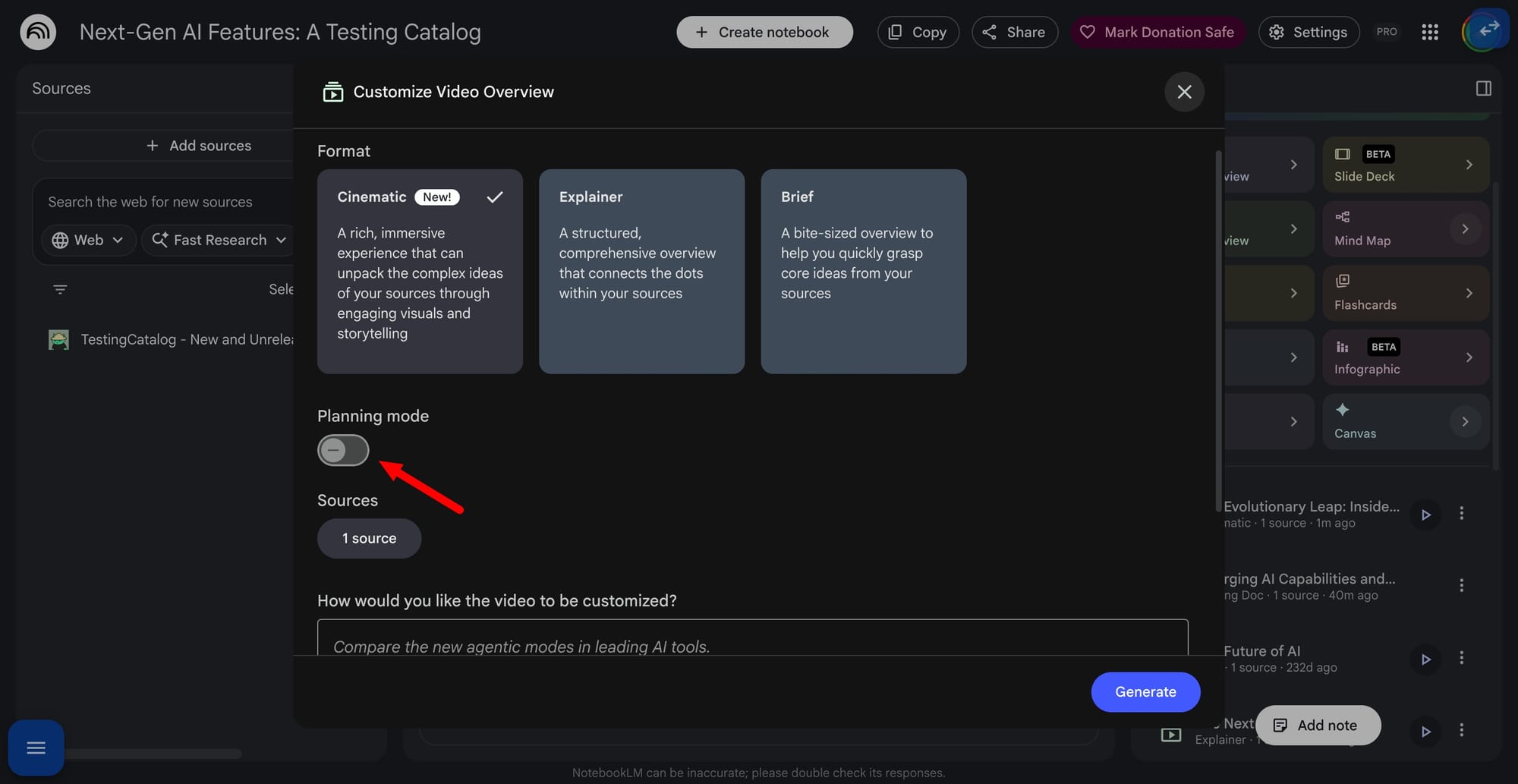
💡Learn how Google is adding human oversight to AI video generation to improve accuracy and control.
⚡ 30-Second TL;DR
What Changed
Introduces a human-in-the-loop step for AI-generated video content.
Why It Matters
This feature reduces hallucinations and formatting errors in automated video generation by giving creators editorial oversight. It signals a shift toward more controlled, agentic workflows in AI content creation tools.
What To Do Next
If you are building AI content tools, implement a 'plan-then-execute' UI pattern to improve user trust and output quality.
Key Points
- •Introduces a human-in-the-loop step for AI-generated video content.
- •Users can approve or modify the draft plan before final rendering.
- •Enhances control over the narrative structure of NotebookLM video summaries.
- •Leverages Gemini models to bridge the gap between document analysis and video production.
🧠 Deep Insight
Background and context from public sources — not the original article. 18 sources cited.
🔑 Enhanced Key Takeaways
- •NotebookLM's Video Overviews currently leverage a combination of Google's Gemini for content scripting, Imagen for visual generation, and Veo for animating the final output.
- •The introduction of 'Planning Mode' aligns with Google's strategic initiative to integrate advanced multimodal AI models, potentially transitioning to Gemini Omni as its default video engine for an 'editing-first design'.
- •NotebookLM supports a broad range of source types, including Google Docs, PDFs, web URLs, YouTube videos, and audio files, with the capacity to process up to 50 sources per notebook and 500,000 words per source.
- •Since its initial experimental launch as 'Project Tailwind' in May 2023, NotebookLM has significantly expanded its feature set to include Audio Overviews, Mind Maps, Infographics, and Slide Decks.
- •NotebookLM is available as a core service for Google Workspace business customers and is included in all Google Workspace for Education editions, ensuring enterprise-grade data protection where user data is not used for model training.
🛠️ Technical Deep Dive
- NotebookLM currently operates on Gemini 3 models as of March 2026.
- For Cinematic Video Overviews, the system integrates Gemini for understanding and scripting, Imagen for generating visuals, and Veo for animation.
- The 'Planning Mode' suggests a potential shift towards utilizing Gemini Omni, Google's multimodal model introduced at I/O 2026, which is designed as a default video engine supporting an 'editing-first' approach.
- The platform employs a Retrieval-Augmented Generation (RAG) approach, grounding AI responses in user-provided documents to minimize hallucinations and provide verifiable citations.
- It offers a substantial context window, capable of processing up to one million tokens or 500,000 words per source.
- For educational applications, Gemini and NotebookLM utilize Gemini 2.5 Pro, which incorporates LearnLM, a specialized family of models fine-tuned for learning.
- Features like Infographics and Slide Decks are powered by Google's Nano Banana Pro image-generation model.
🔮 Future ImplicationsAI analysis grounded in cited sources
⏳ Timeline
📎 Sources (18)
Factual claims are grounded in the sources below. Forward-looking analysis is AI-generated interpretation.
Weekly AI Recap
Read this week's curated digest of top AI events →
👉Related Updates
AI-curated news aggregator. All content rights belong to original publishers.
Original source: TestingCatalog ↗
This is a summary, not the original. Read the source, or get the weekly briefing.
The weekly digest
One email a week. Unsubscribe anytime.