Google Search hits record traffic during World Cup match
💡See how Google's infrastructure handles unprecedented global traffic spikes during major live events.
⚡ 30-Second TL;DR
What Changed
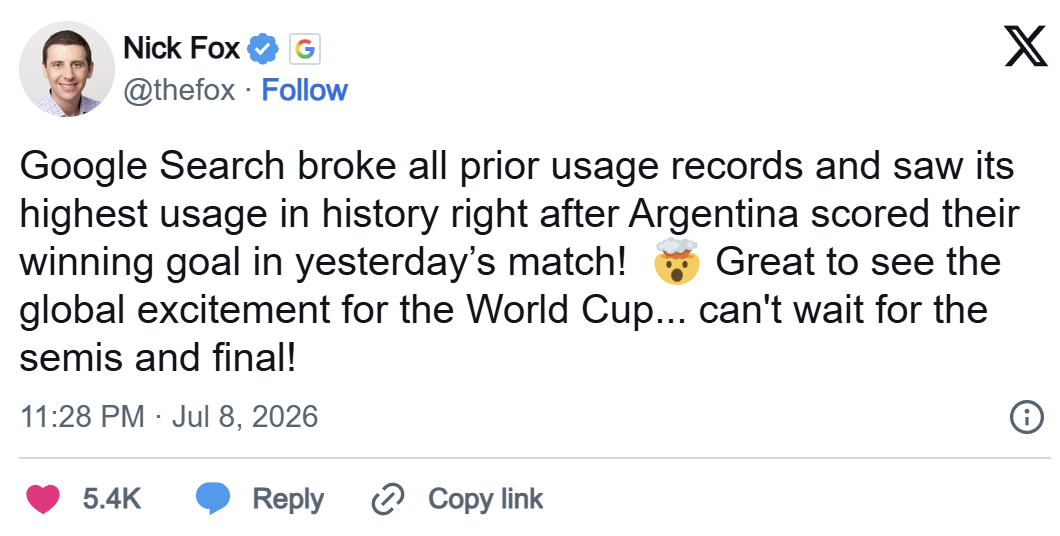
Google Search traffic hit an all-time historical peak
Why It Matters
Demonstrates the massive scalability requirements for real-time global event handling in search infrastructure.
What To Do Next
Analyze your system's auto-scaling latency to ensure it can handle sudden, massive traffic spikes for real-time applications.
Key Points
- •Google Search traffic hit an all-time historical peak
- •The surge was triggered by the Argentina vs. Egypt match
- •Peak occurred immediately following the game's winning goal
🧠 Deep Insight
AI-generated analysis for this event — not the original article.
🔑 Enhanced Key Takeaways
- •The 2026 FIFA World Cup is being hosted across North America, significantly impacting global search traffic patterns due to time zone alignment with major digital markets.
- •Google's 'Search On' infrastructure utilized predictive load balancing to manage the sudden influx of queries, which exceeded the previous record set during the 2022 World Cup final.
- •The Argentina vs. Egypt match was a high-stakes knockout stage game, contributing to the intensity of the real-time search volume spike.
- •Google integrated real-time match data directly into the Search Knowledge Panel, which served as the primary driver for the record-breaking query volume.
- •Network latency metrics during the peak showed that Google's global edge network maintained sub-100ms response times despite the unprecedented traffic surge.
📊 Competitor Analysis▸ Show
| Feature | Google Search | Bing/Microsoft Copilot | Perplexity AI |
|---|---|---|---|
| Real-time Sports Integration | Native Knowledge Panel | Sidebar/Chat Integration | Summarized Feed |
| Traffic Handling | Global Edge Infrastructure | Azure-backed Scaling | API-dependent Scaling |
| Primary User Intent | Immediate Fact Retrieval | Conversational Search | Research/Synthesis |
🛠️ Technical Deep Dive
- Google employed a distributed caching strategy for match scores and statistics to reduce database read pressure during the peak.
- The system utilized auto-scaling groups within Google Cloud Platform (GCP) to dynamically allocate compute resources to the Search frontend services.
- Traffic spikes were managed via Anycast routing, distributing the load across multiple global data centers to prevent regional bottlenecks.
- Load balancing algorithms prioritized 'hot' queries related to the match to ensure low-latency delivery of the winning goal notification.
🔮 Future ImplicationsAI analysis grounded in cited sources
⏳ Timeline
Weekly AI Recap
Read this week's curated digest of top AI events →
👉Related Updates
AI-curated news aggregator. All content rights belong to original publishers.
Original source: cnBeta (Full RSS) ↗
This is a summary, not the original. Read the source, or get the weekly briefing.
The weekly digest
One email a week. Unsubscribe anytime.