Google Releases Open-Source Gemma 4 12B Multimodal Model
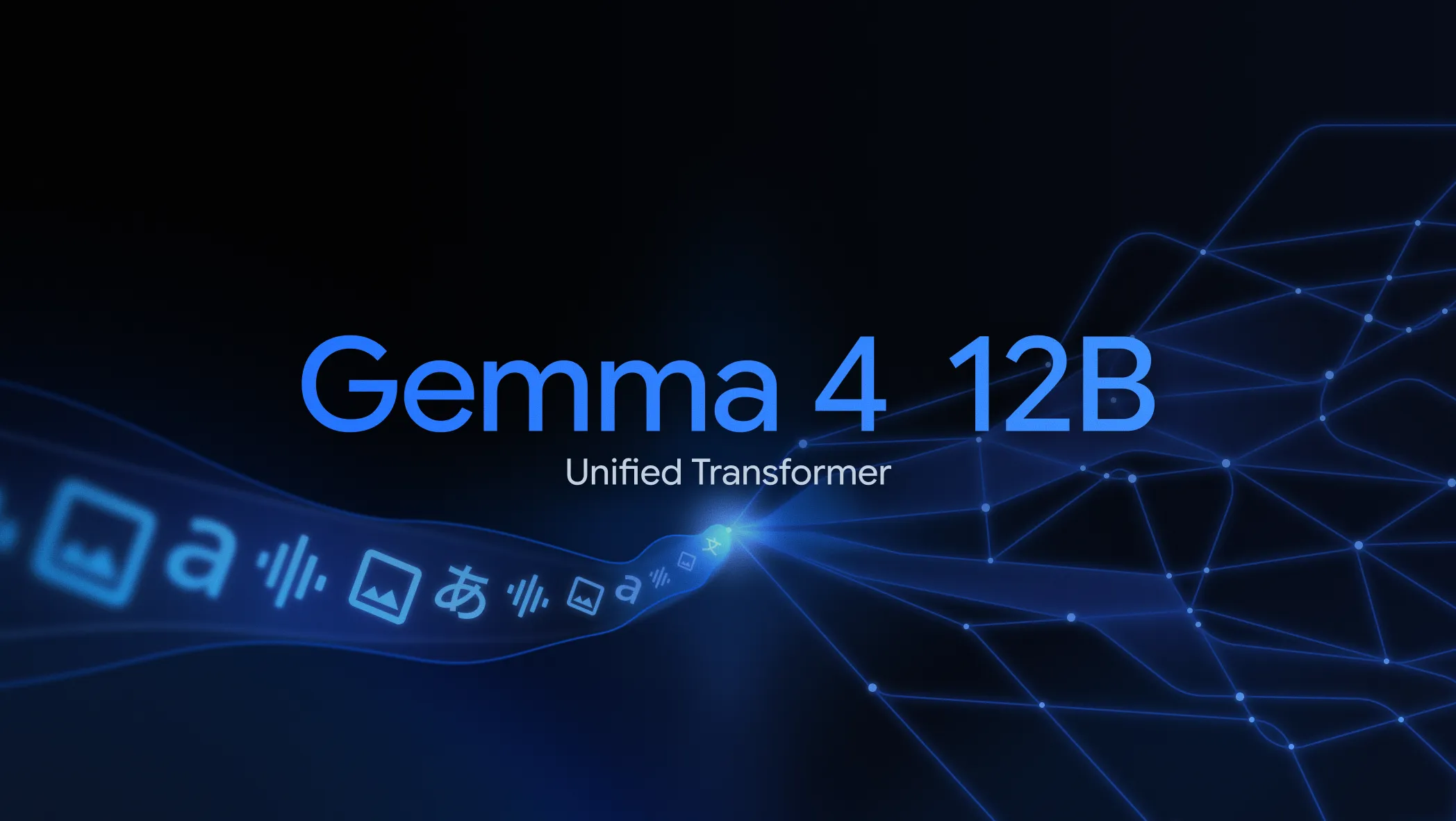
💡Run high-performance multimodal AI locally on 16GB RAM hardware with Google's new open-source 12B model.
⚡ 30-Second TL;DR
What Changed
12B parameter count optimized for local execution
Why It Matters
This release significantly lowers the barrier for developers to deploy high-performance multimodal AI on edge devices without relying on cloud APIs.
What To Do Next
Download the Gemma 4 12B weights and test its multimodal inference speed on your local machine to evaluate its suitability for your edge applications.
Key Points
- •12B parameter count optimized for local execution
- •Requires only 16GB of RAM/VRAM for inference
- •Performance matches previous 26B model iterations
- •Fully open-source for developer accessibility
🧠 Deep Insight
Background and context from public sources — not the original article. 11 sources cited.
🔑 Enhanced Key Takeaways
- •Gemma 4 12B features a novel unified, encoder-free architecture that integrates raw audio waveforms and visual patches directly into the large language model (LLM) backbone, significantly reducing multimodal latency and memory overhead compared to traditional models with separate encoders.
- •It is the first medium-sized model in the Gemma family to natively ingest audio inputs, enabling capabilities such as automatic speech recognition, diarization, and video understanding directly on consumer hardware.
- •The model is released under a permissive Apache 2.0 license, explicitly allowing unrestricted commercial use, modification, and distribution, which is a key factor for enterprise adoption and integration into proprietary products.
- •Gemma 4 12B supports a substantial 256K token context window, enabling it to process extensive documents, large code repositories, or lengthy meeting transcripts for advanced reasoning and agentic workflows.
- •It includes native agentic tool-use capabilities and an explicit 'thinking' mode, allowing the model to map out step-by-step reasoning before generating a response, enhancing its utility for complex tasks.
🛠️ Technical Deep Dive
- Architecture: Decoder-only transformer with a unified, encoder-free design. It utilizes the same advanced decoder structure as the Gemma 4 31B Dense model.
- Multimodal Input Processing:
- Vision: Replaces traditional vision encoders with a lightweight 35-million-parameter embedding module. Raw 48x48 pixel patches are projected to the LLM hidden dimension via a single matrix multiplication, with factorized coordinate lookup for spatial information.
- Audio: Eliminates separate audio encoders. Raw 16 kHz audio signals are sliced into 40ms frames and linearly projected directly into the LLM input space.
- Parameter Count: 11.95 billion parameters.
- Memory Requirement: Optimized to run locally on consumer hardware with 16GB of VRAM or unified memory.
- Context Window: Supports a 256K token context window.
- Fine-tuning: The unified architecture allows vision, audio, and text inputs to share the same weights, enabling single-pass fine-tuning for the entire multimodal token loop.
- Performance Enhancements: Includes Multi-Token Prediction (MTP) drafters to further reduce latency.
- Capabilities: Offers automatic speech recognition, agentic reasoning, diarization, video understanding, coding, and a built-in step-by-step reasoning mode.
- Deployment: Available for download on Hugging Face and Kaggle, and supported by tools like llama.cpp, Ollama, LM Studio, MLX, SGLang, vLLM, and Unsloth. Google also released macOS desktop applications for local interaction.
🔮 Future ImplicationsAI analysis grounded in cited sources
⏳ Timeline
📎 Sources (11)
Factual claims are grounded in the sources below. Forward-looking analysis is AI-generated interpretation.
Weekly AI Recap
Read this week's curated digest of top AI events →
👉Related Updates
AI-curated news aggregator. All content rights belong to original publishers.
Original source: cnBeta (Full RSS) ↗
This is a summary, not the original. Read the source, or get the weekly briefing.
The weekly digest
One email a week. Unsubscribe anytime.