Google plans to release 64 million lab-bred mosquitoes
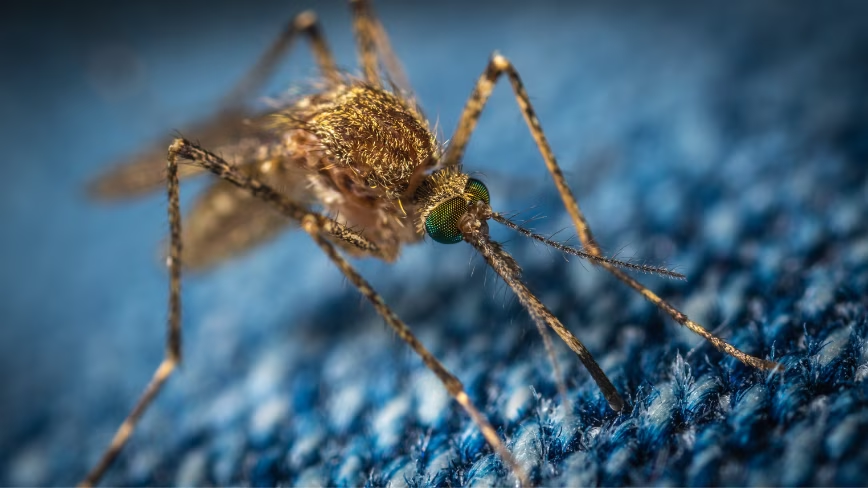
💡See how Alphabet's Verily applies large-scale data modeling to biological population control.
⚡ 30-Second TL;DR
What Changed
Verily submitted a proposal to the EPA for a two-year release program.
Why It Matters
This represents a significant application of biological data modeling and precision intervention. It highlights how tech giants are expanding into bio-engineering and public health infrastructure.
What To Do Next
Research how Verily uses predictive modeling for population control to apply similar simulation techniques to your own data-driven projects.
Key Points
- •Verily submitted a proposal to the EPA for a two-year release program.
- •The project targets Aedes aegypti mosquitoes carrying Wolbachia bacteria.
- •The initiative aims to curb the spread of dengue and Zika viruses.
- •The release is planned across specific regions in Florida and California.
🧠 Deep Insight
Background and context from public sources — not the original article. 19 sources cited.
🔑 Enhanced Key Takeaways
- •The proposed two-year program involves releasing up to 64 million mosquitoes, specifically 16 million per state (Florida and California) per year.
- •In addition to combating dengue and Zika viruses by targeting Aedes aegypti, the project also aims to reduce Culex mosquito populations, which are known vectors for West Nile virus and St. Louis encephalitis.
- •Previous Debug trials have demonstrated significant efficacy, with reductions in biting female Aedes aegypti populations reaching over 95% in Fresno, California (2018), and similar Wolbachia-based programs in Singapore achieving 80-90% suppression of Aedes aegypti and over 70% reduction in dengue cases.
- •Verily's methodology leverages advanced technology, including AI-powered computer vision for precise sex-sorting of mosquitoes, automated breeding systems for industrial-scale production, and specialized release platforms such as drones and ground-based dispensers.
- •The U.S. Environmental Protection Agency (EPA) is currently reviewing Verily's application for an experimental use permit, with a public comment period open through early June 2026 before a decision is made.
📊 Competitor Analysis▸ Show
| Feature/Aspect | Verily (Debug) | Oxitec | World Mosquito Program (WMP) |
|---|---|---|---|
| Core Technology | Wolbachia-infected male mosquitoes (IIT) | Genetically modified male mosquitoes (RIDL) | Wolbachia-infected mosquitoes (Population Replacement) |
| Mechanism | Male Wolbachia mosquitoes mate with wild females; eggs do not hatch (population suppression). | Genetically modified males produce female offspring that die before maturity (population suppression). | Releases both male and female Wolbachia mosquitoes to establish Wolbachia in wild population, blocking virus transmission. |
| Mosquitoes Released | Males only (do not bite). | Males only (do not bite). | Both males and females. |
| Genetic Modification | No (uses naturally occurring bacteria). | Yes (genetically engineered). | No (uses naturally occurring bacteria). |
| Targeted Diseases | Dengue, Zika, Chikungunya, Yellow Fever (via Aedes aegypti); West Nile, St. Louis encephalitis (via Culex). | Dengue, Zika, Chikungunya (via Aedes aegypti). | Dengue, Zika, Chikungunya, Yellow Fever. |
| Scalability | High, leveraging AI, robotics, automation. | Demonstrated large-scale releases. | Demonstrated large-scale deployment in cities. |
| Environmental Impact | Self-limiting, species-specific, no permanent genetic changes or synthetic chemicals. | Self-limiting, species-specific, leaves no environmental footprint. | Natural, self-sustaining, safe for people, mosquitoes, and environment. |
🛠️ Technical Deep Dive
- Mechanism of Action: Verily's method, known as Incompatible Insect Technique (IIT), involves releasing male Aedes aegypti or Culex mosquitoes infected with the Wolbachia pipientis wAlbB bacterium. When these Wolbachia-carrying males mate with wild females that do not carry the same Wolbachia strain, the resulting eggs fail to hatch due to cytoplasmic incompatibility, leading to a reduction in the wild mosquito population.
- Species Specificity: The Wolbachia-based suppression strategy is species-specific, meaning it only impacts the targeted mosquito species (Aedes aegypti or Culex quinquefasciatus) and does not affect other insect populations.
- Automated Rearing and Sex-Sorting: Verily has developed automated systems for mass-rearing mosquitoes. This includes robotic storage and retrieval systems for larval rearing, where batches of larvae are fed a proprietary diet. After a week, pupae are sieved, and adult mosquitoes undergo precise sex-sorting using AI-powered computer vision to ensure only non-biting males are released.
- Release Platforms: Specialized platforms, including drones and ground-based dispensers, are used for distributing the lab-bred male mosquitoes across target areas at optimal densities and timing.
- No Genetic Modification: The Wolbachia bacteria are naturally occurring, and the mosquitoes used in Verily's Debug program are not genetically modified organisms.
🔮 Future ImplicationsAI analysis grounded in cited sources
⏳ Timeline
📎 Sources (19)
Factual claims are grounded in the sources below. Forward-looking analysis is AI-generated interpretation.
Weekly AI Recap
Read this week's curated digest of top AI events →
👉Related Updates


AI-curated news aggregator. All content rights belong to original publishers.
Original source: The Next Web (TNW) ↗
This is a summary, not the original. Read the source, or get the weekly briefing.
The weekly digest
One email a week. Unsubscribe anytime.