Google, Nvidia and Anthropic leaders share AI student advice
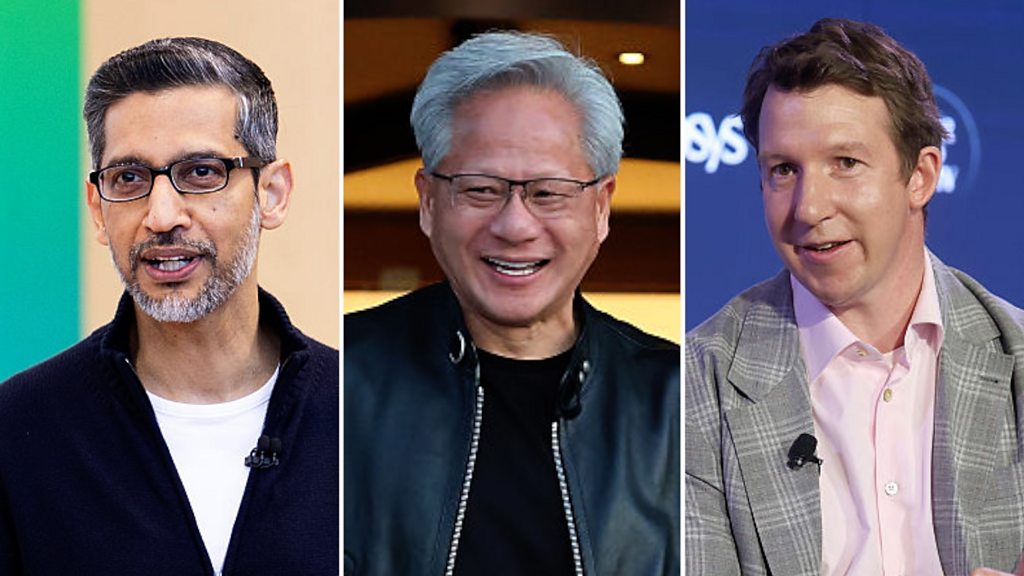
💡Get career-defining advice from the CEOs of Google, Nvidia, and Anthropic on how to stay relevant in the AI era.
⚡ 30-Second TL;DR
What Changed
Sundar Pichai emphasizes the importance of adaptability and continuous learning in an AI-driven world.
Why It Matters
These insights help shape the educational focus for future AI developers, emphasizing foundational skills over rote memorization. It signals a shift in industry expectations for entry-level talent.
What To Do Next
Review your current learning path to ensure you are focusing on fundamental computer science principles rather than just specific framework syntax.
Key Points
- •Sundar Pichai emphasizes the importance of adaptability and continuous learning in an AI-driven world.
- •Jensen Huang highlights the shift toward AI-native problem solving and computational thinking.
- •Jack Clark discusses the necessity of understanding both the capabilities and ethical implications of AI models.
🧠 Deep Insight
Background and context from public sources — not the original article. 34 sources cited.
🔑 Enhanced Key Takeaways
- •Sundar Pichai, CEO of Google, acknowledges the widespread anxiety among students regarding AI's impact on jobs but expresses confidence that the next generation will adapt, innovate, and create new opportunities, emphasizing the tech industry's responsibility to demonstrate AI's benefits and ensure safe, responsible scaling.
- •Jensen Huang's emphasis on computational thinking is further defined as a problem-solving process involving decomposition, pattern recognition, algorithm design, testing, and generalization, which is crucial for students to understand how AI models function and to effectively structure problems for AI to solve.
- •Jack Clark's focus on ethical implications aligns with Anthropic's core mission to build interpretable, steerable, and aligned AI systems, evidenced by their Responsible Scaling Policy (RSP) and the Anthropic Fellows program dedicated to AI safety research.
- •Google has committed $1 billion over three years to its 'AI for Education Accelerator' program, providing higher education institutions with AI literacy programs, research funding, cloud computing resources, free Google AI Pro plans, and Career Certificates to enhance student skills.
- •The demand for AI skills is rapidly intensifying, with a significant talent shortage, and employers increasingly seek not only technical expertise in areas like prompt engineering and machine learning but also 'human-intensive' skills such as critical thinking, adaptability, and ethical reasoning across all roles.
🛠️ Technical Deep Dive
- Computational Thinking: Involves breaking down complex problems, abstracting underlying rules, designing algorithms, testing solutions, and generalizing them, enabling users to create mental models of AI systems and iteratively refine AI-generated outputs.
- Anthropic's AI Safety Framework: Focuses on interpretability (understanding internal workings of LLMs), alignment (ensuring models are helpful, honest, and harmless), and societal impact, utilizing 'Constitutional AI' for value alignment and 'model organisms' for demonstrating potential misalignment.
- Google's Educational AI Tools: Includes access to Gemini 2.5 Pro LLM and the NotebookLM organization platform through its education initiatives. Google DeepMind's curriculum teaches fundamentals of language models, including n-gram and transformer models, data preparation (tokenization, embeddings), and neural network training.
- Nvidia's Developer Ecosystem: Offers the CUDA Toolkit, various SDKs, and training through the Deep Learning Institute (DLI) for accelerated computing, AI, deep learning, and data science, alongside certification programs for AI Infrastructure, Accelerated Data Science, Generative AI LLMs, and OpenUSD Development.
🔮 Future ImplicationsAI analysis grounded in cited sources
⏳ Timeline
📎 Sources (34)
Factual claims are grounded in the sources below. Forward-looking analysis is AI-generated interpretation.
- youtube.com
- financialexpress.com
- indiatoday.in
- forbes.com
- sdu.dk
- computationalthinking.org
- birlaopenminds.com
- codility.com
- anthropic.com
- sifars.com
- anthropic.com
- anthropic.com
- ailabwatch.org
- anthropic.com
- anthropic.com
- anthropic.com
- edvisorly.com
- uic.edu
- joinhgs.com
- dice.com
- medium.com
- thirst.io
- pwc.com
- anthropic.com
- skills.google
- nvidia.com
- nvidia.com
- nvidia.com
- nvidia.com
- nvidia.com
- nvidia.com
- youtube.com
- blog.google
- ai.google
Weekly AI Recap
Read this week's curated digest of top AI events →
👉Related Updates
AI-curated news aggregator. All content rights belong to original publishers.
Original source: BBC Technology ↗
This is a summary, not the original. Read the source, or get the weekly briefing.
Weekly AI briefing
One email a week. Unsubscribe anytime.