Google launches Gemini 3.5 Flash and AI agent ecosystem
Google's massive AI update: 900M users, aggressive pricing, and deep Android integration.
30-Second TL;DR
What Changed
Gemini 3.5 Flash features extreme knowledge distillation and a 256-expert MoE architecture for high efficiency.
Why It Matters
Google's vertical integration of AI into its massive user base creates a formidable moat, forcing competitors to rethink their reliance on cloud-only AI strategies.
What To Do Next
Evaluate Gemini 3.5 Flash for high-throughput, low-latency tasks to significantly reduce your inference costs.
Key Points
- •Gemini 3.5 Flash features extreme knowledge distillation and a 256-expert MoE architecture for high efficiency.
- •Omni model offers native end-to-end multi-modal alignment with 120ms latency.
- •Spark AI assistant gains deep system-level control over Android 17.
- •Google is aggressively pricing its AI services to undercut competitors and capture market share.
Deep Insight
Background and context from public sources — not the original article. 25 sources cited.
Enhanced Key Takeaways
- •Google introduced a new AI Ultra subscription tier at $100 per month, targeting developers and power users, which includes 5x higher usage limits than the Pro plan, Gemini 3.5 Flash integration, early access to Gemini Spark, faster workflows, 20TB of cloud storage, and YouTube Premium.
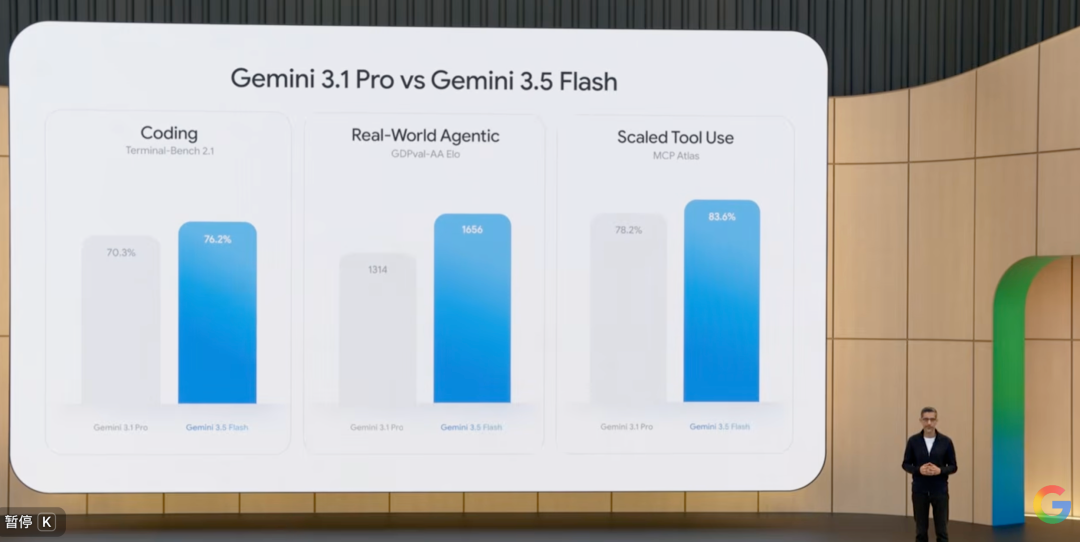
- •Gemini 3.5 Flash is now generally available and serves as the default model for AI Mode in Google Search and the Gemini app, outperforming Gemini 3.1 Pro on agentic and coding benchmarks while running approximately four times faster than other frontier models at less than half the cost.
- •Gemini Omni, Google's new multimodal model, is a significant step towards AGI, capable of generating and editing video content from various inputs (text, audio, image, video) with advanced physics and contextual understanding, and features like conversational editing and avatar creation.
- •Spark AI assistant is a 24/7 personal AI agent that operates on dedicated Google Cloud virtual machines, allowing it to perform long-running tasks even when user devices are closed, and integrates deeply with Google's ecosystem (Gmail, Docs, Drive) and third-party tools via MCP.
- •Google has overhauled its AI subscription pricing and usage limits, shifting from counting individual prompts to measuring compute used, and refreshing limits every five hours instead of daily, with automatic fallback to lighter models if a cap is reached.
Competitor Analysis
A Markdown table comparing this with competitors (Feature/Pricing/Benchmarks). Return null if not applicable (e.g. op-ed, interview, single-product announcement with no clear competitors).
Technical Deep Dive
- Gemini 3.5 Flash utilizes a 256-expert Mixture-of-Experts (MoE) architecture for high efficiency and is engineered using Google DeepMind's purpose-built AI infrastructure, allowing for faster and more efficient training of deeper reasoning capabilities.
- It supports a 1,048,576 input token context window and a 65,536 maximum output token limit, with a knowledge cutoff of January 2025.
- Gemini 3.5 Flash is designed for agentic workflows, coding tasks, and multi-week enterprise processes, accepting text, images, audio, and video files as input, with text as output.
- Gemini Omni achieves native end-to-end multimodal alignment, understanding temporal coherence and physical laws in video, and reduces latency to 120ms, significantly lower than the industry average of 400-600ms.
- Omni is built on the Gemini architecture and trained as multimodal from the ground up, capable of processing text, audio, images, and video simultaneously to generate interactive worlds and realistic video content with accurate physics.
- Spark AI assistant is powered by Gemini 3.5 and the Antigravity agent harness, running on dedicated Google Cloud virtual machines for continuous operation.
Future ImplicationsAI analysis grounded in cited sources
Timeline
- 2023-12Google announced Gemini, a family of multimodal LLMs, and integrated Gemini Pro into Bard (later rebranded as Gemini).
- 2024-02Bard chatbot was officially renamed Gemini, and Gemini 1.5 Pro was introduced in a limited preview with a 1-million-token context window.
- 2024-05Gemini 1.5 Flash, a faster and more cost-efficient variant, was announced at Google I/O.
- 2025-11Google announced the release of Gemini 3 Pro and 3 Deep Think, replacing previous versions.
- 2025-12Gemini 3 Flash was released, becoming the new default model in the Gemini app.
- 2026-05-19Google unveiled Gemini 3.5 Flash, Omni multi-modal model, and Spark AI assistant at I/O 2026.
Sources (25)
Factual claims are grounded in the sources below. Forward-looking analysis is AI-generated interpretation.
Weekly AI Recap
Read this week's curated digest of top AI events →
AI-curated news aggregator. All content rights belong to original publishers.
Original source: 虎嗅 ↗
This is a summary, not the original. Read the source, or get the weekly briefing.
The weekly digest
One email a week. Unsubscribe anytime.