Google Launches Nano Banana 2 for Gemini
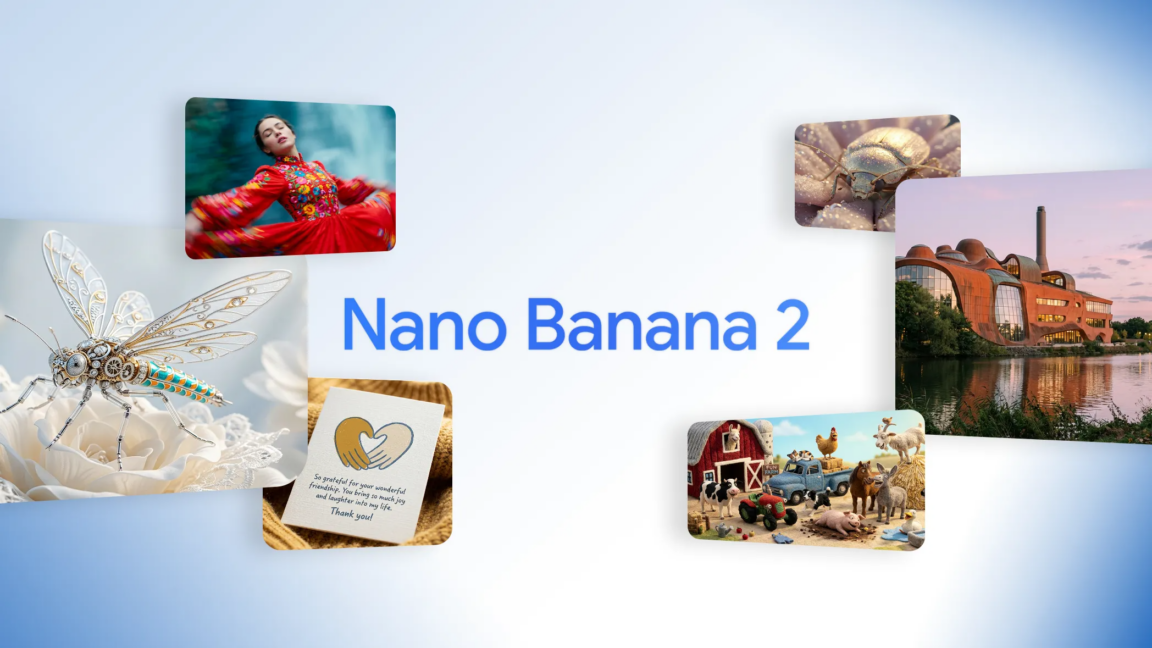
💡Google's new image model replaces Gemini's old ones today—benchmark it now for apps.
⚡ 30-Second TL;DR
What Changed
Google announced Nano Banana 2 AI image model
Why It Matters
This launch upgrades Gemini's image generation, offering potentially faster and higher-quality outputs for developers building multimodal apps. Practitioners gain instant access to improved AI imaging without migration.
What To Do Next
Test Nano Banana 2 image generation in Gemini web/app today for new capabilities.
Key Points
- •Google announced Nano Banana 2 AI image model
- •Model integrates into Gemini starting today
- •Immediately replaces prior image models
🧠 Deep Insight
Background and context from public sources — not the original article. 6 sources cited.
🔑 Enhanced Key Takeaways
- •Nano Banana 2, technically Gemini 3.1 Flash Image, delivers Pro-level features like advanced world knowledge and precise text rendering at Flash speeds for rapid iteration[1][2].
- •It supports subject consistency for up to five characters and fidelity for up to 14 objects, enabling narrative storyboarding, plus resolutions from 512px to 4K in various aspect ratios[1][3].
- •All generated images include SynthID watermarking and C2PA interoperability, with over 20 million SynthID verifications since November 2025[3].
- •Available in preview for developers via Gemini API, AI Studio, Vertex AI, Google Antigravity, and Gemini CLI, requiring a paid API key for Google AI Studio[1][4].
🛠️ Technical Deep Dive
- •Technically named Gemini 3.1 Flash Image, successor to Gemini 2.5 Flash Image (Nano Banana, August 2025) and Gemini 3 Pro Image (Nano Banana Pro, November 2025)[1][2].
- •Leverages Gemini’s real-time web search for grounding, enabling accurate depictions of specific subjects, weather data, stock charts, and data visualizations[2][4][5].
- •Features 'thinking mode' for complex prompts, generating interim thought images (not charged) to refine composition before final output[5].
- •Supports up to 14 reference images mixed into prompts, advanced text rendering/translation/localization, and precise adherence to complex instructions[1][4][5].
🔮 Future ImplicationsAI analysis grounded in cited sources
⏳ Timeline
📎 Sources (6)
Factual claims are grounded in the sources below. Forward-looking analysis is AI-generated interpretation.
Weekly AI Recap
Read this week's curated digest of top AI events →
👉Related Updates
AI-curated news aggregator. All content rights belong to original publishers.
Original source: Ars Technica AI ↗
This is a summary, not the original. Read the source, or get the weekly briefing.
Weekly AI briefing
One email a week. Unsubscribe anytime.