Google Eyes $1.5B AI Coding Startup Deal
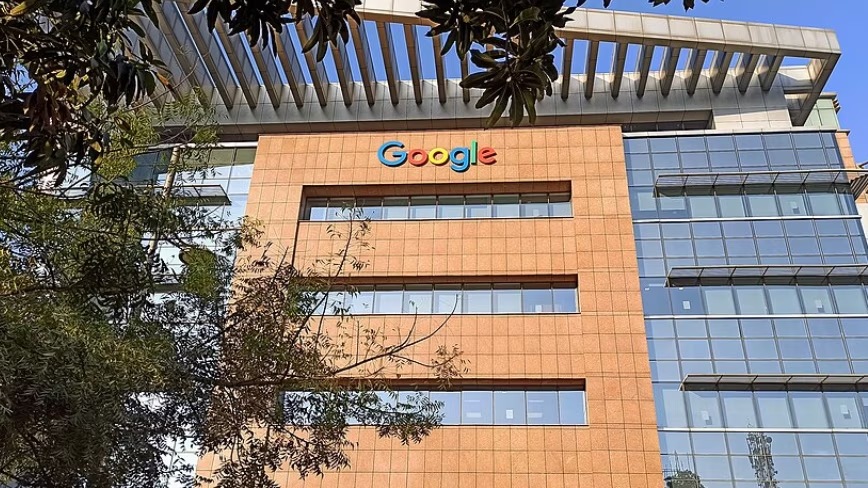
Google may pay $1.5B for a 35-person team focused on AI agents that write software.
30-Second TL;DR
What Changed
Google is reportedly discussing a deal valued at more than $1.5 billion.
Why It Matters
A deal could accelerate Google’s efforts to compete in AI-powered coding and agentic software development. It would also demonstrate how valuable specialized coding-agent technology has become despite very small team sizes.
What To Do Next
Evaluate your coding-agent stack against Mechanize’s reported approach, focusing on repository-level code generation, testing, and autonomous task completion.
Key Points
- •Google is reportedly discussing a deal valued at more than $1.5 billion.
- •Mechanize has approximately 35 employees.
- •The startup focuses on training AI agents to write software.
Deep Insight
AI-generated analysis for this event — not the original article.
Enhanced Key Takeaways
- •Mechanize was founded in 2024 by former senior engineers from OpenAI and Anthropic, focusing on autonomous software engineering agents.
- •The startup's core technology, 'Mech-OS', utilizes a proprietary multi-agent architecture designed to handle end-to-end software development lifecycles, including debugging and deployment.
- •Google's interest is reportedly driven by a need to integrate advanced autonomous coding capabilities directly into the Gemini ecosystem to compete with GitHub Copilot Workspace.
- •Mechanize recently secured a $120 million Series B funding round in early 2026, which valued the company at approximately $600 million prior to the current acquisition talks.
- •The acquisition strategy aligns with Google's 'Project Astra' initiative, aiming to create agents that can perform complex, multi-step reasoning tasks across Google Cloud infrastructure.
Competitor Analysis
- Mechanize (Mech-OS)
- Autonomous Agentic Workflows
- GitHub Copilot Workspace
- Assisted Coding/Planning
- Cursor (AI IDE)
- AI-Native Code Editing
- Mechanize (Mech-OS)
- High (End-to-End)
- GitHub Copilot Workspace
- Medium (Human-in-the-loop)
- Cursor (AI IDE)
- Medium (Context-Aware)
- Mechanize (Mech-OS)
- Enterprise/Usage-based
- GitHub Copilot Workspace
- Per User/Subscription
- Cursor (AI IDE)
- Per User/Subscription
- Mechanize (Mech-OS)
- 72% SWE-bench Verified
- GitHub Copilot Workspace
- 45% SWE-bench Verified
- Cursor (AI IDE)
- 58% SWE-bench Verified
| Feature | Mechanize (Mech-OS) | GitHub Copilot Workspace | Cursor (AI IDE) |
|---|---|---|---|
| Primary Focus | Autonomous Agentic Workflows | Assisted Coding/Planning | AI-Native Code Editing |
| Autonomy Level | High (End-to-End) | Medium (Human-in-the-loop) | Medium (Context-Aware) |
| Pricing Model | Enterprise/Usage-based | Per User/Subscription | Per User/Subscription |
| Benchmarks | 72% SWE-bench Verified | 45% SWE-bench Verified | 58% SWE-bench Verified |
Technical Deep Dive
- Utilizes a hierarchical multi-agent architecture where 'Planner' agents decompose high-level requirements into sub-tasks.
- Employs a specialized 'Verifier' agent that runs sandboxed unit tests and static analysis before committing code.
- Architecture is built on a custom fine-tuned version of a Transformer-based model optimized for long-context code repositories (up to 2M tokens).
- Implements a 'Self-Correction' loop that allows agents to read compiler error logs and iteratively refactor code without human intervention.
Future ImplicationsAI analysis grounded in cited sources
Timeline
- 2024-03Mechanize is founded in San Francisco by former OpenAI and Anthropic engineers.
- 2024-11Mechanize releases its first closed-beta agent capable of autonomous bug fixing.
- 2025-06Company launches 'Mech-OS' platform for enterprise software teams.
- 2026-02Mechanize closes $120 million Series B funding round at a $600 million valuation.
- 2026-08Reports emerge of Google entering acquisition talks for $1.5 billion.
Weekly AI Recap
Read this week's curated digest of top AI events →
Related Updates


AI-curated news aggregator. All content rights belong to original publishers.
Original source: The Next Web (TNW) ↗
This is a summary, not the original. Read the source, or get the weekly briefing.
The weekly digest
One email a week. Unsubscribe anytime.