Google earthquake alerts warned 11.4M in Venezuela
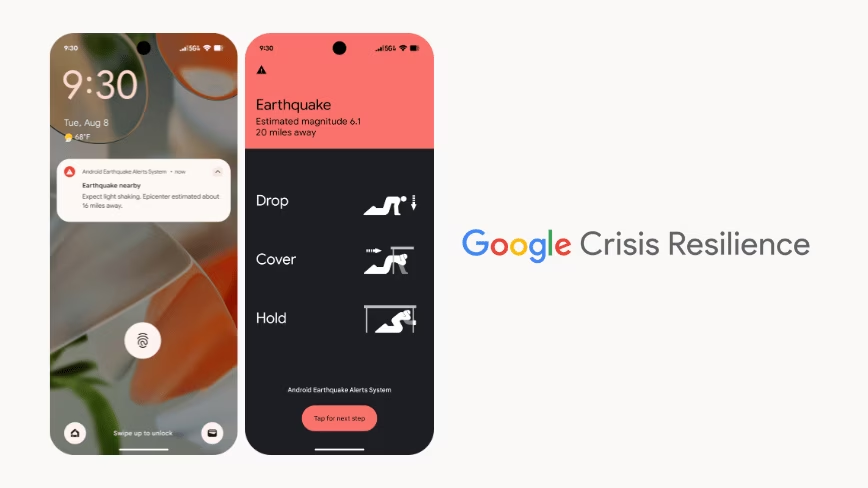
💡See how distributed sensor networks on mobile devices can provide real-time, life-saving AI alerts.
⚡ 30-Second TL;DR
What Changed
11.4 million users received warnings up to two minutes before the quake
Why It Matters
This demonstrates the power of distributed sensor networks and real-time data processing at a global scale. It highlights how mobile OS-level integration can provide massive societal benefits.
What To Do Next
Explore the Android Sensor API to understand how mobile hardware can be utilized for distributed data collection.
Key Points
- •11.4 million users received warnings up to two minutes before the quake
- •System turns Android devices into a crowdsourced seismic sensor network
- •Provides critical life-saving alerts in regions lacking national infrastructure
🧠 Deep Insight
AI-generated analysis for this event — not the original article.
🔑 Enhanced Key Takeaways
- •The system utilizes the accelerometer in Android smartphones to detect P-waves, which are the faster, less destructive seismic waves that precede the more damaging S-waves.
- •Google's algorithm processes data from millions of devices simultaneously to filter out non-seismic vibrations, such as those caused by heavy traffic or household appliances.
- •The Android Earthquake Alerts System is integrated into the Google Play Services framework, allowing it to reach devices without requiring a standalone app download.
- •In addition to alerts, Google provides a 'Safety Check' feature that offers users guidance on what to do during and after an earthquake, such as turning off gas or avoiding elevators.
- •The technology relies on the ShakeAlert system in the United States, but in regions like Venezuela, it operates independently using Google's proprietary crowdsourced detection network.
📊 Competitor Analysis▸ Show
| Feature | Google Earthquake Alerts | MyShake (UC Berkeley) | National Seismic Networks |
|---|---|---|---|
| Detection Method | Crowdsourced Android Sensors | Crowdsourced + Seismometers | Dedicated Seismometers |
| Pricing | Free | Free | Free (Public Service) |
| Latency | Low (Edge Processing) | Low | Higher (Data Transmission) |
| Global Coverage | High (Android footprint) | Limited (Regional focus) | Very Low (Country-specific) |
🛠️ Technical Deep Dive
- The system employs a machine learning classifier trained on historical seismic data to distinguish between earthquake signatures and ambient noise.
- Data is transmitted to Google's servers in near real-time when a device detects a potential P-wave, triggering a server-side aggregation process.
- Once a threshold of detections is met within a specific geographic cluster, the system issues a broadcast alert to all Android devices in the affected area.
- The alert uses the Android Emergency Location Service (ELS) to ensure precise targeting of users within the predicted impact zone.
🔮 Future ImplicationsAI analysis grounded in cited sources
⏳ Timeline
Weekly AI Recap
Read this week's curated digest of top AI events →
👉Related Updates

AI-curated news aggregator. All content rights belong to original publishers.
Original source: The Next Web (TNW) ↗
This is a summary, not the original. Read the source, or get the weekly briefing.
Weekly AI briefing
One email a week. Unsubscribe anytime.