Google and AMD Reportedly Plot Hybrid AI TPU
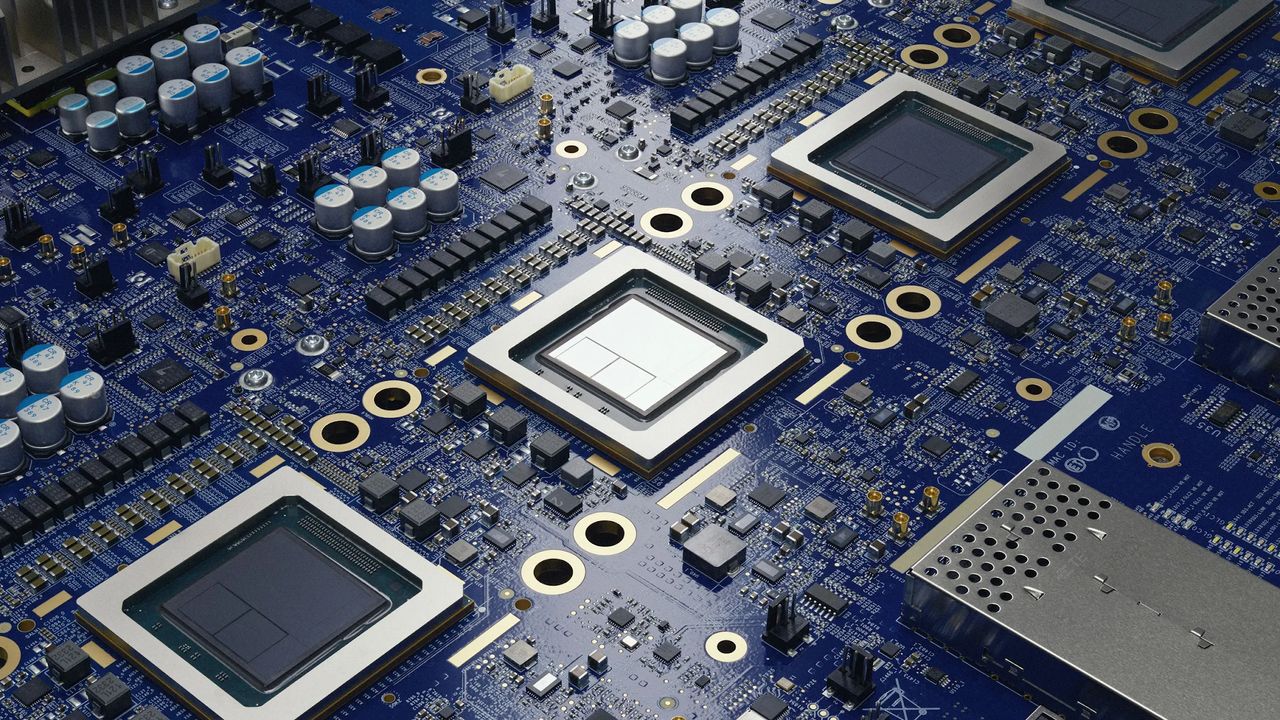
💡A rumored Google–AMD TPU could reshape hardware for agentic AI and reinforcement learning.
⚡ 30-Second TL;DR
What Changed
The rumored partnership would pair Google's TPU expertise with AMD's chip-design capabilities.
Why It Matters
If confirmed, the architecture could reduce coordination overhead for AI agents that frequently alternate between neural-network inference and conventional control logic. It would also intensify competition in custom AI silicon and data-center accelerator design.
What To Do Next
Benchmark your reinforcement-learning and agent workloads separately for host-CPU time and accelerator time so you can evaluate any future CPU–TPU integration advantage.
Key Points
- •The rumored partnership would pair Google's TPU expertise with AMD's chip-design capabilities.
- •The proposed ASIC could place CPU cores on-package with the AI accelerator.
- •Agentic AI and reinforcement learning are identified as potential target workloads.
🧠 Deep Insight
AI-generated analysis for this event.
🔑 Enhanced Key Takeaways
- •The collaboration reportedly leverages AMD's Infinity Fabric interconnect technology to facilitate low-latency communication between the TPU and integrated CPU cores.
- •Industry analysts suggest this move is a strategic response to the rising dominance of NVIDIA's Grace Blackwell architecture, which tightly couples CPU and GPU resources.
- •The hybrid design aims to reduce data movement bottlenecks by utilizing high-bandwidth memory (HBM4) shared across the CPU and TPU die.
- •Google's motivation stems from the need to optimize 'agentic' workflows that require frequent context switching between sequential CPU tasks and parallel AI inference.
- •Reports indicate that the chip may be manufactured using TSMC's advanced 2nm process node, marking a shift in Google's traditional foundry strategy.
📊 Competitor Analysis▸ Show
| Feature | Google/AMD Hybrid TPU | NVIDIA Grace Blackwell | AWS Trainium/Inferentia |
|---|---|---|---|
| Architecture | Hybrid CPU+TPU | Integrated CPU+GPU | Specialized ASIC |
| Interconnect | Infinity Fabric | NVLink | NeuronLink |
| Target Workload | Agentic AI/RL | Large-scale LLM Training | Cloud Inference |
| Pricing | Custom/Internal | Premium/High | Cloud-based/Cost-effective |
🛠️ Technical Deep Dive
- Integration of general-purpose CPU cores (likely Zen-based) directly onto the TPU package to minimize latency for control-plane operations.
- Utilization of advanced chiplet packaging (CoWoS or similar) to enable high-speed data exchange between heterogeneous compute dies.
- Implementation of a unified memory architecture allowing the TPU to access CPU-managed system memory without PCIe overhead.
- Optimization for reinforcement learning (RL) loops where the agent must process environment feedback (CPU) and model inference (TPU) in rapid succession.
🔮 Future ImplicationsAI analysis grounded in cited sources
⏳ Timeline
Weekly AI Recap
Read this week's curated digest of top AI events →
👉Related Updates
AI-curated news aggregator. All content rights belong to original publishers.
Original source: Tom's Hardware ↗