GM triples pull requests by redesigning workflows around AI agents
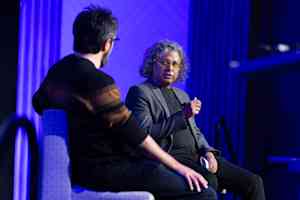
Learn how GM tripled engineering output by moving beyond chatbots to agentic workflow redesign.
30-Second TL;DR
What Changed
Engineers spend only 15% of time coding; GM automated the remaining 85% of tasks like triage and testing.
Why It Matters
This approach demonstrates that AI ROI in engineering is maximized by automating the entire development lifecycle rather than just the code generation phase.
What To Do Next
Audit your engineering workflow to identify non-coding bottlenecks and implement MCP-based agents to automate those specific data-heavy tasks.
Key Points
- •Engineers spend only 15% of time coding; GM automated the remaining 85% of tasks like triage and testing.
- •Implemented Model Context Protocol (MCP) to connect agents to internal telemetry data and tools.
- •Used a loop-based automation strategy, identifying and automating the longest bottleneck in each development cycle.
Deep Insight
AI-generated analysis for this event — not the original article.
Enhanced Key Takeaways
- •GM utilized a 'human-in-the-loop' orchestration layer that allows engineers to approve agentic actions via Slack and Jira integrations, ensuring safety-critical code remains under human oversight.
- •The initiative was part of a broader 'Software-Defined Vehicle' (SDV) strategy aimed at reducing the time-to-market for over-the-air (OTA) updates by 40%.
- •The implementation leveraged Anthropic’s Model Context Protocol (MCP) to standardize how agents query GM's proprietary vehicle telemetry databases, which were previously siloed.
- •Engineers reported a significant reduction in 'context switching' fatigue, as the agents handle the retrieval of historical bug reports and documentation during the triage phase.
- •The automation framework specifically targets the 'integration hell' phase of autonomous driving software, where disparate sensor fusion models often conflict during merge requests.
Competitor Analysis
- GM (Agentic Workflow)
- Workflow/Triage Agents
- Ford (BlueCruise Dev)
- Manual/Hybrid
- Tesla (Autopilot/FSD)
- End-to-End Neural Nets
- GM (Agentic Workflow)
- MCP-based (Open)
- Ford (BlueCruise Dev)
- Proprietary/Closed
- Tesla (Autopilot/FSD)
- Highly Verticalized
- GM (Agentic Workflow)
- Pull Request Velocity
- Ford (BlueCruise Dev)
- Feature Deployment Speed
- Tesla (Autopilot/FSD)
- Training Compute Efficiency
| Feature | GM (Agentic Workflow) | Ford (BlueCruise Dev) | Tesla (Autopilot/FSD) |
|---|---|---|---|
| Automation Focus | Workflow/Triage Agents | Manual/Hybrid | End-to-End Neural Nets |
| Integration | MCP-based (Open) | Proprietary/Closed | Highly Verticalized |
| Primary Metric | Pull Request Velocity | Feature Deployment Speed | Training Compute Efficiency |
Technical Deep Dive
- Architecture: Utilizes a multi-agent orchestration framework where specialized agents (Triage, Test, Documentation) communicate via a centralized message bus.
- Protocol: Implemented Model Context Protocol (MCP) to create a standardized interface between LLMs and internal GM data lakes, allowing agents to read real-time vehicle logs without manual data extraction.
- Loop Strategy: Employs a 'Bottleneck-First' heuristic where the system continuously monitors CI/CD pipeline latency and dynamically reallocates compute resources to the slowest stage.
- Security: Implemented a 'Guardrail Layer' that validates agent-generated code against MISRA C++ standards before it reaches the human review stage.
Future ImplicationsAI analysis grounded in cited sources
Timeline
- 2023-06GM announces major restructuring of its software organization to accelerate SDV development.
- 2024-02Initial pilot of AI-assisted coding tools launched within the autonomous driving division.
- 2025-01GM begins integrating Model Context Protocol (MCP) to unify internal engineering data silos.
- 2026-04Full deployment of agentic workflow automation across the core autonomous vehicle engineering team.
Weekly AI Recap
Read this week's curated digest of top AI events →
AI-curated news aggregator. All content rights belong to original publishers.
Original source: VentureBeat ↗
This is a summary, not the original. Read the source, or get the weekly briefing.
The weekly digest
One email a week. Unsubscribe anytime.