Global Recession: China Must Set AI-Era Agenda
💡AI job displacement stats + bubble warnings shape 2026 funding & hiring strategies
⚡ 30-Second TL;DR
What Changed
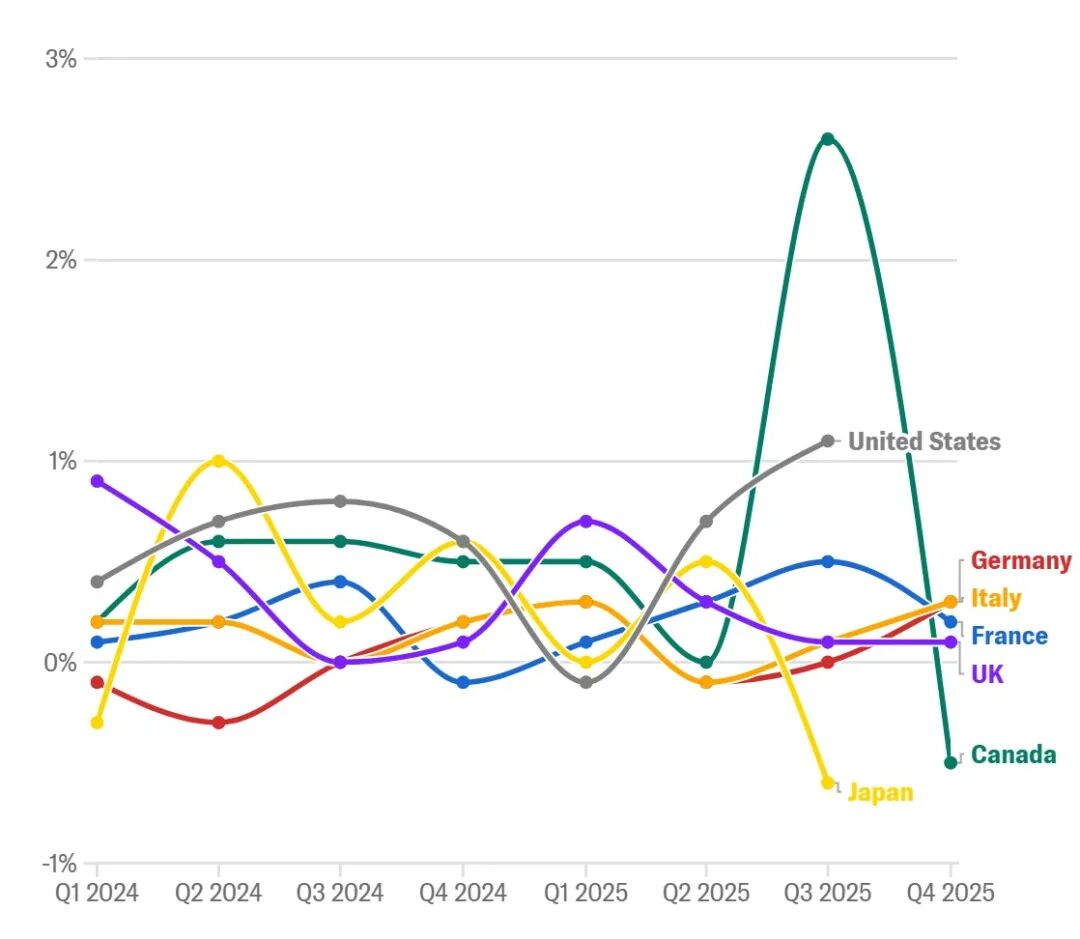
G7 GDP growth forecast at 1.2% (2025) dropping to 1.0% (2026), with many below 1%.
Why It Matters
Highlights AI's overhyped productivity vs real job threats, informing AI founders on macro risks like recessions curbing adoption and bubbles bursting valuations. Signals geopolitical shifts where AI strategy ties to national agenda-setting.
What To Do Next
Analyze OECD NEET data to forecast AI-driven hiring needs in your AI startup's talent pipeline.
Key Points
- •G7 GDP growth forecast at 1.2% (2025) dropping to 1.0% (2026), with many below 1%.
- •Global youth unemployment double adults'; NEET rate hits 25%, worsened by AI entry-level job cuts.
- •AI hype fails scale effects but inflates stocks; US top 10 AI stocks double market share, risking bubble.
- •Emerging markets default rate 40% since 2000; low-income economies poorer than pre-COVID.
- •China urged to be 'question setter' amid order collapse, per WEF 2026 risks report.
🧠 Deep Insight
Background and context from public sources — not the original article. 7 sources cited.
🔑 Enhanced Key Takeaways
- •China's 15th Five-Year Plan prioritizes 'industrial upgrading' through AI deployment across industries, positioning emerging technologies like AI and robotics as the main engine for future growth and productivity enhancement[1][2][4].
- •AI is shifting from consumer applications to an 'AI-plus' strategy, integrating as a general-purpose technology in manufacturing, healthcare, robotics, and services, with MIIT identifying 'AI + Manufacturing' as a 2026 priority[2][3][5].
- •President Xi Jinping emphasized accelerating 'AI-plus' initiatives alongside consumer spending to counter economic headwinds, including income growth and tech breakthroughs ahead of 2026 parliamentary meetings[5].
- •China leverages scale, state capacity, and industrial data for embodied AI, intelligent robots, and standards development, aiming to lead in AI industrial applications by 2030 without pursuing singular AGI[1][3][4].
- •US dominates AI supercomputing (75% global performance by March 2025 vs China's 15%), prompting China to focus on applications-oriented AI to recalibrate global competition[6].
🛠️ Technical Deep Dive
- No specific model architectures or implementation details found; focus is on policy-driven integration of AI as a cross-cutting layer in embodied systems like robots, drones, and autonomous vehicles[2].- Emphasis on AI agents for autonomous perception, planning, and execution in physical and digital systems, leveraging China's hardware manufacturing strengths[2].
🔮 Future ImplicationsAI analysis grounded in cited sources
China's proactive 'AI-plus' agenda positions it to lead in industrial AI applications amid global recession risks, potentially boosting productivity and countering youth unemployment through reskilling and embedding AI across the economy, while challenging US dominance via scale and standards[1][2][4][5][6].
⏳ Timeline
📎 Sources (7)
Factual claims are grounded in the sources below. Forward-looking analysis is AI-generated interpretation.
- institute.global — What to Expect From Chinas New Five Year Plan
- china-briefing.com — Chinas Industries to Watch in 2026
- cms.law — China
- thenationalnews.com — China Is Leading the AI Plus Intelligence Economy
- scmp.com — Chinas Xi Prioritises AI Plus and Consumer Spending Counter Economic Headwinds
- chathamhouse.org — 03 Strategy Meets Reality
- aei.org — Chinas Transition to Scalable Intelligence
Weekly AI Recap
Read this week's curated digest of top AI events →
👉Related Updates

AI-curated news aggregator. All content rights belong to original publishers.
Original source: 虎嗅 ↗
This is a summary, not the original. Read the source, or get the weekly briefing.
Weekly AI briefing
One email a week. Unsubscribe anytime.