GLM vs DeepSeek: The Self-Evolution Race
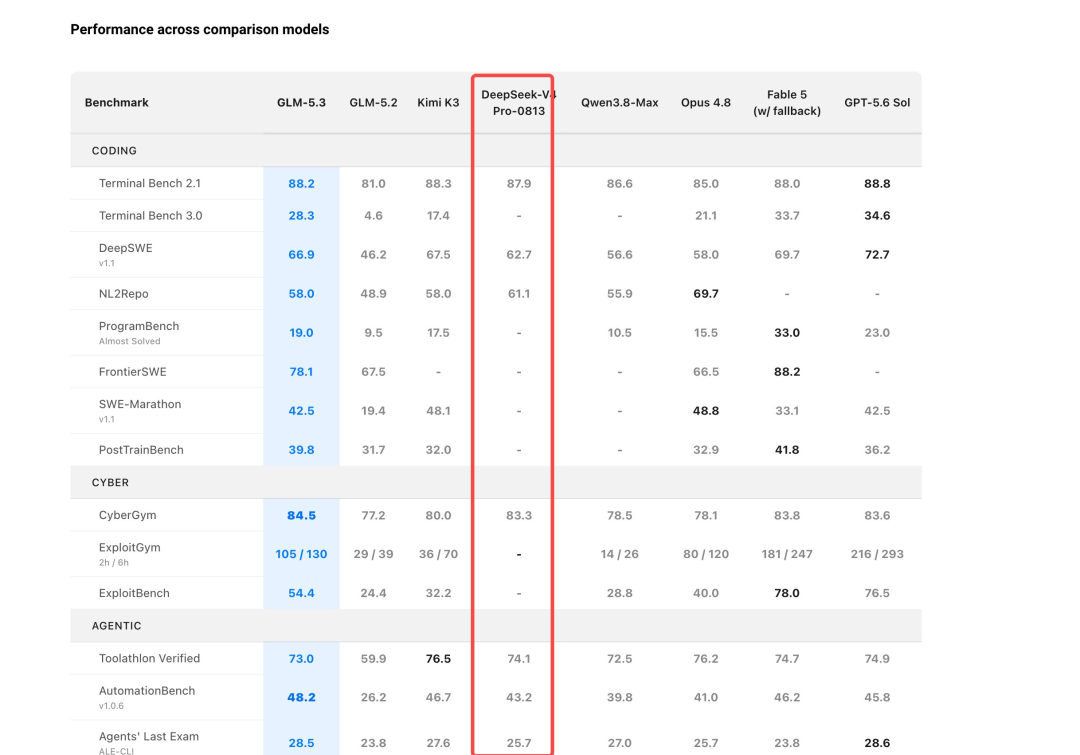
💡Seven benchmark wins put GLM ahead of DeepSeek— but the real battle is self-evolving model pipelines.
⚡ 30-Second TL;DR
What Changed
Zhipu reportedly outperformed DeepSeek in seven of eight benchmark categories.
Why It Matters
If the reported results hold, developers may need to evaluate both GLM and DeepSeek instead of assuming DeepSeek is the default Chinese model choice. The emphasis on self-evolution also highlights the growing importance of post-training pipelines and continuous evaluation.
What To Do Next
Run the same representative workload through GLM and DeepSeek, recording accuracy, latency, token cost, and failure cases before switching models.
Key Points
- •Zhipu reportedly outperformed DeepSeek in seven of eight benchmark categories.
- •The comparison focuses on model self-evolution rather than a single version release.
- •Benchmark leadership may change as both companies improve their training and post-training systems.
🧠 Deep Insight
AI-generated analysis for this event.
🔑 Enhanced Key Takeaways
- •Zhipu AI's GLM series utilizes a unique 'CogView' and 'GLM-4' architecture that emphasizes bilingual proficiency and long-context handling, distinguishing it from DeepSeek's Mixture-of-Experts (MoE) focus.
- •DeepSeek has pioneered cost-efficient training methodologies, specifically through their 'DeepSeek-V3' and 'R1' series, which leverage massive-scale reinforcement learning to optimize reasoning capabilities at a fraction of the compute cost of traditional models.
- •The 'self-evolution' strategies mentioned refer to the transition from supervised fine-tuning (SFT) to automated, iterative data synthesis and reinforcement learning (RL) loops that reduce human annotation dependency.
- •Industry analysts note that Zhipu AI maintains a stronger integration with China's academic and enterprise ecosystem, whereas DeepSeek is often characterized by its 'open-weights' strategy aimed at disrupting the proprietary model market.
- •The benchmark competition is increasingly shifting toward 'reasoning-heavy' tasks (like GSM8K, MATH, and coding benchmarks) where both companies are aggressively deploying chain-of-thought (CoT) optimization techniques.
📊 Competitor Analysis▸ Show
| Feature | Zhipu (GLM-4) | DeepSeek (V3/R1) | Qwen (Alibaba) |
|---|---|---|---|
| Architecture | Dense/Hybrid | Mixture-of-Experts (MoE) | Dense/MoE Hybrid |
| Primary Focus | Enterprise/Bilingual | Reasoning/Cost-Efficiency | Ecosystem/General Purpose |
| Pricing | Tiered API/Private Cloud | Highly Aggressive/Low-Cost | Competitive/Cloud-Integrated |
| Benchmarks | High (General/Multimodal) | Leading (Reasoning/Coding) | High (General/Multimodal) |
🛠️ Technical Deep Dive
- Zhipu GLM-4 utilizes a multi-stage training pipeline that incorporates massive-scale pre-training followed by specialized alignment for instruction following and tool-use capabilities.
- DeepSeek employs a proprietary Multi-head Latent Attention (MLA) mechanism which significantly reduces KV cache memory usage during inference, allowing for longer context windows at lower hardware requirements.
- Both companies are increasingly adopting 'Self-Play' reinforcement learning, where models generate and verify their own training data to improve reasoning performance without human-in-the-loop intervention.
- Zhipu's architecture emphasizes a unified model approach for multimodal tasks, whereas DeepSeek has focused on optimizing the efficiency of sparse MoE architectures for large-scale reasoning tasks.
🔮 Future ImplicationsAI analysis grounded in cited sources
⏳ Timeline
Weekly AI Recap
Read this week's curated digest of top AI events →
👉Related Updates


AI-curated news aggregator. All content rights belong to original publishers.
Original source: 钛媒体 ↗