GitLab Secrets Manager Expands Beyond CI/CD
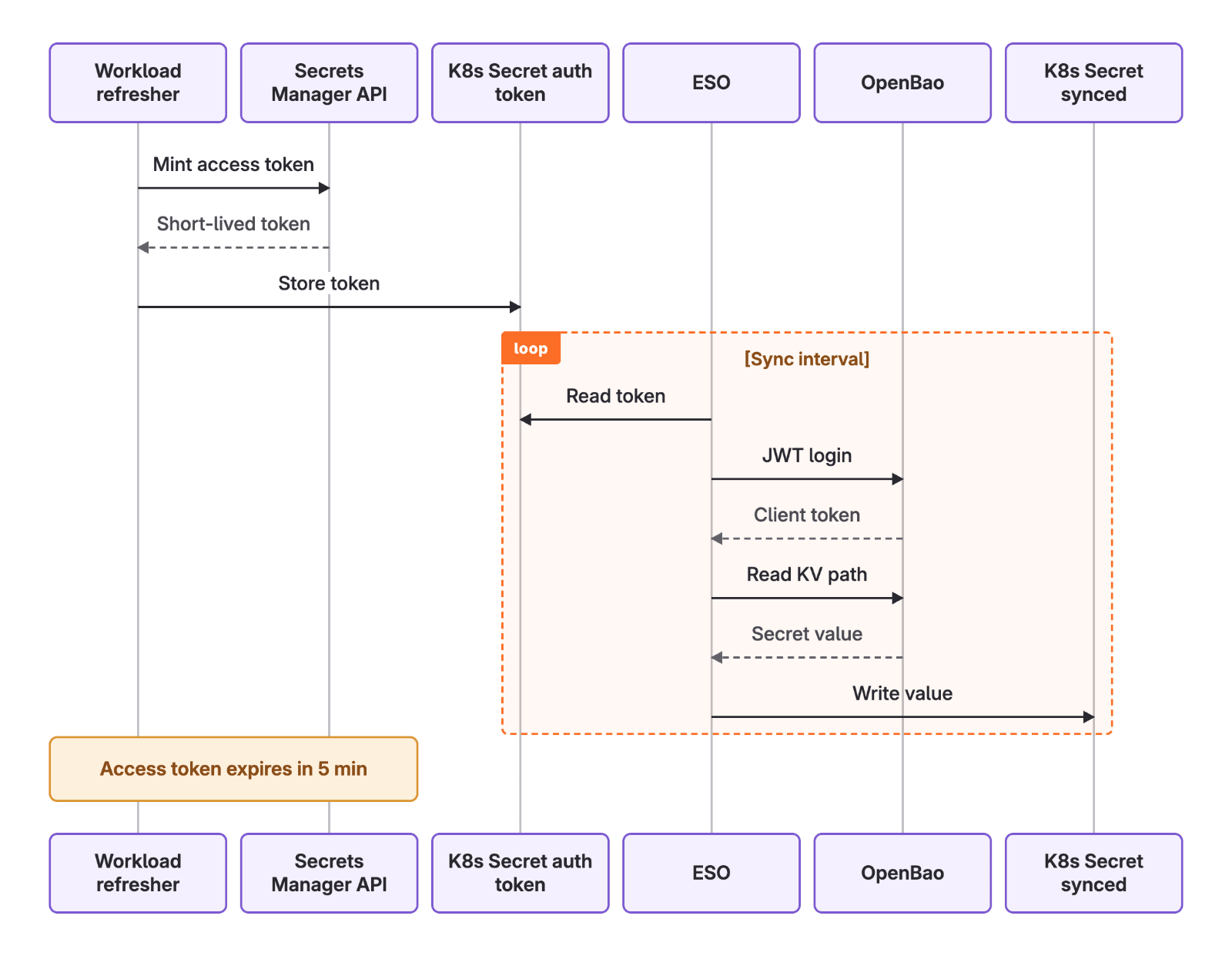
Centralize Kubernetes, Terraform, and AI infrastructure secrets with one OpenBao-backed store.
30-Second TL;DR
What Changed
External Secrets Operator can sync secrets from GitLab Secrets Manager into Kubernetes Secrets.
Why It Matters
Teams can reduce duplicated secret stores and simplify access-policy and audit management across delivery workflows. For AI platform teams, this can centralize credentials used by Kubernetes-hosted inference services, data pipelines, and infrastructure automation.
What To Do Next
Prototype a SecretStore and ExternalSecret in a non-production Kubernetes namespace, using the Vault provider and a short-lived GitLab JWT.
Key Points
- •External Secrets Operator can sync secrets from GitLab Secrets Manager into Kubernetes Secrets.
- •Terraform and OpenTofu runs can retrieve secrets from the same centralized store.
- •The Vault-compatible KV v2 API supports OpenBao or Vault CLI access and external automation.
- •ESO uses short-lived GitLab-minted JWTs, scoped through GitLab organization, group, or project namespaces.
Deep Insight
AI-generated analysis for this event — not the original article.
Enhanced Key Takeaways
- •GitLab Secrets Manager is built on the OpenBao project, a community-driven, open-source fork of HashiCorp Vault, ensuring compatibility with the Vault ecosystem while maintaining an open governance model.
- •The integration leverages GitLab's native identity provider capabilities, allowing users to authenticate external tools using OIDC (OpenID Connect) without needing long-lived static credentials.
- •By centralizing secrets, GitLab aims to reduce 'secret sprawl' across disparate environments, addressing security compliance requirements for organizations managing hybrid cloud and multi-cluster Kubernetes deployments.
- •The architecture supports fine-grained access control policies, enabling administrators to restrict secret access based on GitLab's hierarchical structure (Organization > Group > Project).
- •This expansion marks a strategic shift for GitLab from a CI/CD-centric tool to a broader DevSecOps platform that manages the full lifecycle of infrastructure and application credentials.
Competitor Analysis
- GitLab Secrets Manager
- DevSecOps/CI/CD Integration
- HashiCorp Vault
- Platform-Agnostic Secret Mgmt
- AWS Secrets Manager
- Cloud-Native (AWS)
- Azure Key Vault
- Cloud-Native (Azure)
- GitLab Secrets Manager
- Yes (OpenBao-based)
- HashiCorp Vault
- Yes (BSL License)
- AWS Secrets Manager
- No
- Azure Key Vault
- No
- GitLab Secrets Manager
- Included in GitLab Tiers
- HashiCorp Vault
- Enterprise Licensing
- AWS Secrets Manager
- Pay-per-secret/API call
- Azure Key Vault
- Pay-per-secret/API call
- GitLab Secrets Manager
- GitLab-centric workflows
- HashiCorp Vault
- Multi-cloud/Hybrid enterprise
- AWS Secrets Manager
- AWS-heavy environments
- Azure Key Vault
- Azure-heavy environments
| Feature | GitLab Secrets Manager | HashiCorp Vault | AWS Secrets Manager | Azure Key Vault |
|---|---|---|---|---|
| Core Focus | DevSecOps/CI/CD Integration | Platform-Agnostic Secret Mgmt | Cloud-Native (AWS) | Cloud-Native (Azure) |
| Open Source | Yes (OpenBao-based) | Yes (BSL License) | No | No |
| Pricing | Included in GitLab Tiers | Enterprise Licensing | Pay-per-secret/API call | Pay-per-secret/API call |
| Best For | GitLab-centric workflows | Multi-cloud/Hybrid enterprise | AWS-heavy environments | Azure-heavy environments |
Technical Deep Dive
- Built on OpenBao, which implements the Vault KV (Key-Value) Secrets Engine version 2, supporting versioning and soft-deletion of secrets.
- Utilizes GitLab's OIDC provider to issue short-lived JSON Web Tokens (JWTs) that the External Secrets Operator (ESO) exchanges for temporary access to the secret store.
- Supports the standard Vault API, allowing existing automation scripts that use the Vault CLI or HTTP API to interact with GitLab Secrets Manager without code changes.
- Implements a hierarchical namespace isolation model, ensuring that secrets stored at the Group level are inaccessible to unauthorized Projects unless explicitly permitted by policy.
- Integrates with Terraform/OpenTofu via standard provider authentication mechanisms, allowing infrastructure-as-code runs to fetch secrets dynamically at runtime rather than storing them in state files.
Future ImplicationsAI analysis grounded in cited sources
Timeline
- 2023-11GitLab announces initial plans to integrate native secret management capabilities.
- 2024-03GitLab joins the OpenBao project as a founding member to support open-source secret management.
- 2024-09GitLab Secrets Manager enters early access for CI/CD pipelines.
- 2026-08GitLab expands Secrets Manager to support external integrations like ESO and Terraform.
Weekly AI Recap
Read this week's curated digest of top AI events →
AI-curated news aggregator. All content rights belong to original publishers.
Original source: GitLab Blog ↗
This is a summary, not the original. Read the source, or get the weekly briefing.
The weekly digest
One email a week. Unsubscribe anytime.