GitLab Reframes Software Development for the Agent Era
💡Learn why AI coding’s next bottleneck is trust, not code generation.
⚡ 30-Second TL;DR
What Changed
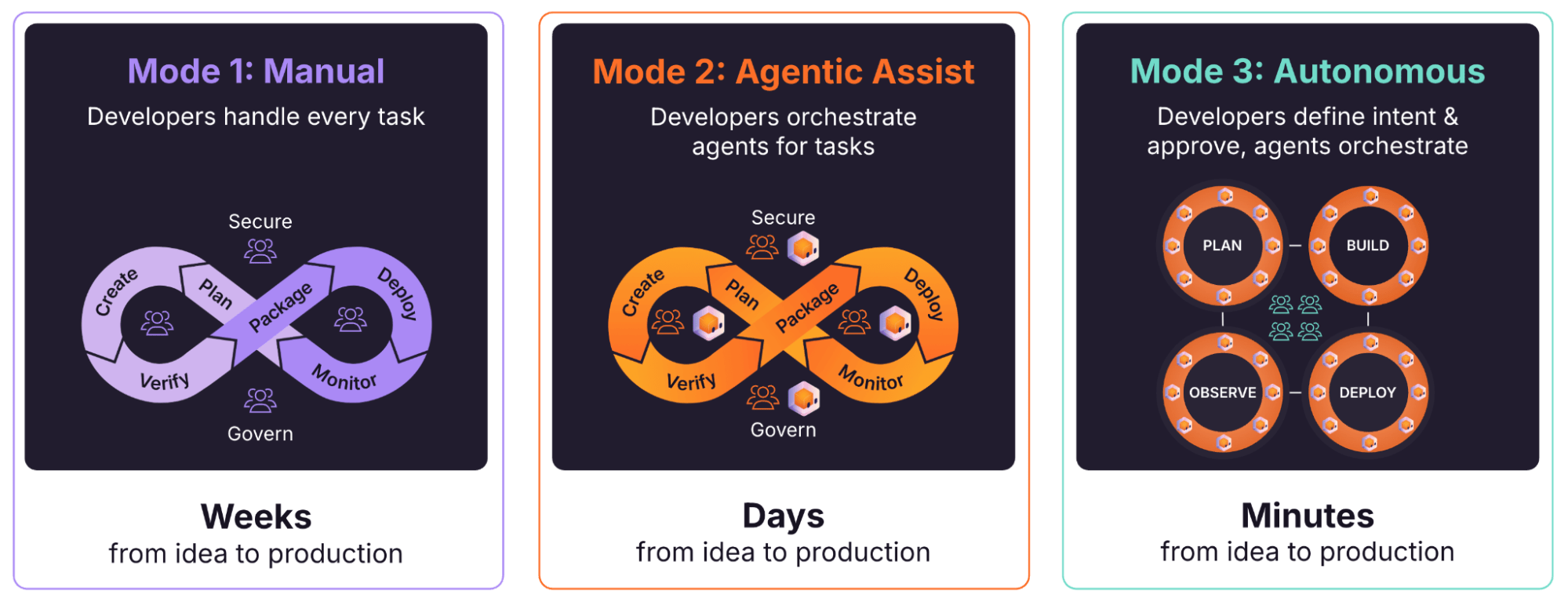
GitLab says the economics of software change when agents can implement code dramatically faster and more cheaply.
Why It Matters
For AI engineering teams, faster code generation will increase the importance of review gates, provenance, automated testing, and policy enforcement. Organizations may need an AI control plane that remains portable across models and vendors instead of coupling workflows to a single assistant.
What To Do Next
Pilot GitLab Orbit or an equivalent lifecycle context layer on one agent-driven repository, and define mandatory approval, verification, and audit gates before expanding usage.
Key Points
- •GitLab says the economics of software change when agents can implement code dramatically faster and more cheaply.
- •GitLab Orbit is presented as a context graph spanning the software lifecycle.
- •Enterprise agent operations require durable controls for identity, policy, approval, verification, and audit across multiple models and agents.
- •GitLab argues that organizational workflows and expertise encoded by agents should remain owned by the organization rather than a model or cloud vendor.
🧠 Deep Insight
Background and context from public sources — not the original article. 6 sources cited.
🔑 Enhanced Key Takeaways
- •GitLab is developing a specialized Git engine currently in private beta to mitigate the 'clone tax' caused by high-concurrency machine interactions with traditional source control backends.
- •The GitLab Dedicated AI Gateway, launched in August 2026, enables enterprises to host the Duo Agent Platform in single-tenant environments to meet strict data residency and regulatory requirements.
- •Market data indicates that 91% of organizations currently utilize two or more AI coding tools, creating a fragmented landscape that GitLab aims to unify through its governance framework.
- •GitLab's 'Flow Creator' agent, now generally available, allows for the automated generation of runnable custom workflows directly from natural language prompts.
- •In May 2026, GitLab initiated 'GitLab Act 2,' a major organizational restructuring that flattened the company hierarchy to accelerate R&D cycles for agentic engineering.
📊 Competitor Analysis▸ Show
| Feature | GitLab (Agentic Era) | GitHub (Copilot Workspace) | Atlassian (Rovo) |
|---|---|---|---|
| Agent Governance | Centralized policy/audit | Integrated via Copilot Extensions | Federated via Atlassian Intelligence |
| Context Graph | GitLab Orbit (Full SDLC) | GitHub Knowledge Graph | Atlassian Graph |
| Deployment | Dedicated AI Gateway (Single-tenant) | Cloud-native / GitHub Enterprise | Cloud-native |
| Primary Focus | Enterprise-scale agent orchestration | Developer productivity/IDE flow | Cross-tool knowledge management |
🛠️ Technical Deep Dive
- GitLab Orbit utilizes a graph-based architecture to map relationships between code, issues, CI/CD pipelines, and security vulnerabilities across the entire SDLC.
- The new Git engine architecture is optimized for high-concurrency read/write operations to support autonomous agents performing simultaneous commits and branch management.
- The Duo Agent Platform employs a multi-model orchestration layer that allows enterprises to swap underlying LLMs while maintaining consistent policy enforcement and identity management.
- Agentic SAST integration uses a feedback loop where the agent consumes vulnerability metadata to generate and validate merge requests against existing security policies.
🔮 Future ImplicationsAI analysis grounded in cited sources
⏳ Timeline
📎 Sources (6)
Factual claims are grounded in the sources below. Forward-looking analysis is AI-generated interpretation.
Weekly AI Recap
Read this week's curated digest of top AI events →
👉Related Updates

AI-curated news aggregator. All content rights belong to original publishers.
Original source: GitLab Blog ↗
This is a summary, not the original. Read the source, or get the weekly briefing.
Weekly AI briefing
One email a week. Unsubscribe anytime.