GitLab Rebuilds Source Control for AI Agents
💡Agent coding at scale hits Git’s clone, concurrency, and isolation limits—GitLab proposes a server-side redesign.
⚡ 30-Second TL;DR
What Changed
Full repository cloning can transfer 5–10GB and take more than 30 seconds for a single agent task.
Why It Matters
If delivered, GitLab’s approach could significantly reduce latency and bandwidth costs for multi-agent coding workflows. It also signals that source-control infrastructure, rather than only coding models, is becoming a critical bottleneck for autonomous software development.
What To Do Next
Prototype your coding-agent workflow around GitLab Next-gen SCM’s planned server-side batch-read and path-history APIs, and measure clone bandwidth, latency, and concurrency before migrating.
Key Points
- •Full repository cloning can transfer 5–10GB and take more than 30 seconds for a single agent task.
- •Thousands of concurrent agent sessions can overwhelm Git backends designed for human-scale usage.
- •Next-gen SCM uses server-side batch reads, diff-stat queries, and path-specific history lookups instead of full clones.
- •The architecture separates intelligence services from elastic compute and S3-compatible object storage.
- •Agent isolation is designed to support disposable work, scoped visibility, and auditable activity.
🧠 Deep Insight
Background and context from public sources — not the original article. 9 sources cited.
🔑 Enhanced Key Takeaways
- •GitLab introduced 'Orbit,' a unified graph system that maps code, work items, and pipelines to provide agents with holistic lifecycle context rather than just file-level data.
- •The architecture utilizes server-side coalescing to merge duplicate CI clone operations into single compilation tasks, drastically reducing CPU overhead during high-concurrency agent activity.
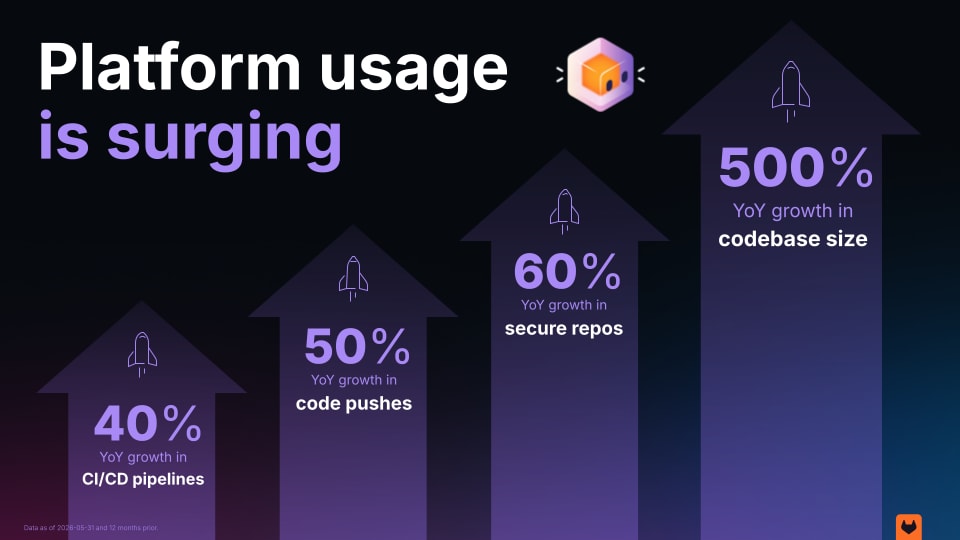
- •GitLab co-engineered these infrastructure improvements with Anthropic to address the eight-fold increase in developer output observed over the past year.
- •The new framework optimizes context processing structures to reduce token consumption by up to 3x, directly lowering latency and operational costs for AI-driven development.
- •GitLab 19.3 introduced the AI Gateway for GitLab Dedicated, enabling enterprises to execute agentic workloads within secure, residency-compliant, single-tenant boundaries.
📊 Competitor Analysis▸ Show
| Feature | GitLab Next-gen SCM | GitHub Copilot Workspace | Atlassian Rovo |
|---|---|---|---|
| Architecture | Decoupled compute/storage | Integrated/Cloud-native | Integrated/Cloud-native |
| Agentic Access | Server-side batch/graph | Full repo/index-based | Index-based/API-driven |
| Pricing | Enterprise/Dedicated | Per-user subscription | Per-user/Usage-based |
| Benchmarks | 50x faster clone performance | Standard Git performance | Standard Git performance |
🛠️ Technical Deep Dive
- Decoupled compute and storage architecture allows for horizontal scaling of repository resources independent of the primary Git backend.
- Implementation of GitLab Orbit graph database to maintain live relationships between code, work items, and deployment status.
- Server-side coalescing engine that intercepts and merges redundant clone requests into single-task execution threads.
- Optimized context-window management that filters repository data to reduce token consumption by 66% compared to raw file ingestion.
- S3-compatible object storage integration for elastic, high-throughput data retrieval during agentic operations.
🔮 Future ImplicationsAI analysis grounded in cited sources
⏳ Timeline
📎 Sources (9)
Factual claims are grounded in the sources below. Forward-looking analysis is AI-generated interpretation.
Weekly AI Recap
Read this week's curated digest of top AI events →
👉Related Updates
AI-curated news aggregator. All content rights belong to original publishers.
Original source: GitLab Blog ↗
This is a summary, not the original. Read the source, or get the weekly briefing.
Weekly AI briefing
One email a week. Unsubscribe anytime.