GitLab Orbit brings full lifecycle context to Antigravity agents
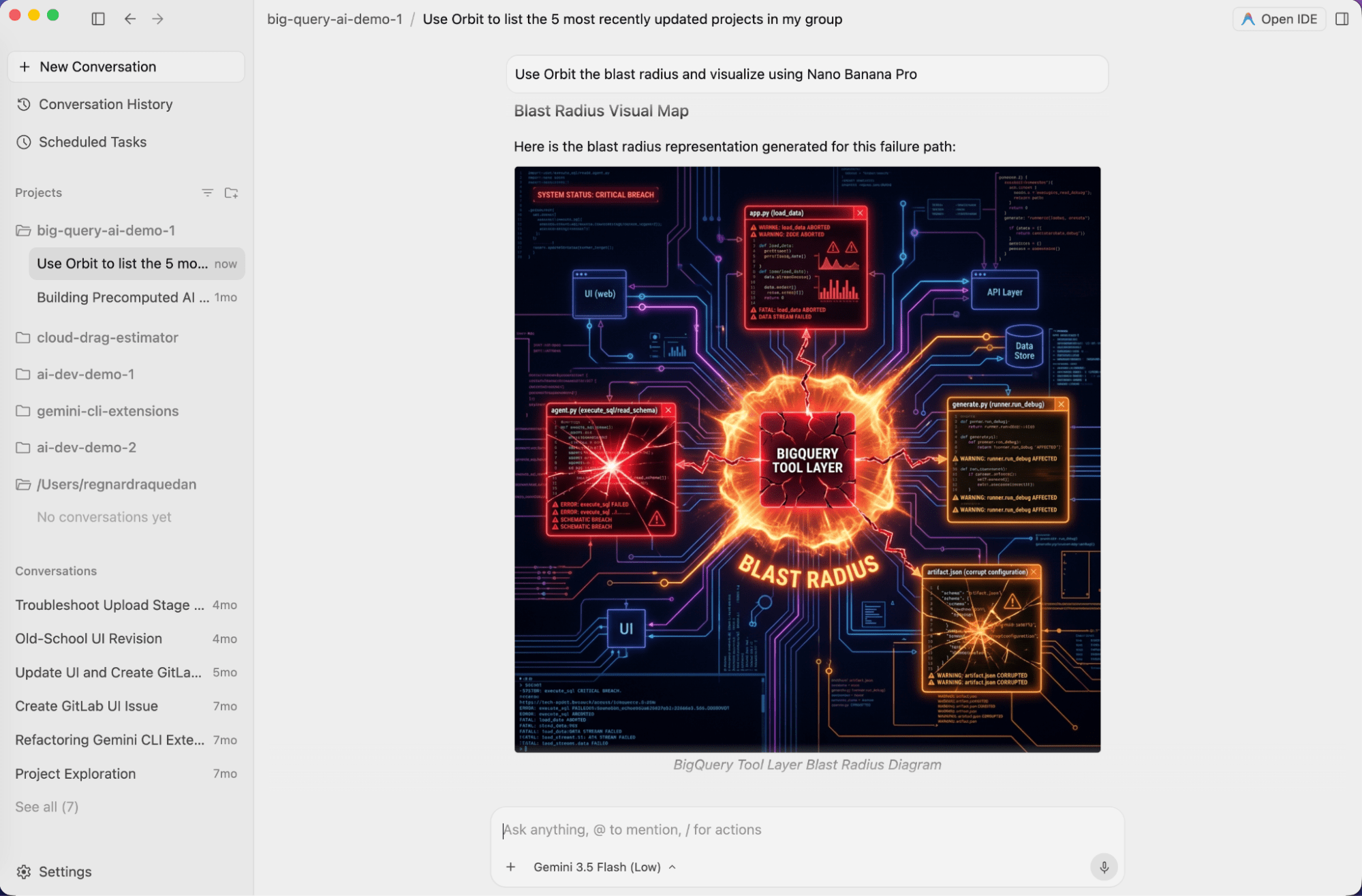
Reduce AI coding hallucinations by 45x by grounding your agents in real-time GitLab project and dependency data.
30-Second TL;DR
What Changed
Provides AI agents with structured access to GitLab projects, merge requests, and source code via MCP tools.
Why It Matters
This integration bridges the gap between siloed DevSecOps data and AI coding assistants, allowing for more context-aware code generation. It sets a new standard for 'grounded' AI development by moving beyond simple file-reading to system-wide awareness.
What To Do Next
Install the GitLab Orbit MCP server in your Antigravity environment to enable context-aware coding and reduce hallucinations in your agent workflows.
Key Points
- •Provides AI agents with structured access to GitLab projects, merge requests, and source code via MCP tools.
- •Reduces agent hallucinations by up to 45x and improves response speed by up to 11x in internal tests.
- •Enables complex lifecycle queries like blast radius analysis and dependency tracking directly within the coding environment.
- •Uses a JSON DSL to execute structured queries via query_graph and get_graph_schema tools.
Deep Insight
AI-generated analysis for this event — not the original article.
Enhanced Key Takeaways
- •GitLab Orbit leverages the Model Context Protocol (MCP) as its primary integration layer, allowing interoperability with non-GitLab AI clients that support the open standard.
- •The system utilizes a proprietary graph database backend that maps relationships between CI/CD pipeline stages and security vulnerability metadata in real-time.
- •GitLab Orbit includes a 'Contextual Guardrail' feature that prevents AI agents from accessing sensitive environment variables or production secrets unless explicitly scoped by the user.
- •The integration is currently available as a beta feature for GitLab Ultimate customers, with plans to expand to Premium tiers by Q4 2026.
- •Internal benchmarks indicate that the 45x reduction in hallucinations is primarily driven by the 'Graph-RAG' approach, which forces agents to verify code references against the live repository state before generating responses.
Competitor Analysis
- GitLab Orbit
- Native Graph-RAG
- GitHub Copilot Extensions
- Limited (Repo-centric)
- Atlassian Rovo
- Knowledge Graph (Jira/Confluence)
- GitLab Orbit
- Full Native Support
- GitHub Copilot Extensions
- Partial
- Atlassian Rovo
- Limited
- GitLab Orbit
- Included in Ultimate
- GitHub Copilot Extensions
- Add-on per user
- Atlassian Rovo
- Included in Premium/Enterprise
- GitLab Orbit
- Deep Pipeline/Vuln
- GitHub Copilot Extensions
- Code-focused
- Atlassian Rovo
- Project/Task-focused
| Feature | GitLab Orbit | GitHub Copilot Extensions | Atlassian Rovo |
|---|---|---|---|
| Lifecycle Graph | Native Graph-RAG | Limited (Repo-centric) | Knowledge Graph (Jira/Confluence) |
| MCP Support | Full Native Support | Partial | Limited |
| Pricing | Included in Ultimate | Add-on per user | Included in Premium/Enterprise |
| Security Context | Deep Pipeline/Vuln | Code-focused | Project/Task-focused |
Technical Deep Dive
- Architecture: Utilizes a Graph-RAG (Retrieval-Augmented Generation) pipeline that indexes GitLab metadata into a vector-graph hybrid store.
- Query Execution: The JSON DSL interacts with a GraphQL-based middleware that translates natural language intent into structured graph traversal queries.
- MCP Implementation: Exposes server-side tools via MCP endpoints, allowing agents to perform 'get_graph_schema' to understand relationship nodes (e.g., Commit -> Pipeline -> Vulnerability).
- Latency Optimization: Implements a caching layer for graph nodes that are frequently accessed during active coding sessions, reducing round-trip time to the primary database.
Future ImplicationsAI analysis grounded in cited sources
Timeline
- 2024-05GitLab announces expansion of AI-powered DevSecOps features.
- 2025-02GitLab introduces initial AI agent framework for automated merge request summaries.
- 2025-11GitLab joins the Model Context Protocol (MCP) initiative.
- 2026-06GitLab Orbit launches, integrating lifecycle graph data with AI agents.
Weekly AI Recap
Read this week's curated digest of top AI events →
AI-curated news aggregator. All content rights belong to original publishers.
Original source: GitLab Blog ↗
This is a summary, not the original. Read the source, or get the weekly briefing.
The weekly digest
One email a week. Unsubscribe anytime.