GitHub Outage Update: Reliability Work Ahead
💡Learn how GitHub is responding to a major outage and what it means for engineering reliability.
⚡ 30-Second TL;DR
What Changed
The update focuses on GitHub's August 17 outage.
Why It Matters
Reliability issues on GitHub can disrupt source control, CI/CD pipelines, issue tracking, and deployment workflows used by AI teams. Practitioners should treat GitHub as a critical dependency and prepare fallback procedures for outages.
What To Do Next
Audit your GitHub-dependent CI/CD workflows and add retry logic, artifact caching, and an alternate deployment path for GitHub outages.
Key Points
- •The update focuses on GitHub's August 17 outage.
- •GitHub is communicating follow-up work to improve reliability.
- •The available excerpt does not specify the outage's root cause, affected services, or remediation timeline.
🧠 Deep Insight
Background and context from public sources — not the original article. 21 sources cited.
🔑 Enhanced Key Takeaways
- •The August 17 outage, lasting 7 hours and 47 minutes, was primarily caused by network saturation in GitHub's Central US data center, exacerbated by a misconfigured autoscaling policy that failed to provision capacity for Istio sidecars reaching their concurrency limits.
- •The disruption led to elevated error rates, with web and API traffic experiencing approximately 20% failure rates, and archive/raw content downloads seeing up to 50% failure rates, impacting core services like Issues, Pull Requests, Actions, and Copilot.
- •A significant factor prolonging the outage, especially for GitHub Copilot, was a "retry storm" amplified by a previously unidentified bug in Visual Studio Code, which caused Copilot token traffic to surge tenfold.
- •GitHub's incident response involved rerouting traffic, isolating affected infrastructure, and temporarily disabling authentication token retries to mitigate persistent authentication failures.
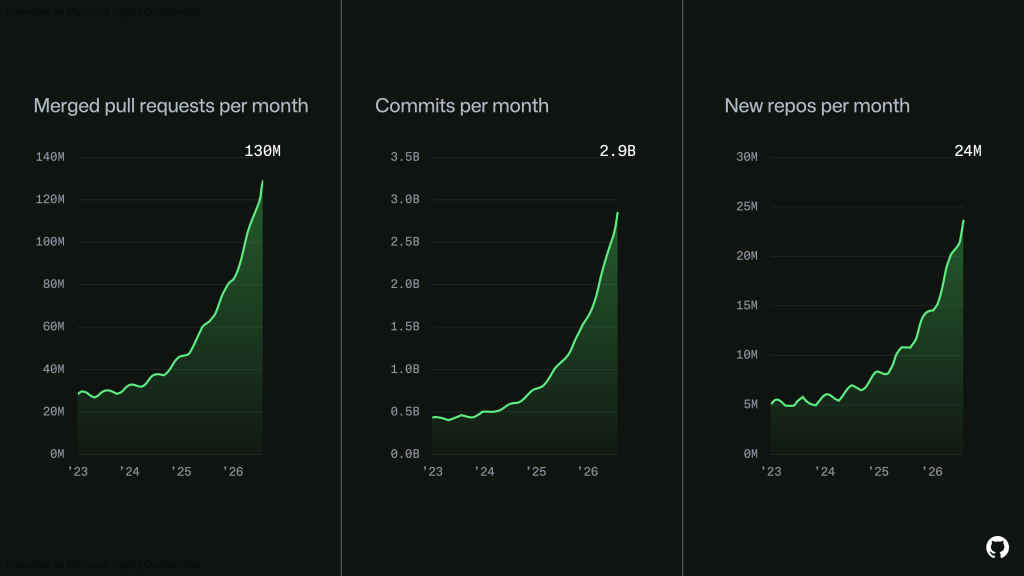
- •This incident is part of a broader trend of increased reliability challenges for GitHub, with 48 major outages reported between May 2025 and April 2026, largely attributed to capacity issues stemming from a rapid surge in AI-driven development traffic.
📊 Competitor Analysis▸ Show
| Platform | Key Strengths (in context of reliability/features) |
|---|---|
| GitHub | Largest developer community, user-friendly UI, robust CI/CD pipelines, integrated AI coding assistant (Copilot). |
| GitLab | Comprehensive DevSecOps platform, extensive suite of DevOps tools including security testing and monitoring, strong for self-hosted solutions. |
| Bitbucket | Seamless integration with Atlassian ecosystem (Jira, Confluence), native support for Mercurial VCS, advanced branch permissions. |
🛠️ Technical Deep Dive
- The August 17 outage originated from network saturation at load balancers in GitHub's Central US data center.
- An Istio sidecar, a component for managing network traffic between services, reached its concurrency limit.
- A misconfigured autoscaling policy failed to add necessary capacity because it was monitoring the host service rather than the Istio sidecar's concurrency limit.
- The failure cascaded, leading to the exhaustion of flow limits on four HAProxy nodes, which are critical components of the authentication path.
- Overly optimistic retry logic and a previously unidentified retry bug within Visual Studio Code amplified traffic to the Copilot Token Service by approximately ten times, significantly delaying its recovery.
- GitHub's recovery efforts included rerouting traffic, isolating affected infrastructure, and partially disabling authentication token retries to stabilize services.
- In response to the incident, GitHub plans to revise its autoscaling policies and conduct a thorough review of retry behavior across its internal gateways and client-side integrations.
- GitHub is also accelerating the migration of its GitHub Actions service to Azure to leverage greater headroom and capabilities for absorbing traffic spikes.
🔮 Future ImplicationsAI analysis grounded in cited sources
⏳ Timeline
📎 Sources (21)
Factual claims are grounded in the sources below. Forward-looking analysis is AI-generated interpretation.
Weekly AI Recap
Read this week's curated digest of top AI events →
👉Related Updates
AI-curated news aggregator. All content rights belong to original publishers.
Original source: GitHub Blog ↗
This is a summary, not the original. Read the source, or get the weekly briefing.
Weekly AI briefing
One email a week. Unsubscribe anytime.