GitHub Named Leader in Gartner Magic Quadrant for AI Coding
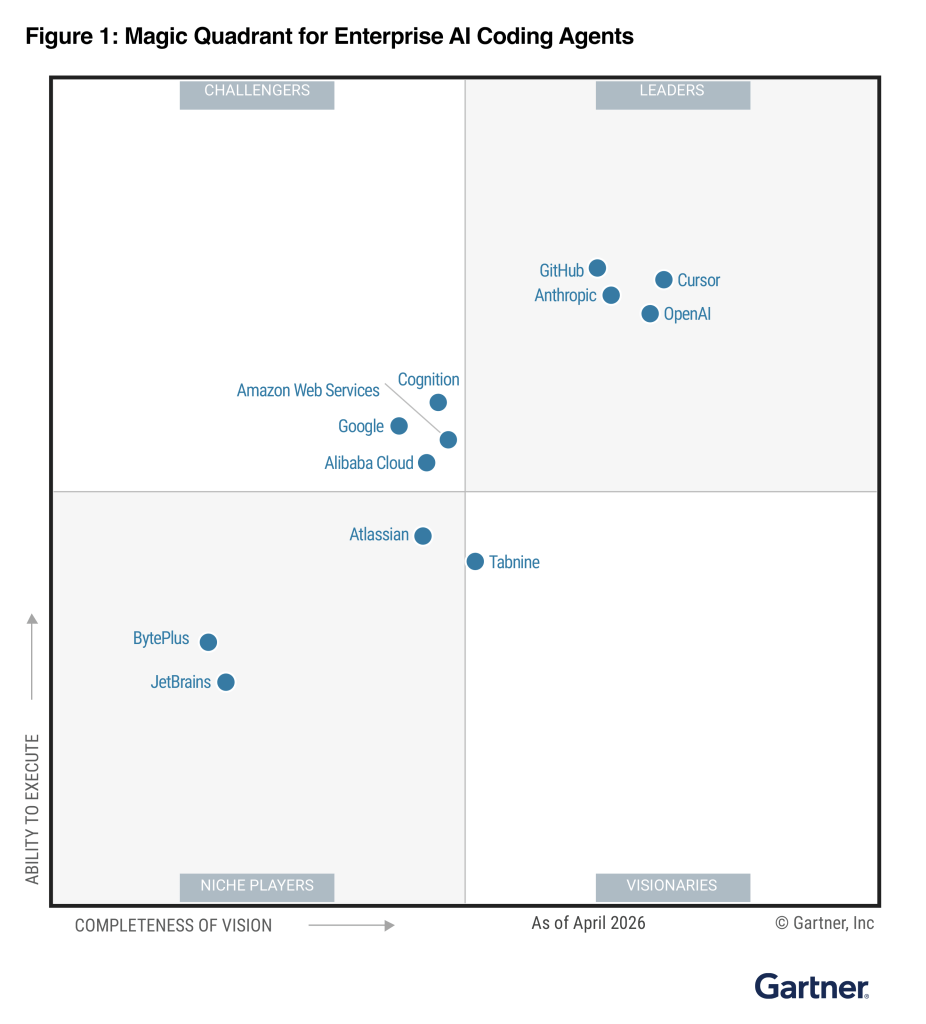
See why GitHub remains the industry benchmark for enterprise AI coding agents in the latest Gartner report.
30-Second TL;DR
What Changed
GitHub maintains its position as a Leader in the Gartner Magic Quadrant for the third year.
Why It Matters
This industry validation reinforces GitHub's dominance in the enterprise AI coding space, likely influencing procurement decisions for large-scale development teams.
What To Do Next
Evaluate GitHub Copilot's latest enterprise features against your current coding agent stack to ensure your team is leveraging industry-leading tools.
Key Points
- •GitHub maintains its position as a Leader in the Gartner Magic Quadrant for the third year.
- •Recognition focuses on their Enterprise AI Coding Agents capabilities.
- •Emphasizes the platform's commitment to secure and open AI-powered software development.
Deep Insight
Background and context from public sources — not the original article. 34 sources cited.
Enhanced Key Takeaways
- •GitHub has been recognized as a Leader in the Gartner Magic Quadrant for Enterprise AI Coding Agents for the third consecutive year, with the latest report published on May 20, 2026.
- •The market for Enterprise AI Coding Agents is substantial, estimated at $9.8 billion to $11.0 billion annually as of April 2026, reflecting a significant and rapidly growing sector.
- •Gartner predicts that by 2028, 90% of enterprise software engineers will utilize AI code assistants, a substantial increase from less than 14% in early 2024, indicating widespread adoption.
- •GitHub Copilot Enterprise, which became generally available in February 2024, offers advanced features like conversational AI for understanding an organization's unique codebase, access to internal knowledge, and accelerated pull request reviews.
- •Starting June 1, 2026, GitHub Copilot is transitioning to a usage-based billing model where AI Credits will be consumed based on token usage for advanced features, while core code completions and next edit suggestions will remain included in all plans.
Competitor Analysis
- GitHub Copilot Enterprise
- AI-driven code completion, generation, translation, runtime awareness, context enrichment, automated documentation, conversational AI for codebase, organizational knowledge, pull request reviews, custom agents, multi-agent orchestration.
- Amazon Q Developer (formerly CodeWhisperer)
- Real-time code suggestions, reference tracking, security scans, autonomous agents for multi-step tasks (feature implementation, refactoring, upgrades), conversational AI for AWS resources, console error diagnostics, code transformations, project-wide context, test generation, enterprise compliance.
- Google Gemini Code Assist
- Code completions, multi-modal chat, unit-test generation, debugging, code explanation, code transformation, agentic interactions (with Git, Cloud Run, BigQuery), private codebase indexing, Google Cloud integrations, code customization with private codebases.
- JetBrains AI Assistant
- Context-aware code completion, AI chat, automated test generation, documentation creation, Junie autonomous agent, Claude Agent integration, local model support, multi-agent architectures.
- GitHub Copilot Enterprise
- $39/user/month (includes $39 in monthly AI Credits, transitioning to usage-based billing June 1, 2026).
- Amazon Q Developer (formerly CodeWhisperer)
- Professional Tier: $19/user/month (includes 1,000 agentic requests/month, 4,000 lines/month code transformations). Free Individual Tier.
- Google Gemini Code Assist
- Standard: $22.80/user/month (1500 max model requests/user/day); Enterprise: $54/user/month (2000 max model requests/user/day). Free Individual Tier.
- JetBrains AI Assistant
- AI Pro (Business): $20/user/month; AI Ultimate (Business): $60/user/month; AI Enterprise: Custom. Free Tier available.
- GitHub Copilot Enterprise
- Does not train on private code/prompts for Business/Enterprise tiers, optional code referencing filter, scans for vulnerable code, content exclusion via
.copilotignore, IP indemnification, ISO/IEC 42001:2023 certification. - Amazon Q Developer (formerly CodeWhisperer)
- Enterprise compliance (SOC, ISO, HIPAA, PCI), built-in security scans, reference tracking for open-source code.
- Google Gemini Code Assist
- Enterprise-grade security, Gen AI indemnification, respects enterprise data boundaries.
- JetBrains AI Assistant
- Data excluded from training, zero data retention, content exclusion with
.aiignore, advanced user/group access management, SSO, SCIM, AI audit logs.
- GitHub Copilot Enterprise
- Deep integration with GitHub platform, focus on full SDLC agentic capabilities, extensive user base (140,000 organizations, 20 million users).
- Amazon Q Developer (formerly CodeWhisperer)
- Deep integration with AWS services, strong for AWS cloud development and infrastructure-as-code, built-in security vulnerability scanning.
- Google Gemini Code Assist
- Agentic workflows, deeper integration with Google Cloud services, built on Gemini 2.5 model, large context window for CLI.
- JetBrains AI Assistant
- Native integration into JetBrains IDEs, unique Junie autonomous agent and Claude Agent integration, strong for Java/Kotlin developers.
| Feature/Category | GitHub Copilot Enterprise | Amazon Q Developer (formerly CodeWhisperer) | Google Gemini Code Assist | JetBrains AI Assistant |
|---|---|---|---|---|
| Core Capabilities | AI-driven code completion, generation, translation, runtime awareness, context enrichment, automated documentation, conversational AI for codebase, organizational knowledge, pull request reviews, custom agents, multi-agent orchestration. | Real-time code suggestions, reference tracking, security scans, autonomous agents for multi-step tasks (feature implementation, refactoring, upgrades), conversational AI for AWS resources, console error diagnostics, code transformations, project-wide context, test generation, enterprise compliance. | Code completions, multi-modal chat, unit-test generation, debugging, code explanation, code transformation, agentic interactions (with Git, Cloud Run, BigQuery), private codebase indexing, Google Cloud integrations, code customization with private codebases. | Context-aware code completion, AI chat, automated test generation, documentation creation, Junie autonomous agent, Claude Agent integration, local model support, multi-agent architectures. |
| Pricing (Enterprise/Business) | $39/user/month (includes $39 in monthly AI Credits, transitioning to usage-based billing June 1, 2026). | Professional Tier: $19/user/month (includes 1,000 agentic requests/month, 4,000 lines/month code transformations). Free Individual Tier. | Standard: $22.80/user/month (1500 max model requests/user/day); Enterprise: $54/user/month (2000 max model requests/user/day). Free Individual Tier. | AI Pro (Business): $20/user/month; AI Ultimate (Business): $60/user/month; AI Enterprise: Custom. Free Tier available. |
| Security & Privacy | Does not train on private code/prompts for Business/Enterprise tiers, optional code referencing filter, scans for vulnerable code, content exclusion via .copilotignore, IP indemnification, ISO/IEC 42001:2023 certification. | Enterprise compliance (SOC, ISO, HIPAA, PCI), built-in security scans, reference tracking for open-source code. | Enterprise-grade security, Gen AI indemnification, respects enterprise data boundaries. | Data excluded from training, zero data retention, content exclusion with .aiignore, advanced user/group access management, SSO, SCIM, AI audit logs. |
| Key Differentiators | Deep integration with GitHub platform, focus on full SDLC agentic capabilities, extensive user base (140,000 organizations, 20 million users). | Deep integration with AWS services, strong for AWS cloud development and infrastructure-as-code, built-in security vulnerability scanning. | Agentic workflows, deeper integration with Google Cloud services, built on Gemini 2.5 model, large context window for CLI. | Native integration into JetBrains IDEs, unique Junie autonomous agent and Claude Agent integration, strong for Java/Kotlin developers. |
Technical Deep Dive
- GitHub Copilot's architecture utilizes client-side plugins (e.g., VS Code, JetBrains, Neovim) to monitor code in real-time and trigger completion requests.
- Input code undergoes a preprocessing pipeline, including tokenization, before being sent to the AI model.
- The underlying AI model, initially a fine-tuned version of OpenAI's GPT-3 called Codex, has evolved, and current completions in Visual Studio 17.10 no longer exclusively use the Codex model.
- The production pipeline incorporates caching and ranking algorithms to enhance the user experience.
- GitHub Copilot Enterprise offers deployment options that include on-premise or private cloud to ensure sensitive code remains within an organization's boundaries.
- The customization architecture of GitHub Copilot is built upon five core components: Instructions, Skills, Agents, Hooks, and Workflow, allowing for layered and cooperative functionality.
- It supports six distinct instruction mechanisms that are merged into the context when multiple types are present.
- Custom agents can be developed with long-term memory and specialized tool sets, enabling the orchestration of sub-agents for complex tasks.
- Security features include an optional code referencing filter that detects and suppresses suggestions matching public code segments of 65 lexemes or more.
- GitHub Copilot also scans outputs for vulnerable code and allows for content exclusion using
.copilotignorefiles to prevent indexing of sensitive data. - For Business and Enterprise tiers, GitHub Copilot explicitly does not use private code or prompts for model training.
- GitHub is extending ISO/IEC 42001:2023 certification across its Copilot portfolio to reinforce responsible AI practices.
- Microsoft provides intellectual property indemnification for unmodified code suggestions generated by GitHub Copilot.
Future ImplicationsAI analysis grounded in cited sources
Timeline
- 2021GitHub introduces Copilot, based on OpenAI Codex, pioneering the AI coding assistant space.
- 2024-02-27GitHub Copilot Enterprise becomes generally available, offering features tailored for organizational codebases.
- 2024-08-22GitHub named a Leader in Gartner's first-ever Magic Quadrant for AI Code Assistants.
- 2025-09-17GitHub named a Leader in the Gartner Magic Quadrant for AI Code Assistants for the second consecutive year.
- 2026-05-22GitHub named a Leader in the Gartner Magic Quadrant for Enterprise AI Coding Agents for the third consecutive year.
- 2026-06-01GitHub Copilot transitions to usage-based billing for premium requests, consuming AI Credits based on token usage.
Sources (34)
Factual claims are grounded in the sources below. Forward-looking analysis is AI-generated interpretation.
Weekly AI Recap
Read this week's curated digest of top AI events →
AI-curated news aggregator. All content rights belong to original publishers.
Original source: GitHub Blog ↗
This is a summary, not the original. Read the source, or get the weekly briefing.
The weekly digest
One email a week. Unsubscribe anytime.