GitHub Agentic Workflows Security Architecture
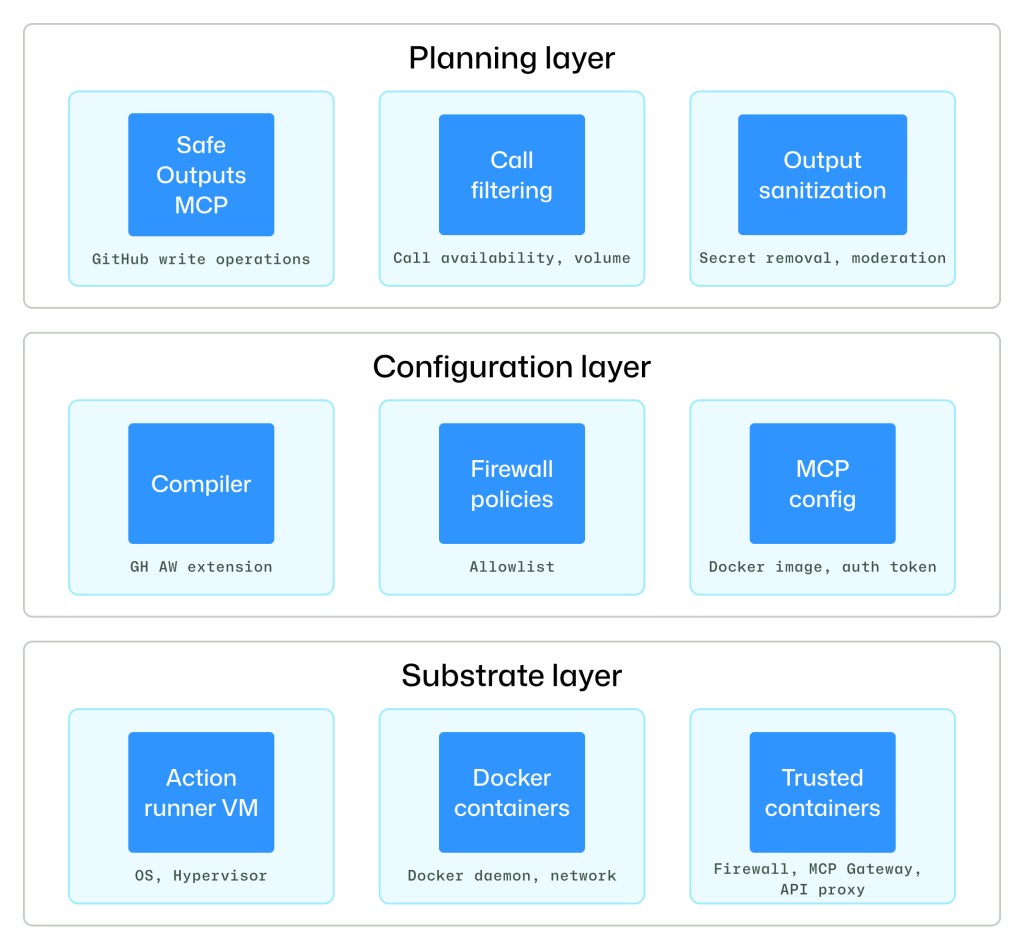
💡Secure your AI agents in GitHub Actions – isolation & logging essentials revealed
⚡ 30-Second TL;DR
What Changed
Isolation protects against agent overreach
Why It Matters
Boosts enterprise confidence in AI-driven workflows, reducing security barriers to agent adoption in CI/CD. Enables scalable AI automation without compromising repos.
What To Do Next
Test Agentic Workflows isolation in a GitHub Actions repo for your AI agents.
Key Points
- •Isolation protects against agent overreach
- •Constrained outputs limit potential risks
- •Comprehensive logging enables full audit trails
- •Threat model focuses on safe GitHub Actions integration
🧠 Deep Insight
Background and context from public sources — not the original article. 8 sources cited.
🔑 Enhanced Key Takeaways
- •GitHub Agentic Workflows entered technical preview in February 2026, developed collaboratively by GitHub Next and Microsoft Research, representing a significant shift toward AI-native CI/CD automation beyond traditional action-based workflows[2][4].
- •The architecture implements multi-layered threat detection including AI-powered analysis, custom security scanner integration (Semgrep, TruffleHog, LlamaGuard), and isolated detection jobs that run with zero write permissions before any safe outputs execute[1].
- •Workflows support natural language Markdown-based configuration instead of YAML, with compilation-time security enforcement through schema validation and expression allowlisting that constrains component loading and connections at deployment[1][4].
- •The platform includes pre-built security-focused agent workflows (Daily Secrets Analysis, Malicious Code Scan, Firewall validation) that have generated 59+ daily firewall reports and 57+ static analysis discussions, demonstrating operational maturity[3].
- •User content sanitization, network firewall restrictions, and SHA-pinned dependencies create defense-in-depth protections specifically designed to be safer than running AI agents directly via CLI tools, which typically grant excessive permissions[2].
🛠️ Technical Deep Dive
- •Detection Job Architecture: Isolated execution environment with no write permissions, artifact-based analysis (outputs, patches, context only), and mandatory "safe" verdict emission before downstream jobs execute[1]
- •Compilation-Time Security: Schema validation and expression allowlisting enforced by trusted compiler; constrains component loading and connection topology but does not restrict runtime behavior[1]
- •Safe Outputs Subsystem: Write operations execute in separate permission-controlled jobs distinct from read-only agent execution; tasks that modify repository state run with constrained permissions[2]
- •Network Isolation: Firewall restricts access to wider internet with configurable destination allowlisting; validated through daily firewall workflows that test unauthorized resource access[3]
- •User Content Sanitization: Input from issues, pull requests, and comments is sanitized before agent processing to prevent prompt injection attacks in public repositories[2]
- •MCP Server Protection: Defense-in-depth architecture protects against untrusted Model Context Protocol servers and compromised agents through multiple validation layers[1]
- •Lockdown Mode: Optional security configuration for public repositories that restricts agent visibility to issues from contributors with push access, with explicit toggle for triage workflows requiring broader visibility[5]
🔮 Future ImplicationsAI analysis grounded in cited sources
⏳ Timeline
📎 Sources (8)
Factual claims are grounded in the sources below. Forward-looking analysis is AI-generated interpretation.
- github.github.com — Architecture
- devclass.com — 4091356
- github.github.io — 2026 01 13 Meet the Workflows Security Compliance
- github.blog — 2026 02 13 Github Agentic Workflows Are Now in Technical Preview
- github.github.com — 2026 01 13 Meet the Workflows
- GitHub — Gh Aw
- github.github.com — 2026 01 13 Meet the Workflows Quality Hygiene
- github.github.com — 2026 01 13 Meet the Workflows Documentation
Weekly AI Recap
Read this week's curated digest of top AI events →
👉Related Updates
AI-curated news aggregator. All content rights belong to original publishers.
Original source: GitHub Blog ↗
This is a summary, not the original. Read the source, or get the weekly briefing.
Weekly AI briefing
One email a week. Unsubscribe anytime.