Georgia Tech's Spherephones use spatial audio for robot safety
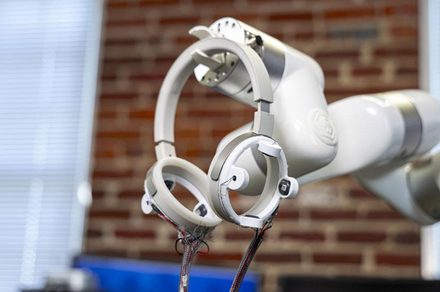
💡Learn how spatial audio can replace visual alerts to improve safety in human-robot collaborative workspaces.
⚡ 30-Second TL;DR
What Changed
Uses spatial audio to map robot proximity in real-time
Why It Matters
This research demonstrates a novel approach to human-machine interface design by leveraging auditory perception to reduce cognitive load in industrial environments.
What To Do Next
Explore spatial audio libraries like Resonance Audio to prototype non-visual feedback loops for your robotics or AR projects.
Key Points
- •Uses spatial audio to map robot proximity in real-time
- •Translates sensor data into lo-fi music for non-intrusive warnings
- •Designed to improve human-robot collaboration safety in industrial settings
🧠 Deep Insight
AI-generated analysis for this event — not the original article.
🔑 Enhanced Key Takeaways
- •The system utilizes a technique called 'sonification' to map the robot's position, velocity, and trajectory into continuous auditory streams rather than discrete alarms.
- •Research indicates that lo-fi music was specifically chosen to reduce 'alarm fatigue,' a common issue where workers become desensitized to traditional high-pitched beeping or sirens.
- •Spherephones rely on a combination of ultra-wideband (UWB) or similar precision localization sensors to maintain low-latency tracking of autonomous mobile robots (AMRs).
- •The device is designed to be 'eyes-free,' allowing workers to maintain situational awareness of their primary tasks while receiving peripheral spatial cues about robot movement.
- •Initial user studies conducted by the Georgia Tech team demonstrated that participants could accurately identify the direction and distance of a moving robot without looking at it.
🛠️ Technical Deep Dive
- Audio Mapping: Uses a spatial audio engine (likely HRTF-based) to render sound sources in a 3D virtual space relative to the user's head position.
- Latency: Optimized for sub-100ms latency to ensure the audio feedback matches the real-time movement of the robot.
- Sensor Fusion: Integrates robot telemetry data (via ROS or similar middleware) with wearable IMU data to adjust the audio field as the worker turns their head.
- Sound Design: Employs generative lo-fi synthesis where parameters like tempo, pitch, and filter cutoff are modulated by the robot's proximity and speed.
🔮 Future ImplicationsAI analysis grounded in cited sources
⏳ Timeline
Weekly AI Recap
Read this week's curated digest of top AI events →
👉Related Updates

AI-curated news aggregator. All content rights belong to original publishers.
Original source: Digital Trends ↗
This is a summary, not the original. Read the source, or get the weekly briefing.
Weekly AI briefing
One email a week. Unsubscribe anytime.