Anduril rocket motor explosion during routine testing
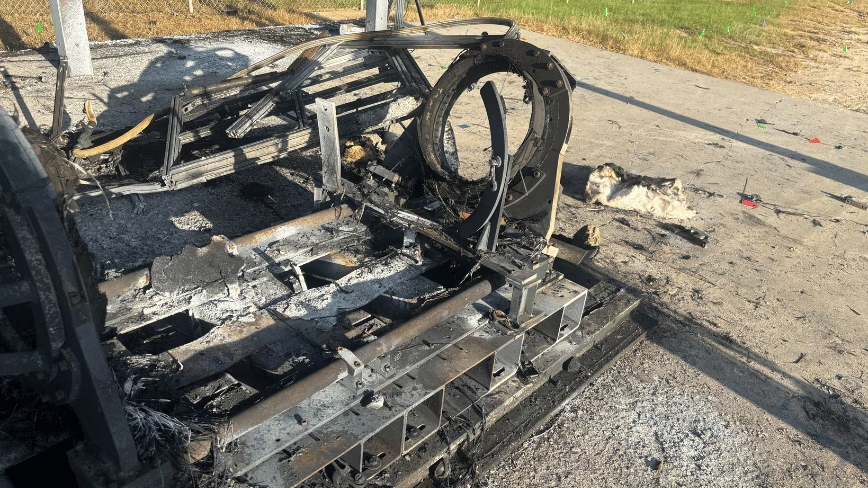
💡Hardware failures in defense AI highlight the risks of rapid iteration in mission-critical autonomous systems.
⚡ 30-Second TL;DR
What Changed
Anduril experienced a rocket motor explosion at its Mississippi test site.
Why It Matters
This incident underscores the challenges of 'software-speed' hardware development in the defense sector. It may lead to increased scrutiny of safety protocols for AI-integrated defense systems.
What To Do Next
Review safety documentation for autonomous hardware testing if you are building robotics or defense-adjacent AI systems.
Key Points
- •Anduril experienced a rocket motor explosion at its Mississippi test site.
- •The company maintains the incident is a routine part of the development process.
- •The event highlights the inherent difficulty and risks in scaling defense-tech hardware.
🧠 Deep Insight
AI-generated analysis for this event — not the original article.
🔑 Enhanced Key Takeaways
- •The incident occurred at Anduril's Stennis Space Center testing facility in Mississippi, a site previously utilized for large-scale propulsion development.
- •Anduril is currently scaling its solid rocket motor production to support the 'Solid Rocket Motor Modernization' initiative aimed at addressing U.S. defense supply chain shortages.
- •The explosion involved a prototype motor intended for the company's Barracuda cruise missile family, which emphasizes low-cost, mass-producible autonomous air vehicles.
- •Regulatory bodies, including the Occupational Safety and Health Administration (OSHA) and local environmental agencies, have initiated standard reviews following the containment of the site.
- •This testing failure marks the first major public safety incident for Anduril's propulsion division since the company acquired Adranos, the solid rocket motor manufacturer, in 2023.
📊 Competitor Analysis▸ Show
| Feature | Anduril (Barracuda) | Lockheed Martin (LRASM) | RTX (Tomahawk) |
|---|---|---|---|
| Primary Focus | Low-cost, mass-producible | High-end, stealth, long-range | Proven, long-range, strategic |
| Propulsion | Solid Rocket Motor | Turbofan | Turbofan |
| Development Cycle | Rapid/Agile | Traditional/Long-term | Traditional/Long-term |
🛠️ Technical Deep Dive
- The motor utilizes a high-energy solid propellant formulation designed for increased thrust-to-weight ratios in compact airframes.
- The failure is suspected to be related to case-bonding integrity or propellant grain structural stability under high-pressure ignition phases.
- Anduril's propulsion technology incorporates additive manufacturing techniques for motor casings to reduce production time and material waste.
- The testing protocol involved static fire instrumentation to measure chamber pressure, thrust vectoring, and thermal dissipation rates.
🔮 Future ImplicationsAI analysis grounded in cited sources
⏳ Timeline
Weekly AI Recap
Read this week's curated digest of top AI events →
👉Related Updates


AI-curated news aggregator. All content rights belong to original publishers.
Original source: The Next Web (TNW) ↗
This is a summary, not the original. Read the source, or get the weekly briefing.
Weekly AI briefing
One email a week. Unsubscribe anytime.