Gemini Adds Lyria 3 Music Creation
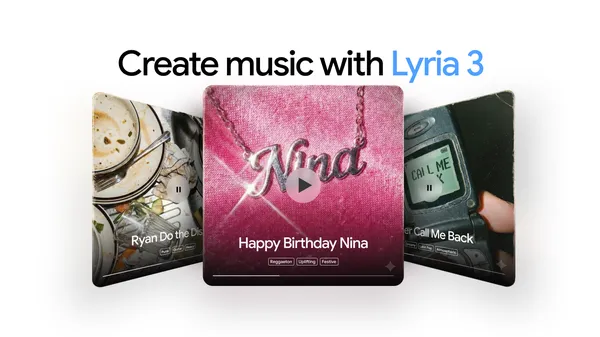
💡Gemini generates music from text/images via Lyria 3—explore new multimodal audio in app now.
⚡ 30-Second TL;DR
What Changed
Lyria 3 now available in Gemini app
Why It Matters
This multimodal audio feature boosts Gemini's utility for creators, potentially inspiring AI-driven music apps and content generation workflows. It signals Google's push into generative audio, competing in creative AI spaces.
What To Do Next
Open Gemini app and test Lyria 3 by prompting a 30-second track from text or image.
Key Points
- •Lyria 3 now available in Gemini app
- •Generates 30-second high-quality music tracks
- •Supports creation from text prompts and images
🧠 Deep Insight
Background and context from public sources — not the original article. 4 sources cited.
🔑 Enhanced Key Takeaways
- •Lyria 3 is Google DeepMind's most advanced music generation model, automatically generating lyrics based on user prompts without requiring manual lyric input[1][3]
- •The feature generates 30-second tracks with customizable elements including style, vocals, tempo, and mood, with accompanying AI-generated cover art via Nano Banana[1][2][3]
- •All generated music includes SynthID watermarking to identify AI-generated content, with built-in verification capabilities allowing users to upload audio files to confirm AI generation[1][2]
- •Lyria 3 is designed for original expression rather than artist mimicry; naming an artist in prompts triggers style-based inspiration rather than direct imitation, with filters checking outputs against existing content[1][2][3]
- •The feature is rolling out globally in beta to Gemini app users 18 and older across desktop and mobile, with free access available and higher generation limits for paid subscribers[4]
📊 Competitor Analysis▸ Show
| Feature | Lyria 3 (Gemini) | Details |
|---|---|---|
| Track Length | 30 seconds | Fixed duration |
| Input Methods | Text prompts, image/video upload | Multimodal support |
| Lyric Generation | Automatic | No manual lyric input required |
| Customization | Style, vocals, tempo control | User-adjustable parameters |
| Copyright Protection | SynthID watermarking, content filters | AI-generated content identification |
| Availability | Beta, global rollout | Desktop and mobile |
| Age Requirement | 18+ | User eligibility |
| Pricing | Free tier + paid subscriber limits | Tiered access model |
🛠️ Technical Deep Dive
• Lyria 3 represents advancement over previous Lyria models with three key improvements: automatic lyric generation from prompts, enhanced creative control over musical elements, and capability to produce more realistic and musically complex compositions[1][3] • SynthID watermarking technology embeds invisible digital markers in generated audio to enable AI-generated content identification and verification[1][2] • The model integrates with Nano Banana for automated cover art generation, creating complete multimedia packages for each track[1] • Content filtering mechanisms are implemented to check generated outputs against existing music to prevent unauthorized mimicry[1][3] • The system supports multimodal input processing, accepting both text descriptions and visual media (photos/videos) to inform musical composition[1][3][4] • Lyria 3 is also deployed on YouTube's Dream Track platform for creator use in generating customized Shorts soundtracks[3]
🔮 Future ImplicationsAI analysis grounded in cited sources
Lyria 3's integration into Gemini represents a significant expansion of AI-powered creative tools, democratizing music production for non-musicians and potentially reshaping content creation workflows across platforms. The emphasis on SynthID watermarking and content filtering suggests the industry is moving toward standardized AI-generated content identification, which could influence regulatory frameworks and copyright enforcement mechanisms. The availability across YouTube's Dream Track indicates Google's strategy to embed music generation capabilities throughout its creator ecosystem, potentially increasing user engagement and content production velocity. However, the acknowledged imperfection of copyright safeguards and the reliance on user reporting for rights violations may face scrutiny from music industry stakeholders regarding intellectual property protection.
⏳ Timeline
📎 Sources (4)
Factual claims are grounded in the sources below. Forward-looking analysis is AI-generated interpretation.
Weekly AI Recap
Read this week's curated digest of top AI events →
👉Related Updates
AI-curated news aggregator. All content rights belong to original publishers.
Original source: Google AI Blog ↗
This is a summary, not the original. Read the source, or get the weekly briefing.
Weekly AI briefing
One email a week. Unsubscribe anytime.