Functional Robot Dogs Outpace Humanoids
💡Insights on 2026 AI hardware winners: robots, glasses via cloud hybrid.
⚡ 30-Second TL;DR
What Changed
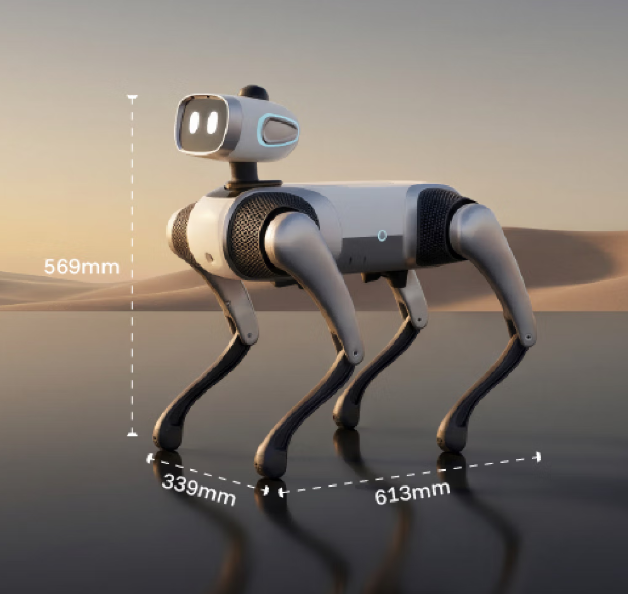
Vbot BoBo excels in stability and cost for family companionship over humanoid robots.
Why It Matters
Validates practical AI robotics and hybrid AI deployment, guiding investments away from hyped humanoids toward niche applications.
What To Do Next
Prototype cloud-edge AI for robots using Alibaba Qianwen API for scheduling.
Key Points
- •Vbot BoBo excels in stability and cost for family companionship over humanoid robots.
- •Qianwen G1 glasses priced at 1997 RMB use cloud LLM + local agent hybrid.
- •Huawei HanHan sells 100k units via channels despite lacking unique tech.
🧠 Deep Insight
AI-generated analysis for this event — not the original article.
🔑 Enhanced Key Takeaways
- •The shift toward 'scenario-driven' robotics in China is heavily influenced by the 'AI Hardware 2.0' trend, where manufacturers prioritize supply chain integration and retail distribution networks over proprietary foundational model development.
- •Vbot BoBo's market success is attributed to its adoption of a modular 'chassis-plus-application' design, which allows for rapid deployment across diverse environments like elderly care and warehouse logistics without requiring custom hardware redesigns.
- •The pricing strategy for devices like the Qianwen G1 glasses reflects a broader industry trend of 'hardware-as-a-service' (HaaS), where the low entry price is subsidized by long-term subscription models for advanced cloud-based AI agent capabilities.
📊 Competitor Analysis▸ Show
| Product | Type | Pricing | Key Differentiator |
|---|---|---|---|
| Vbot BoBo | Quadruped Robot | ~3,000-5,000 RMB | Stability & Cost-efficiency |
| Qianwen G1 | AI Glasses | 1,997 RMB | Cloud-local hybrid LLM |
| Huawei HanHan | Companion Robot | Variable | Channel/Retail dominance |
🛠️ Technical Deep Dive
- •Cloud-End Hybrid Architecture: Utilizes a local lightweight transformer model (e.g., 1B-3B parameters) for low-latency tasks like wake-word detection and basic gesture recognition, while offloading complex reasoning and multimodal processing to a cloud-based LLM.
- •Edge AI Optimization: Implementation of model quantization (INT8/INT4) and pruning techniques to fit LLM agents onto mobile-grade SoCs within glasses and small robotic form factors.
- •Sensor Fusion: Integration of IMU, depth cameras, and ultrasonic sensors for SLAM (Simultaneous Localization and Mapping) in Vbot units, prioritizing robust navigation over high-fidelity humanoid manipulation.
🔮 Future ImplicationsAI analysis grounded in cited sources
⏳ Timeline
Weekly AI Recap
Read this week's curated digest of top AI events →
👉Related Updates


AI-curated news aggregator. All content rights belong to original publishers.
Original source: 虎嗅 ↗
This is a summary, not the original. Read the source, or get the weekly briefing.
The weekly digest
One email a week. Unsubscribe anytime.