French Publishers Challenge Google’s AI Answers
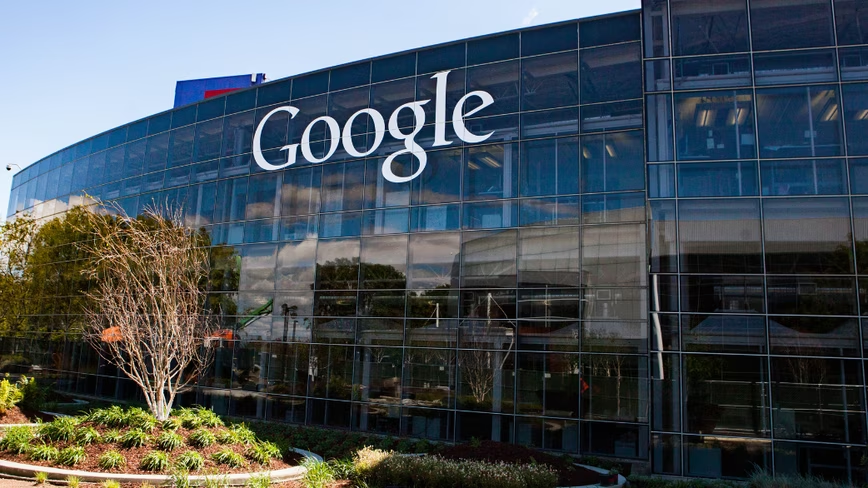
💡A live test of whether AI search can reuse journalism without paying publishers.
⚡ 30-Second TL;DR
What Changed
A French publishers’ association filed a complaint with the national competition authority.
Why It Matters
The case could influence how AI search products license, attribute, and monetize publisher content in Europe. A ruling or negotiated settlement may increase costs for AI search providers and reshape traffic models for news websites.
What To Do Next
Audit your site’s visibility and referral traffic from Google AI Overviews, then document attribution gaps and quantify traffic losses for licensing discussions.
Key Points
- •A French publishers’ association filed a complaint with the national competition authority.
- •The complaint targets Google’s AI-generated search summaries and their use of publishers’ journalism.
- •Publishers say AI answers may siphon readers away from source outlets and want Google to pay for the content.
🧠 Deep Insight
AI-generated analysis for this event.
🔑 Enhanced Key Takeaways
- •The French publishers' association, known as SEPM (Syndicat des éditeurs de la presse magazine), is leading the complaint alongside other press groups, citing the 'AI Overviews' feature as a direct threat to their business model.
- •This action follows a long-standing legal battle in France regarding 'neighboring rights,' where French regulators previously fined Google for failing to negotiate in good faith with publishers over content licensing.
- •Publishers argue that Google's AI Overviews create a 'zero-click' environment, which prevents traffic from reaching their websites and undermines the advertising revenue necessary to sustain journalism.
- •The French Competition Authority (Autorité de la concurrence) has previously demonstrated a willingness to impose significant fines on Big Tech companies, making this a high-stakes venue for Google's AI deployment strategy.
- •Google maintains that its AI summaries are designed to help users find information quickly and that they continue to drive traffic to publishers by providing links to source material within the AI-generated responses.
📊 Competitor Analysis▸ Show
| Feature | Google AI Overviews | Perplexity AI | OpenAI SearchGPT |
|---|---|---|---|
| Primary Model | Gemini | Multi-model (Claude/GPT/Sonar) | GPT-4o |
| Revenue Model | Ad-supported/Search | Subscription/Enterprise | Subscription/Ad-supported |
| Publisher Relations | Content licensing/Legal disputes | Publisher Program/Revenue sharing | Licensing partnerships |
🛠️ Technical Deep Dive
- Google AI Overviews utilize the Gemini family of multimodal models, specifically optimized for search retrieval and synthesis.
- The system employs Retrieval-Augmented Generation (RAG) to ground AI responses in real-time search index data.
- Implementation involves a 'Search-to-AI' pipeline where the model identifies high-intent queries, retrieves top-ranking web results, and synthesizes a summary while attempting to maintain citation links.
- The architecture includes safety filters designed to mitigate hallucinations and prevent the generation of harmful or biased content during the summarization process.
🔮 Future ImplicationsAI analysis grounded in cited sources
⏳ Timeline
Weekly AI Recap
Read this week's curated digest of top AI events →
👉Related Updates




AI-curated news aggregator. All content rights belong to original publishers.
Original source: The Next Web (TNW) ↗