🇨🇳cnBeta (Full RSS)•Freshcollected in 7h
FreeBSD Laptop Support Sees Significant Driver Improvements
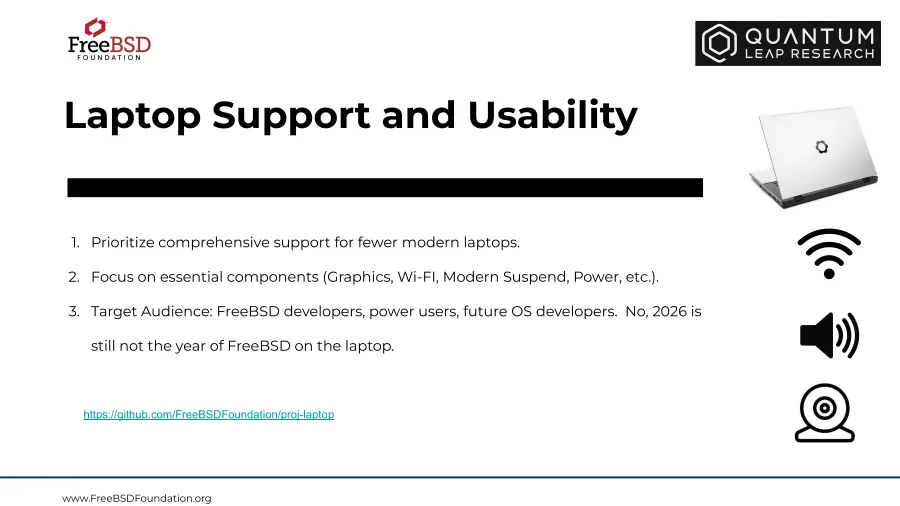
💡Improved FreeBSD hardware support makes it a more viable OS for AI/ML development workstations.
⚡ 30-Second TL;DR
What Changed
Significant progress in Wi-Fi driver stability and performance
Why It Matters
Better laptop support lowers the barrier for developers to use FreeBSD as a primary workstation, potentially increasing the OS's adoption in the open-source community.
What To Do Next
If you are a FreeBSD user, test the latest -CURRENT snapshot on your laptop to verify driver improvements for your specific GPU and Wi-Fi chipset.
Who should care:Developers & AI Engineers
Key Points
- •Significant progress in Wi-Fi driver stability and performance
- •GPU driver optimizations for better hardware compatibility
- •Audio driver improvements to enhance multimedia usability
- •Project funded by over $750,000 to boost desktop experience
🧠 Deep Insight
AI-generated analysis for this event.
🔑 Enhanced Key Takeaways
- •The project leverages the 'iwlwifi' driver stack ported from Linux, significantly narrowing the feature gap for Intel-based wireless chipsets.
- •GPU improvements are primarily focused on backporting DRM (Direct Rendering Manager) and KMS (Kernel Mode Setting) drivers from recent Linux kernel releases to the FreeBSD base system.
- •The initiative includes a new power management framework designed to address long-standing issues with suspend/resume cycles on modern laptop hardware.
- •Audio enhancements involve the integration of improved HDA (High Definition Audio) verb handling, enabling support for modern laptop internal speakers and multi-microphone arrays.
- •The project has established a dedicated hardware compatibility list (HCL) specifically for laptops, allowing community members to submit telemetry data to track driver stability across different OEM models.
📊 Competitor Analysis▸ Show
| Feature | FreeBSD (Laptop) | Linux (Desktop Distros) | OpenBSD |
|---|---|---|---|
| Driver Availability | Improving (Ported) | Native/Primary | Conservative/Secure |
| Power Management | Moderate | Excellent | Good |
| Hardware Support | Expanding | Industry Standard | Selective |
🛠️ Technical Deep Dive
- Implementation of the LinuxKPI compatibility layer allows FreeBSD to compile and run Linux-native drivers with minimal modifications.
- GPU stack updates utilize the latest libdrm and Mesa ports to support newer Intel Xe and AMD Radeon graphics architectures.
- Audio improvements utilize the updated sound(4) subsystem, specifically targeting improved support for HDMI audio and complex codec configurations.
- Wireless improvements include support for WPA3 and improved 802.11ax (Wi-Fi 6) throughput via the updated net80211 stack.
🔮 Future ImplicationsAI analysis grounded in cited sources
FreeBSD will achieve parity with mainstream Linux distributions for standard laptop hardware support by 2028.
The accelerated pace of LinuxKPI development and increased funding suggest a sustainable trajectory for closing the driver gap.
The project will lead to a measurable increase in FreeBSD adoption among software developers and system administrators.
Improved laptop usability removes the primary barrier to entry for professionals who require a portable FreeBSD environment for development.
⏳ Timeline
2022-06
FreeBSD Foundation identifies laptop support as a top-tier strategic priority.
2023-03
Initial funding phase for the Laptop Support and Usability Project is announced.
2024-01
Major update to the LinuxKPI layer enables broader support for modern Intel Wi-Fi chipsets.
2025-05
FreeBSD 15.0 development cycle incorporates significant DRM/KMS driver updates.
2026-02
Project reaches $750,000 funding milestone to expand driver development team.
📰
Weekly AI Recap
Read this week's curated digest of top AI events →
👉Related Updates
AI-curated news aggregator. All content rights belong to original publishers.
Original source: cnBeta (Full RSS) ↗