Fraunhofer Builds Real-Time Deepfake Meeting Warnings
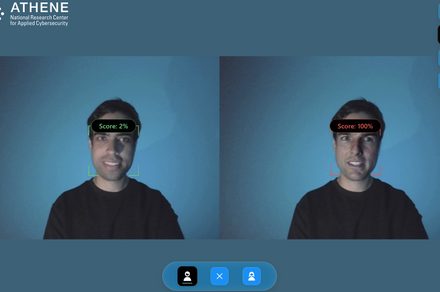
Deepfake bosses can turn ordinary video calls into high-impact enterprise security incidents.
30-Second TL;DR
What Changed
Fraunhofer is researching real-time deepfake warnings for video meetings.
Why It Matters
Real-time detection could add an important security layer to enterprise video communications and reduce losses from executive-impersonation scams. However, organizations will need to manage false positives, privacy concerns, and attackers adapting their generated video and audio.
What To Do Next
Evaluate Fraunhofer's real-time warning system when available and pair it with out-of-band approval workflows for payments and other high-risk requests.
Key Points
- •Fraunhofer is researching real-time deepfake warnings for video meetings.
- •The system is designed to address impersonation scams involving AI-generated bosses and coworkers.
- •The main risk is social engineering that pushes employees toward expensive or unauthorized decisions.
Deep Insight
AI-generated analysis for this event — not the original article.
Enhanced Key Takeaways
- •The Fraunhofer system utilizes physiological signal analysis, specifically detecting subtle inconsistencies in blood flow patterns (photoplethysmography) that are often absent in AI-generated video feeds.
- •Researchers are integrating this detection mechanism directly into existing video conferencing protocols like WebRTC to ensure compatibility with platforms such as Zoom and Microsoft Teams.
- •The project is part of a broader European Union-funded initiative aimed at bolstering cybersecurity resilience against 'CEO fraud' and advanced social engineering attacks.
- •Unlike static deepfake detectors, this system employs a temporal analysis approach that monitors frame-to-frame consistency to identify artifacts introduced by real-time generative models.
- •Fraunhofer is exploring a 'trust score' interface that provides meeting participants with a real-time confidence metric regarding the authenticity of other attendees.
Competitor Analysis
- Fraunhofer (Real-Time)
- Physiological/Blood Flow
- Intel FakeCatcher
- Photoplethysmography
- Microsoft Video Authenticator
- Metadata/Blending Analysis
- Fraunhofer (Real-Time)
- Real-time Meeting Plugin
- Intel FakeCatcher
- Cloud/API-based
- Microsoft Video Authenticator
- Post-hoc/Static Analysis
- Fraunhofer (Real-Time)
- Corporate Security
- Intel FakeCatcher
- Media Verification
- Microsoft Video Authenticator
- Content Provenance
| Feature | Fraunhofer (Real-Time) | Intel FakeCatcher | Microsoft Video Authenticator |
|---|---|---|---|
| Detection Method | Physiological/Blood Flow | Photoplethysmography | Metadata/Blending Analysis |
| Deployment | Real-time Meeting Plugin | Cloud/API-based | Post-hoc/Static Analysis |
| Primary Use Case | Corporate Security | Media Verification | Content Provenance |
Technical Deep Dive
- Architecture: Uses a multi-modal neural network that combines spatial feature extraction with temporal signal processing.
- Physiological Detection: Analyzes subtle skin color changes caused by cardiac cycles, which current generative AI models struggle to synthesize accurately.
- Latency Optimization: Implements lightweight inference kernels to maintain sub-100ms processing times, preventing noticeable lag in live video streams.
- Signal Processing: Employs remote photoplethysmography (rPPG) algorithms to extract pulse signals from facial regions in video frames.
- Integration: Designed as a middleware layer that intercepts video streams before they are rendered in the conferencing application.
Future ImplicationsAI analysis grounded in cited sources
Timeline
- 2023-05Fraunhofer initiates research into AI-based biometric spoofing detection.
- 2024-11Fraunhofer publishes preliminary findings on rPPG-based deepfake identification.
- 2026-03Fraunhofer demonstrates the first real-time prototype integrated with standard video conferencing software.
Weekly AI Recap
Read this week's curated digest of top AI events →
AI-curated news aggregator. All content rights belong to original publishers.
Original source: Digital Trends ↗
This is a summary, not the original. Read the source, or get the weekly briefing.
The weekly digest
One email a week. Unsubscribe anytime.