Four Paths from AGI to Superintelligence
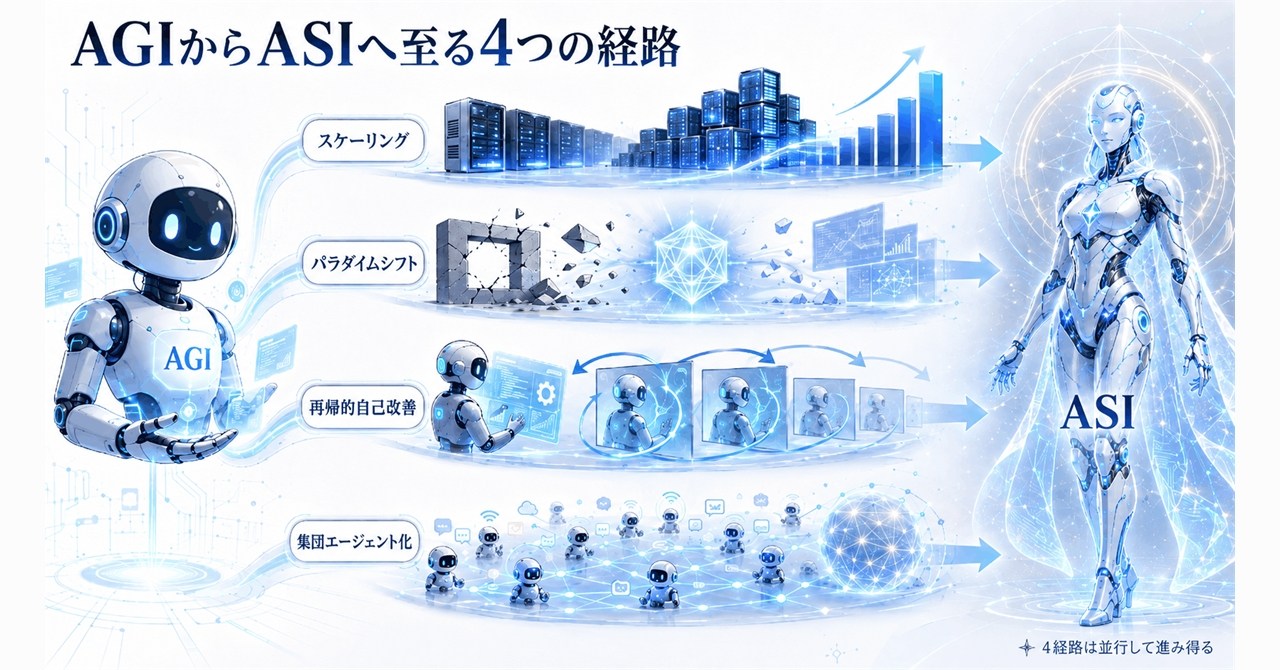
See how Google DeepMind frames the routes and constraints beyond human-level AGI.
30-Second TL;DR
What Changed
The paper focuses on AI development after human-level AGI is achieved.
Why It Matters
The framework gives AI researchers and technology leaders a structured way to evaluate post-AGI scenarios rather than treating superintelligence as a single inevitable outcome. Its emphasis on bottlenecks also highlights where research, infrastructure, and safety work may be most important.
What To Do Next
Read the underlying Google DeepMind paper and map its four pathways and six bottlenecks against your organization’s AGI research and safety roadmap.
Key Points
- •The paper focuses on AI development after human-level AGI is achieved.
- •It organizes possible routes toward ASI into four distinct pathways.
- •It identifies six bottlenecks that may constrain progress toward superintelligence.
- •The framework is presented as an accessible overview for readers new to AGI and ASI.
Deep Insight
AI-generated analysis for this event — not the original article.
Enhanced Key Takeaways
- •The DeepMind paper, titled 'Pathways to Superintelligence,' explicitly defines the transition from AGI to ASI as a process of recursive self-improvement and capability scaling beyond human cognitive limits [1].
- •The six identified bottlenecks include data scarcity, compute limitations, algorithmic efficiency plateaus, energy consumption constraints, safety/alignment verification challenges, and socio-economic regulatory hurdles [1].
- •The four pathways identified are: 'Scaling' (brute force compute/data), 'Algorithmic Innovation' (new architectures), 'Recursive Self-Improvement' (AI-driven code optimization), and 'Hybrid/Neuro-symbolic Integration' (combining neural networks with symbolic logic) [1].
- •The research emphasizes that the transition to ASI is not inevitable and depends heavily on solving the 'alignment tax,' where safety measures may inherently slow down performance gains [1].
- •DeepMind proposes a 'capability-safety' framework to monitor progress, suggesting that ASI development must be coupled with verifiable safety benchmarks to prevent catastrophic misalignment [1].
Technical Deep Dive
- The framework utilizes a multi-layered evaluation metric to assess 'Superintelligence' based on task-specific performance vs. human expert baselines.
- It discusses the shift from Transformer-only architectures to potential 'World Models' that incorporate causal reasoning and long-term planning capabilities.
- The paper highlights the role of synthetic data generation as a critical technical bridge to overcome the exhaustion of high-quality human-generated training corpora.
- It explores the implementation of 'automated scientific discovery' modules within AI agents to accelerate the R&D cycle for future model iterations.
Future ImplicationsAI analysis grounded in cited sources
Timeline
- 2023-05Google DeepMind is formed by merging Google Brain and DeepMind to accelerate AGI research.
- 2024-02Google releases Gemini 1.5 Pro, demonstrating long-context window capabilities critical for AGI research.
- 2025-06DeepMind publishes internal research on 'Recursive Self-Improvement' frameworks for agentic systems.
- 2026-07Google DeepMind releases the 'Pathways to Superintelligence' paper outlining the four-path framework.
Weekly AI Recap
Read this week's curated digest of top AI events →
Related Updates
AI-curated news aggregator. All content rights belong to original publishers.
Original source: ITmedia AI+ (日本) ↗
This is a summary, not the original. Read the source, or get the weekly briefing.
The weekly digest
One email a week. Unsubscribe anytime.