Former NASA Chief Takes Quantum Space Public at $1.2bn
💡Space infrastructure is the next frontier for AI; track how former NASA leadership is scaling hardware for the industry.
⚡ 30-Second TL;DR
What Changed
Quantum Space to go public at a $1.2 billion valuation
Why It Matters
This move signals increased commercial interest in space infrastructure, potentially opening new avenues for AI-driven autonomous spacecraft navigation and operations.
What To Do Next
Monitor the S-4 filing for details on Quantum Space's proprietary hardware roadmap to identify potential integration opportunities for autonomous flight software.
Key Points
- •Quantum Space to go public at a $1.2 billion valuation
- •Led by former NASA administrator Jim Bridenstine
- •Focusing on hardware development for future space missions
🧠 Deep Insight
Background and context from public sources — not the original article. 17 sources cited.
🔑 Enhanced Key Takeaways
- •Quantum Space was co-founded in 2021 by serial entrepreneur Kam Ghaffarian, alongside Steve Jurczyk and Benjamin Reed, focusing on maneuverable spacecraft for geosynchronous and cislunar space.
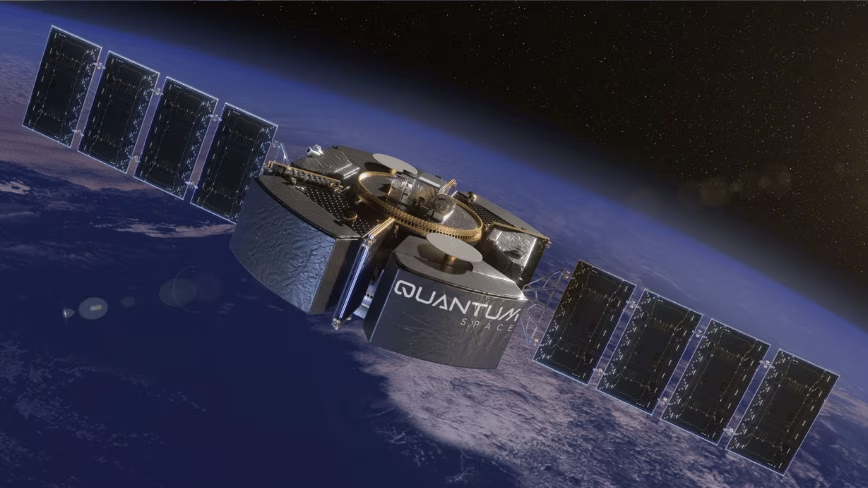
- •The company's core offering is the Ranger spacecraft platform, designed for sustained maneuverability across various orbital environments, including low Earth orbit (LEO), medium Earth orbit (MEO), geosynchronous orbit (GEO), and cislunar space.
- •Quantum Space has secured multiple contracts and proposals with U.S. national security organizations, including the U.S. Space Force, Air Force Research Laboratory, DARPA, and the Department of War, and holds an award position under the Space Force's $6.2 billion Andromeda program.
- •The SPAC merger with Inflection Point Acquisition Corp. VI includes a $300 million private investment in public equity (PIPE) led by Inflection Point Asset Management.
- •Jim Bridenstine assumed the role of CEO of Quantum Space in May 2026, just one month prior to the announcement of the company's intent to go public.
🛠️ Technical Deep Dive
- Platform Name: Ranger spacecraft platform
- Mission Focus: High-mobility operations for space domain awareness, satellite inspection, data relay, and logistics services in GEO and cislunar environments.
- Propulsion: Features a single-fuel, multi-mode propulsion architecture. The company acquired multimode electric propulsion assets from Phase Four in September 2024/2025 to enhance its systems.
- Propellant Capacity: Designed with over 4,000 kilograms of storable propellant capacity.
- Modularity & Refueling: Emphasizes a modular design with refueling capabilities, aiming for mission lifespans of up to 15 years.
- Payload Capacity: Capable of carrying over 1.5 metric tons of payload directly to geostationary orbit or more than 2.5 metric tons to cislunar space.
- Payload Interfaces: Equipped with four 24-inch modular ports that can host customer spacecraft ranging from CubeSats to larger orbital transfer vehicles, offering tailored power and data interfaces.
- Variants: Initial plans include the Ranger 500 bus for the inaugural Ranger Prime mission in mid-2026, followed by the more capable Ranger 2000 in late 2026.
- Key Components: Beyond Gravity, a subsidiary of RUAG, will provide processor and navigation electronics for the Ranger 500.
🔮 Future ImplicationsAI analysis grounded in cited sources
⏳ Timeline
📎 Sources (17)
Factual claims are grounded in the sources below. Forward-looking analysis is AI-generated interpretation.
Weekly AI Recap
Read this week's curated digest of top AI events →
👉Related Updates


AI-curated news aggregator. All content rights belong to original publishers.
Original source: The Next Web (TNW) ↗
This is a summary, not the original. Read the source, or get the weekly briefing.
The weekly digest
One email a week. Unsubscribe anytime.