Ford CEO Praises Chinese EV AI
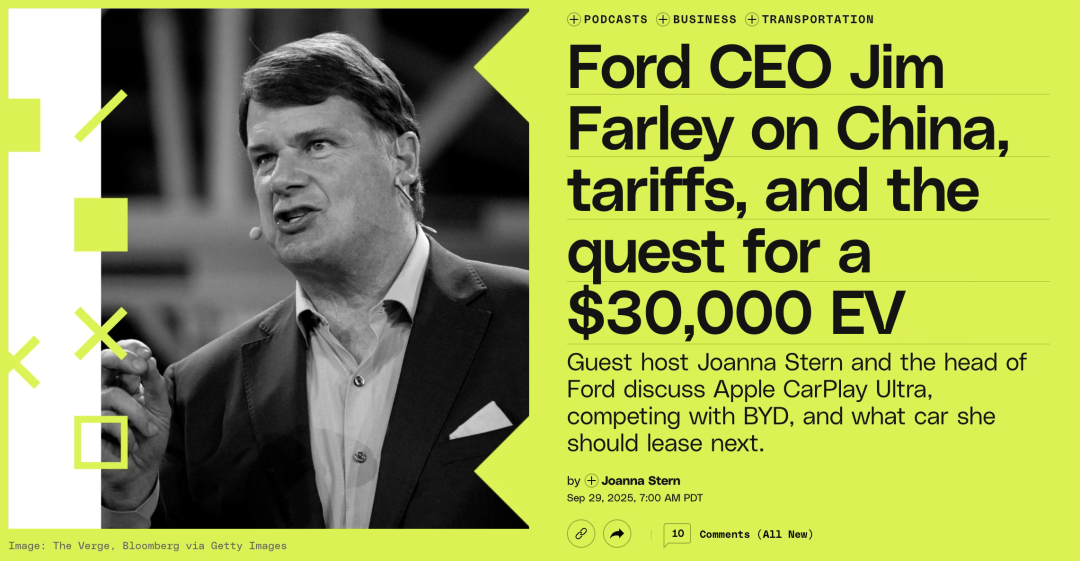
💡Ford insider: Chinese EV AI + integration crushes Detroit—lessons for auto AI devs
⚡ 30-Second TL;DR
What Changed
Farley drove Xiaomi SU7 for 6 months, calls it 'China's Apple' with auto face ID
Why It Matters
Exposes US-China auto tech gap in AI/software; protectionism risks long-term isolation from global scale.
What To Do Next
Prototype embedded AI recognition like Xiaomi's for your next vehicle software stack.
Key Points
- •Farley drove Xiaomi SU7 for 6 months, calls it 'China's Apple' with auto face ID
- •BYD vertical integration 75-80%, costs 15-35% lower than Tesla/VW
- •Ford writes off $19.5B EV assets, shifts to hybrids amid US protectionism
🧠 Deep Insight
AI-generated analysis for this event — not the original article.
🔑 Enhanced Key Takeaways
- •Farley's public praise for Chinese EV tech follows a broader strategic pivot where Ford has shifted its 'Ford+' plan to prioritize hybrid profitability and commercial vehicle dominance over pure-play EV volume targets.
- •The $19.5 billion write-down is largely attributed to the 'Model e' division's struggle to achieve cost parity with legacy internal combustion engine vehicles, exacerbated by high battery material costs and cooling consumer demand in North America.
- •Xiaomi's SU7 success is driven by its 'Human x Car x Home' ecosystem, which allows seamless integration between the vehicle's cockpit and Xiaomi's massive installed base of consumer electronics, a level of integration Ford currently lacks.
📊 Competitor Analysis▸ Show
| Feature | Xiaomi SU7 (Max) | Ford Mustang Mach-E | BYD Seal | Tesla Model 3 |
|---|---|---|---|---|
| Platform | Modena Architecture | GE1 | e-Platform 3.0 | 3rd Gen Platform |
| AI/Software | HyperOS (Deep Integration) | SYNC 4A | DiLink | Tesla Vision/FSD |
| Vertical Integration | High (Xiaomi Ecosystem) | Moderate | Very High (Battery/Chips) | High |
| Market Positioning | Tech-focused Performance | Legacy Brand EV | Mass Market Value | Global Benchmark |
🛠️ Technical Deep Dive
- Xiaomi SU7 utilizes the 'HyperOS' operating system, which shares a kernel with Xiaomi smartphones, enabling real-time synchronization of apps and UI elements.
- The vehicle features a 'Xiaomi Pilot' autonomous driving system powered by dual NVIDIA Orin-X chips, providing 508 TOPS of computing power.
- BYD's vertical integration includes the 'Blade Battery' (LFP chemistry), which utilizes a cell-to-pack (CTP) design to increase volumetric efficiency and safety compared to traditional modular battery packs.
- Ford's recent software architecture shift involves moving toward a 'Skunkworks' team approach, aiming to develop a low-cost EV platform that mimics the simplified, modular wiring harnesses found in Chinese-designed EVs.
🔮 Future ImplicationsAI analysis grounded in cited sources
⏳ Timeline
Weekly AI Recap
Read this week's curated digest of top AI events →
👉Related Updates




AI-curated news aggregator. All content rights belong to original publishers.
Original source: 虎嗅 ↗
This is a summary, not the original. Read the source, or get the weekly briefing.
The weekly digest
One email a week. Unsubscribe anytime.