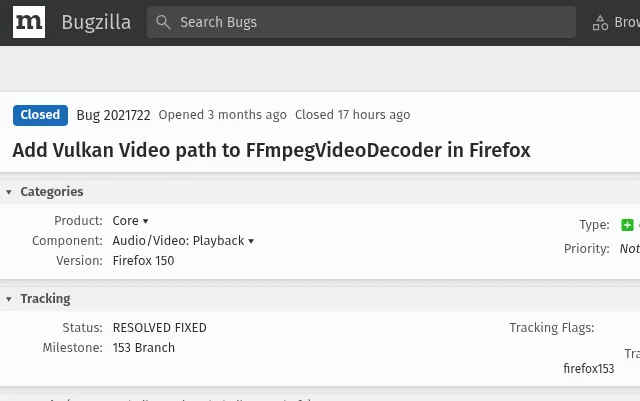
Firefox Adds Vulkan Video Decoding Support
💡Significant performance boost for browser-based media pipelines, essential for high-performance AI video tools.
⚡ 30-Second TL;DR
What Changed
Initial Vulkan Video support merged into Firefox development branch
Why It Matters
This enhances browser-based media performance on Linux and embedded systems, which is critical for web-based AI video processing and streaming applications.
What To Do Next
Test your web-based video processing applications on the latest Firefox nightly build with Vulkan enabled to measure latency improvements.
Key Points
- •Initial Vulkan Video support merged into Firefox development branch
- •Provides a unified GPU hardware decoding path across platforms
- •Reduces reliance on VA-API, benefiting NVIDIA and Arm-based devices
🧠 Deep Insight
Background and context from public sources — not the original article. 24 sources cited.
🔑 Enhanced Key Takeaways
- •Vulkan Video is a set of finalized extensions by the Khronos Group, providing fine-grained control over video processing scheduling, synchronization, and memory allocation for hardware-accelerated video compression and decompression.
- •The Khronos Group finalized Vulkan Video extensions for H.264 and H.265 decode in December 2022, followed by encode extensions in December 2023. Support for AV1 decode was released in February 2024, and VP9 decode in June 2025.
- •This integration in Firefox is expected to provide 'out of the box' hardware-accelerated video decode for NVIDIA users on Linux, potentially eliminating the need for complex third-party VA-API translation layers.
- •Vulkan Video is designed as a cross-platform and vendor-agnostic API, ensuring portability across various operating systems like Windows and Linux, and supporting major GPU vendors including AMD, Intel, and NVIDIA.
- •The Firefox implementation specifically adds a Vulkan Video path to its FFmpegVideoDecoder, incorporating DRM modifier handling and utilizing Vulkan semaphores for synchronization between decode and copy operations.
📊 Competitor Analysis▸ Show
While Firefox is integrating Vulkan Video, other major browsers have different approaches:
| Feature/Aspect | Firefox (with Vulkan Video) | Chromium (Chrome, Edge, etc.) | Safari (Apple) |
|---|---|---|---|
| Hardware Video Decode | Direct Vulkan Video path, reducing VA-API reliance. | Primarily relies on VA-API (Linux), DXVA (Windows). NVIDIA is collaborating to add Vulkan Video support. | Relies on Apple's proprietary Video Toolbox and Metal API. |
| Cross-Platform API | Embracing Vulkan Video for unified cross-platform support. | Exploring Vulkan Video for cross-platform benefits, but not yet implemented. | Uses Apple's Metal, which is not cross-platform with Vulkan. |
| NVIDIA Support (Linux) | Aims for out-of-the-box hardware acceleration, bypassing VA-API workarounds. | Historically relied on nvidia-vaapi-driver workarounds; native Vulkan Video support is in discussion/development. | Not applicable, as macOS does not natively support Vulkan. |
| Codec Support | Supports H.264, H.265, AV1, VP9 decode via Vulkan Video extensions. | Supports various codecs via existing hardware acceleration backends. | Supports various codecs via Video Toolbox. |
| API Control | Leverages Vulkan's low-level, fine-grained control over GPU resources. | Current implementations vary; Vulkan Video would offer similar low-level control if integrated. | Metal offers low-level control optimized for Apple's hardware. |
🛠️ Technical Deep Dive
- Vulkan Video is implemented as a set of extensions on top of the core Vulkan API, providing explicit control over hardware-accelerated video compression and decompression.
- It introduces video-specific queue functionality, including
VK_KHR_video_queuefor common operations,VK_KHR_video_decode_queuefor decode, andVK_KHR_video_encode_queuefor encode. - The API defines specific calls,
vkCmdBeginVideoCodingKHRandvkCmdEndVideoCodingKHR, to delineate the scope of video command control parameters within a session. - Vulkan Video extends existing Vulkan structures like
VkBufferUsage,VkImageUsage, andVkImageLayoutwith video-relevant bits to facilitate optimal management of video decode and encode resources. - For handling protected content, Vulkan Video employs an architecture where a Content Decryption Module (CDM) decrypts video slices into a protected
VkBuffer, which the decoder then processes, writing to a protectedVkImage. - Firefox's integration involves adding a Vulkan Video path to its
FFmpegVideoDecoder, which includes handling DRM modifiers and utilizing direct DMA-BUF export when FFmpeg supportsVK_IMAGE_TILING_DRM_FORMAT_MODIFIER_EXT, otherwise resorting to a copy path.
🔮 Future ImplicationsAI analysis grounded in cited sources
⏳ Timeline
📎 Sources (24)
Factual claims are grounded in the sources below. Forward-looking analysis is AI-generated interpretation.
Weekly AI Recap
Read this week's curated digest of top AI events →
👉Related Updates
AI-curated news aggregator. All content rights belong to original publishers.
Original source: cnBeta (Full RSS) ↗
This is a summary, not the original. Read the source, or get the weekly briefing.
The weekly digest
One email a week. Unsubscribe anytime.