Figure Humanoid Robot Competes Against Humans in Live Task
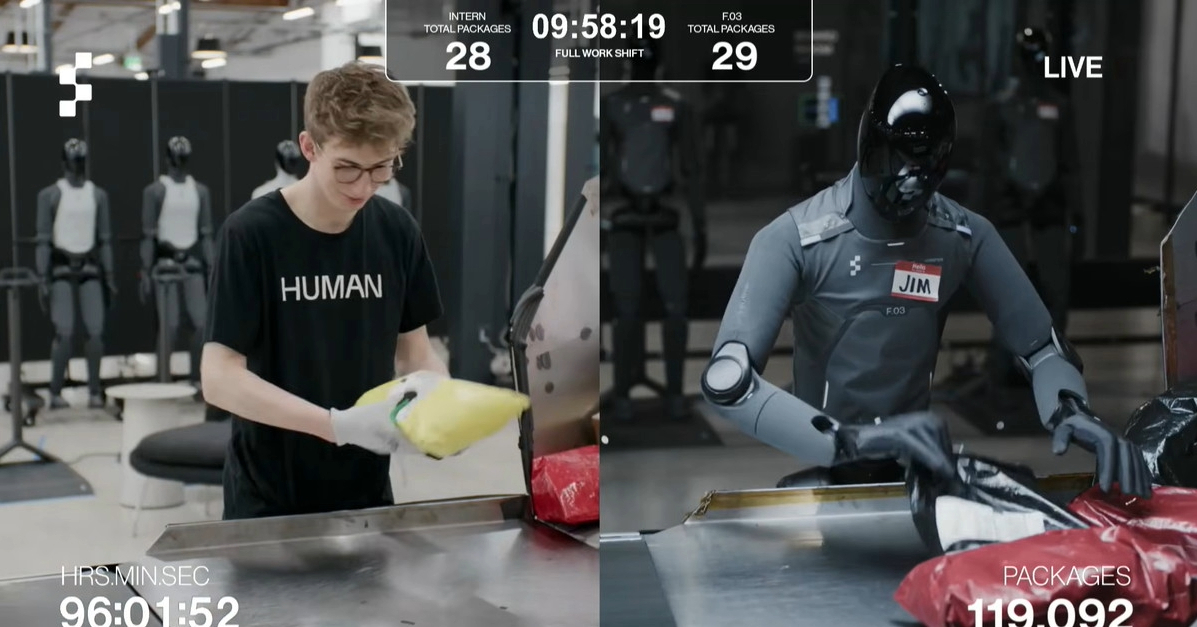
💡See how humanoid robots stack up against human labor in real-time, a key milestone for embodied AI deployment.
⚡ 30-Second TL;DR
What Changed
Figure hosted a live-streamed performance comparison between a humanoid robot and a human.
Why It Matters
This demonstration provides a tangible metric for the industry to track the gap between robotic automation and human labor. It signals a shift toward deploying general-purpose robots in commercial logistics and manufacturing.
What To Do Next
Monitor Figure's technical whitepapers or developer API documentation to understand how their embodied AI models handle unstructured physical tasks.
Key Points
- •Figure hosted a live-streamed performance comparison between a humanoid robot and a human.
- •The demonstration focused on measuring task completion speed and accuracy in a controlled environment.
- •This event highlights the progress of embodied AI in performing manual labor tasks traditionally handled by humans.
🧠 Deep Insight
Web-grounded analysis with 28 cited sources.
🔑 Enhanced Key Takeaways
- •The live demonstration involved Figure AI's humanoid robot, likely the F.03 model, autonomously sorting over 100,000 packages in a logistics warehouse setting over an extended period, surpassing 80 hours, demonstrating sustained operational endurance.
- •The robot operated using Figure AI's proprietary Helix-02 AI system, which enables fully autonomous, long-horizon tasks and real-time decision-making without remote human intervention.
- •Figure AI has secured significant investment, raising over $1.8 billion in total funding, with a valuation reaching $39 billion by September 2025, backed by major tech investors including Microsoft, Nvidia, Intel, and Jeff Bezos.
- •The company ended its collaboration with OpenAI in early 2025, opting to focus on its in-house Helix AI development after achieving breakthroughs in end-to-end robot AI, tailored for embodied intelligence.
- •Figure AI's strategy includes addressing critical workforce shortages in sectors like manufacturing and logistics, with plans to expand into consumer applications such as home assistance and eldercare by 2030.
📊 Competitor Analysis▸ Show
| Feature/Company | Figure 03 | Tesla Optimus Gen 3 | Agility Robotics Digit | Boston Dynamics Atlas (Electric) |
|---|---|---|---|---|
| Primary Application | Versatile (Industrial/Home) | General-purpose (Manufacturing focus) | Logistics & Warehouse Automation | Research & Industrial (part sequencing) |
| Height | ~1.73 m (5'8") | ~1.73 m (5'8") | 1.75 m (5'9") | 1.5 m (4'11") |
| Weight | ~61 kg (134 lbs) | ~57 kg (125 lbs) | ~65 kg (143 lbs) | ~85 kg (187 lbs) |
| Payload Capacity | 20 kg (44 lbs) | ~20 kg (45 lbs carrying, 10 lbs arm manipulation) | 22.6 kg (50 lbs) | 11 kg (24 lbs) |
| Battery Life | ~5 hours | Several hours | 8 hours | 4 hours |
| Hand Dexterity | 20 DoF, tactile sensors (3g sensitivity), palm cameras | 22 DoF, tendon-driven biomimetic system | Tote-optimized grippers | Highly dexterous |
| AI System | Helix (Vision-Language-Action model) | FSD computer, vision-based perception | Agility Arc (fleet management) | Google DeepMind models |
| Estimated Price (at scale) | ~$20,000 | $20,000 - $30,000 | $150,000 - $250,000 | >$150,000 (if commercial) |
| Production/Deployment | BotQ facility (12,000 units/year target), pilot deployments | Mass production started Jan 2026, deployed in Tesla factories | Deployed in Amazon and GXO warehouses | Electric version shipping to Hyundai factories |
🛠️ Technical Deep Dive
- Figure 03 (latest model):
- Height: Approximately 1.73 meters (5'8")
- Weight: Approximately 61 kg (134 lbs)
- Payload Capacity: Up to 20 kg (44 lbs)
- Runtime: Up to 5 hours per charge
- Speed: Maximum walking speed of 1.2 meters per second
- Actuation: Fully electric, utilizing custom electromechanical actuators, which are reportedly twice as fast as those in Figure 02.
- Degrees of Freedom (DoF): 30 total DoF, with 20 DoF distributed across its 5-finger hands.
- Vision System: Features a next-generation vision system with double the frame rate, one-quarter the latency, and a 60% wider field of view compared to previous models. Includes palm cameras embedded in each hand for enhanced close-range visual feedback during manipulation.
- Tactile Sensors: Equipped with new tactile fingertips capable of detecting forces as minute as 3 grams (equivalent to a paperclip).
- AI Model: Powered by Figure's proprietary Helix (Vision-Language-Action) model, specifically Helix-02, which enables the robot to learn tasks from demonstration videos and perform pixel-to-action, long-horizon tasks autonomously.
- Data Offload: Supports 10 Gbps mmWave capability for high-speed data upload, facilitating continuous fleet-wide learning.
- Charging: Features inductive wireless charging (2 kW) via coils in its feet, with a certified battery pack (UN38.3 standard) for safety.
- Manufacturing Design: Engineered for mass production, transitioning from CNC-machined parts to more scalable methods like die-casting, injection molding, and stamping.
- Safety Features: Designed with soft textiles and multi-density foam protection, and is approximately 9% lighter and smaller than Figure 02, making it more suitable for safe operation in home environments.
🔮 Future ImplicationsAI analysis grounded in cited sources
⏳ Timeline
📎 Sources (28)
Factual claims are grounded in the sources below. Forward-looking analysis is AI-generated interpretation.
- Google Search Source
- Google Search Source
- Google Search Source
- Google Search Source
- Google Search Source
- Google Search Source
- Google Search Source
- Google Search Source
- Google Search Source
- Google Search Source
- Google Search Source
- Google Search Source
- Google Search Source
- Google Search Source
- Google Search Source
- Google Search Source
- Google Search Source
- Google Search Source
- Google Search Source
- Google Search Source
- Google Search Source
- Google Search Source
- Google Search Source
- Google Search Source
- Google Search Source
- Google Search Source
- Google Search Source
- Google Search Source
Weekly AI Recap
Read this week's curated digest of top AI events →
👉Related Updates
AI-curated news aggregator. All content rights belong to original publishers.
Original source: ITmedia AI+ (日本) ↗